
 Gaurav Keswani
Key Highlights
Imagine, you’re a jewelry trader in Mumbai who’s spent a decade sourcing gold from local artisans, and you’ve just landed a contract to supply a Dubai-based distributor.
You start searching online for “gold trading license Dubai cost,” and within ten minutes you have five wildly different numbers; one site says AED 15,000, another says AED 40,000, and none of them tell you where those figures actually come from.
That confusion is exactly what stalls entrepreneurs right when they’re closest to launching, and it gets worse the deeper you dig.
This guide strips out that guesswork entirely.
A free zone license is issued by an independent free zone authority with its own published fee schedule, while a mainland license is issued by Dubai’s Department of Economy and Tourism, or DET, and requires a tenancy registered physical office.
One well-documented free zone example is IFZA, International Free Zone Authority, whose 2026 pricing is fully published and verifiable, starting at AED 11,900 for a one-year Zero Visa License.
Mainland licensing runs through the Basher platform and involves initial approval, trade name reservation, Memorandum of Association drafting, and license issuance, but DET does not publish a centralized public cost table for these steps.
This distinction matters more for gold trading than for most other commercial activities, because gold dealers face additional layers of regulatory scrutiny that apply regardless of which jurisdiction they choose.
Understanding both cost structures before you commit helps you avoid the common mistake of comparing a promotional free zone quote against an unverified mainland estimate.
Yes. Every gold, jewelry, or precious metals dealer in Dubai is classified as a Dealer in Precious Metals and Stones, or DPMS, under the UAE Central Bank Rulebook, which triggers mandatory enhanced due diligence and AML and CFT compliance regardless of whether you’re licensed in a free zone or on the mainland.
This compliance obligation applies from your first day of operation and continues as a recurring operational requirement, not a one-time setup cost.
It’s not a factor that should influence your jurisdiction choice, since it applies equally to both routes, but it adds ongoing operational overhead you should plan for financially and administratively from day one.
In practice, this means your business needs internal AML policies, customer due diligence procedures, and transaction monitoring processes in place before you start trading, not after your first sale.
Skipping this step isn’t just a compliance risk; it can delay or jeopardize your license renewal down the line.
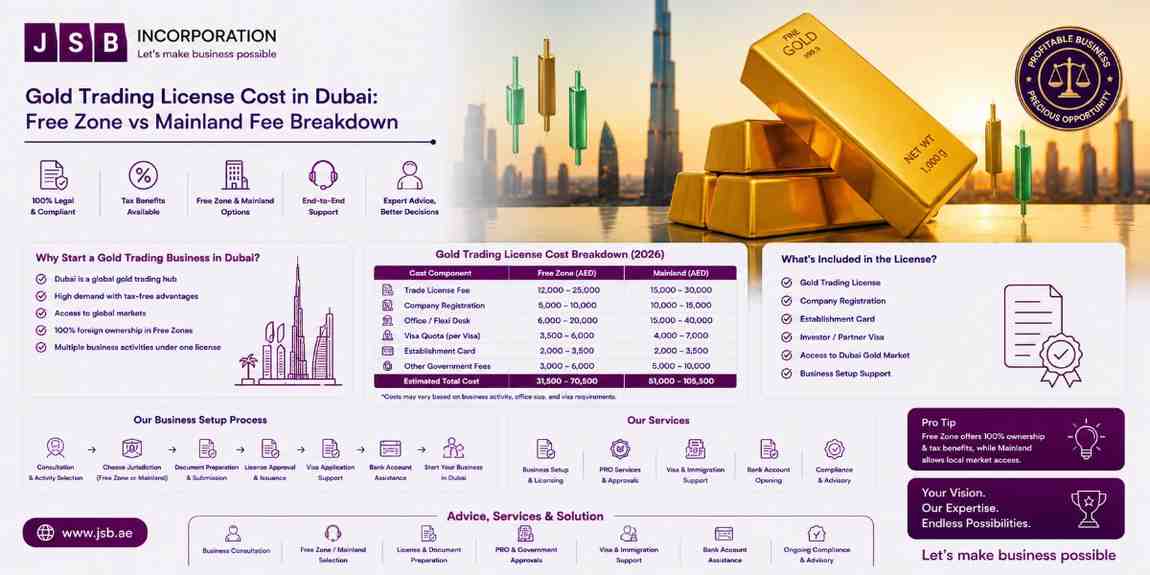
A one-year free zone license, using IFZA’s verified 2026 schedule, ranges from AED 11,900 for a Zero Visa License to AED 20,900 for a 4-plus-visa license, inclusive of VAT.
License Package | 1-Year Price (VAT inclusive) |
Zero Visa License | AED 11,900 |
1 Visa License (plus 1 free lifetime residence visa) | AED 14,900 |
2 visa licenses (plus 1 free lifetime residence visa) | AED 16,900 |
3 visa licenses (plus 1 free lifetime residence visa) | AED 18,900 |
4 plus a visa license (plus 1 free lifetime residence visa) | AED 20,900 |
Each package tier is built around visa allocation, which matters if you plan to sponsor staff or family members alongside your license.
The jump from a zero-visa to a 1-visa license costs an extra AED 3,000 upfront, but it also bundles one residence visa free for life as part of the promotion, offsetting standard visa issuance costs elsewhere.
A 5-year IFZA license commitment cuts your total cost by 30 percent compared to paying the standard annual rate each year.
Specifically, the Zero Visa License package totals AED 41,700 over five years versus AED 59,500 at the standard annual rate, a savings of AED 17,800. A 2-year term carries a 15 percent discount and a 3-year term carries a 20 percent discount.
Take our Mumbai jewelry trader as a working example. If she chooses a 1 Visa License on a 5-year term, she pays AED 52,200 total instead of AED 74,500 at the standard annual rate, saving over AED 22,000 while also locking in one free lifetime residence visa tied to the package.
For a founder confident about a multi-year commitment to the Dubai market, that discount alone can offset a meaningful portion of first-year setup costs elsewhere in the business, from inventory to initial marketing.
Gold trading typically requires the General Trading activity classification, which normally carries a AED 10,000 fee but is currently waived for new applications and the next three renewals under IFZA’s 2026 promotion, covering a four-year window.
This waiver represents a substantial saving for a business activity that’s otherwise a standard requirement for most gold and precious metals traders operating across multiple product lines.
Beyond the license itself, budget for these recurring government-related fees, all confirmed in IFZA’s Schedule of Fees:
Mainland gold trading license costs are quote-based because Dubai’s Department of Economy and Tourism does not publish a centralized public fee schedule, unlike free zones with published rate cards.
You confirm your exact cost by submitting a request through Invest in Dubai’s official trade licence request service, which routes your application through DET’s approval process.
This doesn’t mean mainland pricing is arbitrary; it simply means costs vary based on your specific activity classification, office size and location, and legal structure, all assessed on a case-by-case basis rather than through a fixed public rate card.
The mainland process, per official guidance on doing business on the mainland, runs through the Basher platform and includes several distinct stages: initial approval for your activity and legal form, trade name reservation, Memorandum of Association notarization, external approvals where your activity requires them, and final license issuance.
Unlike free zones, mainland licenses require a tenancy registered physical office, handled via Ejari registration as part of the setup workflow.
If your gold business includes a retail storefront or showroom, you may also encounter security-related compliance requirements tied to physical premises.
This detail isn’t confirmed through the government sources reviewed for this guide, so verify it directly with Dubai’s Department of Economy and Tourism before assuming any specific cost or requirement applies to your setup.
Factor | Free Zone (IFZA example) | Mainland |
Licensing authority | Free zone authority, e.g. IFZA | Dubai’s Department of Economy and Tourism |
Office requirement | A flexi-desk option available | Mandatory tenancy registered premises |
1-year entry-level cost | AED 11,900 Zero Visa License | Quote based via Invest in Dubai |
Multi-year discount | Up to 30 percent for 5-year term | Not publicly published |
Residence visa inclusion | 1 free lifetime visa bundled | Standard visa fees apply |
AML and DPMS compliance | Applies per Central Bank Rulebook | Applies equally per Central Bank Rulebook |
The core distinction isn’t that one route is universally cheaper; it’s that free zone pricing, at least for the IFZA example, is transparent and published upfront, while mainland pricing requires you to go through an official quote process before you know your real number.
License fees are only part of your first-year budget, and ongoing costs often surprise first-time applicants. On the free zone side, plan for Establishment Card renewal at AED 2,200 annually, license amendment fees at AED 2,000 per change, and a late renewal penalty of AED 1,000 per month if you miss a deadline.
Mainland recurring costs aren’t published in the sources reviewed for this guide, so request the full renewal fee schedule directly from Dubai’s Department of Economy and Tourism at the time of licensing rather than relying on third-party estimates.
One cost applies equally to both routes and never goes away: AML and CFT compliance under the Central Bank Rulebook is an ongoing operational obligation for DPMS-classified businesses, not a one-time setup fee.
Use this three-step framework to decide which licensing path fits your business.
If your model is trading, wholesale, or online sales without a walk-in storefront, the free zone route, using IFZA as one verified example, gives you published entry pricing starting at AED 11,900 and a bundled lifetime residence visa on qualifying packages.
This suits founders who want cost predictability before they commit, which matters if you’re also juggling a visa transition or relocating from another country while building out your business.
If you’re planning a retail showroom where customers physically browse and purchase gold, the mainland route makes more practical sense because it permits direct walk in trade across the emirate.
The tradeoff is that your total cost stays quote-based until you go through the Invest in Dubai licensing request, so build in extra time for that step when you’re planning your launch timeline.
Q: How much does a free zone trading license cost in Dubai in 2026?
A: Using IFZA as a verified example, 1-year license packages range from AED 11,900 for a Zero Visa License up to AED 20,900 for a four-plus-visa license, all inclusive of VAT. Other free zones set their own independent pricing.
Q: Is a free zone or mainland license cheaper for gold trading?
A: Free zone pricing, IFZA example, is published and starts at AED 11,900 for the first year, while mainland costs remain quote-based and vary by activity and office size, so a direct dollar-for-dollar comparison isn’t possible from public data alone.
Q: Do gold trading businesses need a physical office in Dubai?
A: Mainland licenses require a tenancy registered physical premise, while many free zones, including IFZA, offer flexi-desk options as an alternative.
Q: Are gold and precious metals traders subject to anti-money laundering rules in Dubai?
A: Yes. All DPMS businesses face enhanced due diligence and AML and CFT obligations under the UAE Central Bank Rulebook, regardless of whether they’re licensed onshore or in a free zone.
Q: How do I get an official mainland license cost quote in Dubai?
A: Submit a request through Invest in Dubai’s official trade licence request service, which routes you through Dubai’s Department of Economy and Tourism approval process.
Disclaimer: All pricing figures cited above reflect IFZA’s published 2026 fee schedules as one verified free zone example and are inclusive of VAT as stated by the issuing authority; they are subject to change without prior notice. Mainland costs are process-based and not centrally published, so always confirm current fees directly with Dubai’s Department of Economy and Tourism or through Invest in Dubai before making financial commitments.
Sorting through free zone fee schedules, mainland quote requests, and DPMS compliance rules takes real time, and getting any one of them wrong can delay your gold trading license by weeks.
JSB Incorporation handles the entire process end to end, from choosing the right jurisdiction to securing your bank account, with a higher success rate, transparent pricing, and a track record of setting up businesses in weeks rather than months.
Book your free consultation call today with the experts of JSB Incorporation to learn more.

Office 2505, 25th Floor, Regal Tower, Business Bay, Dubai, UAE P.O Box 27614.
+971 4 824 4842
info@jsbincorporation.com