
 Gaurav Keswani
Key Highlights
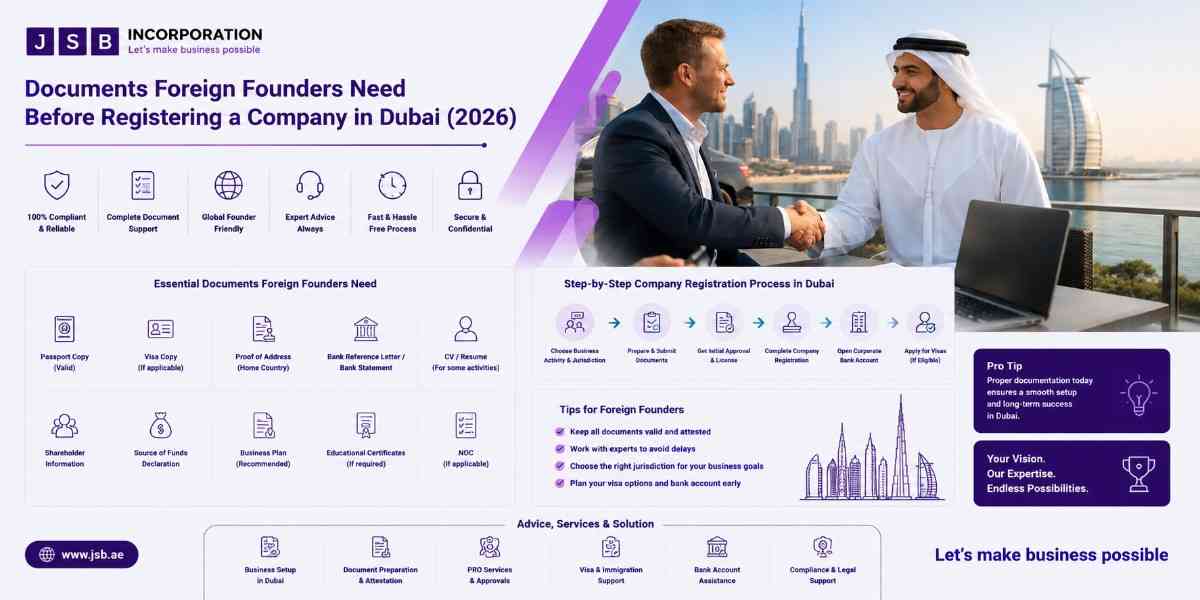
If you’re gathering paperwork to register a company in Dubai as an individual shareholder, you’ll typically need five documents: your passport copy, a passport-size photo, proof of your residential address, a business plan describing your activity, and your entry visa or current UAE residence visa copy.
That’s your baseline. What changes everything else on your checklist, how many extra documents you’ll need, how long attestation takes, and whether you owe an NOC comes down to two decisions you make early: mainland or free zone and individual or corporate shareholder.
This distinction shapes your entire timeline. A solo founder registering a simple free zone activity can often clear document collection in days, while a corporate shareholder structure typically adds weeks, mainly because of the attestation chain covered later in this guide.
Knowing which path applies to you before you start collecting paperwork saves you real time and money.
Regardless of which jurisdiction or shareholder structure you choose, you’ll need this core set of documents on hand before you approach any UAE authority.
Mainland licensing can move as quickly as 15 minutes through the Basher digital platform for simple cases or around four working days through standard licensing channels.
You’ll find free zones generally ask for the same core documents, then layer on their own activity-specific requirements once you move past this starting point.
You’ve probably seen conflicting answers to this question on forums, and the honest truth is that there’s no single blanket rule you can rely on.
Your NOC requirement depends on your current UAE employment status and on the specific free zone or mainland authority you’re registering with, and this policy area has shifted as the UAE has relaxed several dual-employment restrictions in recent years.
Fujairah Free Zone Authority’s own published checklist still lists an NOC from the current sponsor as a required document for individual shareholders during initial approval.
And RAK Free Zone’s corporate incorporation checklist similarly requires an original NOC from the sponsor for the appointed general manager if that person already holds a UAE residence visa.
Because real user experiences you’ll find online often contradict each other, don’t assume any zone is NOC-free unless you confirm it directly on that authority’s own official page at the time you apply.
Choosing the mainland brings a distinct layer of documentation beyond your core five, largely because mainland companies fall under licensing rules set by Dubai’s Department of Economy and Tourism, and depending on your activity, the Commercial Companies Law framework.
The Department of Economy and Tourism, commonly known as DET, is the licensing authority for Dubai mainland companies today, having taken over this role from the former Department of Economic Development in 2021.
You’ll move through this in sequence: trade name reservation, then initial approval, then final license issuance, as Dubai’s licensing platform lays these out as sequential rather than parallel steps.
If your MOA isn’t already drafted in Arabic, you’ll need a certified legal translation before Dubai Courts will notarize it, since Arabic remains the governing language for your mainland incorporation documents.
Free zones streamline much of what mainland registration demands, but you’ll still need to prepare documentation tailored to each authority’s own internal review process.
Fujairah Free Zone Authority’s official checklist shows how much this varies by shareholder type: individual shareholders submit a personal bank reference letter, while corporate shareholders instead submit two years of audited financial reports, specimen signatures, and a notarized Registry Identification Code form for their appointed manager.
Since real differences like this exist from one free zone to another, always cross-check your specific target authority’s published checklist rather than assuming a generic list covers you.
When your shareholder is a corporate entity rather than an individual, whether that’s a foreign parent company or a UAE holding structure, you’ll need to prove that entity’s legal existence and its authority to invest in your new company.
RAK Free Zone’s own corporate incorporation checklist confirms this exact document set for corporate shareholders, and it specifies that if the shareholder is a foreign company, its documents must be notarized and legalized up to the level of the UAE embassy or attested by the relevant UAE free zone authority.
Fujairah’s registration stage similarly requires a notarized and attested board resolution and MOA before it will issue a license. Every document you submit here, since it originates outside the UAE, needs to move through the attestation chain before any authority accepts it.
You can’t submit foreign-issued corporate documents as-is. They generally need to move through a defined chain: notarization in your home country, attestation by your home country’s foreign ministry, legalization by the UAE embassy or mission abroad, and finally attestation inside the UAE.
The UAE’s Ministry of Foreign Affairs and International Cooperation, known as MOFAIC, runs this as its official Attestation of Official Documents and Certificates service, which verifies the authenticity of signatures and seals on documents issued either inside or outside the UAE.
MOFAIC’s fast digital attestation channel, which can complete in roughly two hours during working hours, is limited to specific personal and civil documents such as birth certificates, educational certificates, medical reports, and marriage contracts.
Corporate documents like a certificate of incorporation, MOA, or board resolution don’t qualify for that digital route and instead go through the standard attestation channel via an approved courier service provider, which takes about one to three business days.
If you’re applying from abroad, you’ll register for the service, select attestation outside the UAE, pay the applicable fees, and then either visit your nearest UAE mission or apply through that mission’s official website.
Before you submit anything to MOFAIC, make sure your document already carries certification or a stamp from the relevant competent authority in its country of origin, since an incomplete authentication chain is the most common reason applications get rejected.
Requirement | Mainland | Free Zone |
Notarization required | Yes, MOA must be notarized and drafted in Arabic. | Yes for corporate MOA and board resolutions at zones like Fujairah and RAK |
Foreign document attestation | Required for foreign shareholder documents via the MOFAIC chain | Required for foreign shareholder documents, up to UAE Embassy level or via the free zone authority |
NOC condition | Depends on your employment status and activity; verify with DET | It depends on the specific zone’s policy; Fujairah and RAK both require it for individuals holding UAE residence visas |
Tenancy/Ejari requirement | Required, Ejari-registered tenancy contract | Varies by zone; many offer flexi-desk packages; confirm with your target authority |
Since document checklists and NOC policies change periodically at each authority’s discretion, verify current requirements directly on your relevant free zone’s or DET’s official page before you finalize your list.
The UAE enacted Federal Decree-Law No. 20 of 2025, amending the Commercial Companies Law, with the amendments taking effect on October 15, 2025, and applying from January 1, 2026.
Among the most relevant updates for your documentation planning is the new re-domiciliation framework, which lets a company transfer its registration and licensing between Emirates and between mainland and free zone jurisdictions.
This matters for the paperwork you’re compiling right now because it signals that your initial registration documents could eventually carry forward more easily if you decide to relocate your legal seat later.
That said, several elements of the amendment, particularly transfers involving financial free zones like ADGM and DIFC, still depend on the cabinet and local authority implementing regulations that haven’t been fully published yet.
Treat re-domiciliation as a genuine upcoming option rather than something you can rely on operationally today, and confirm the exact procedural requirements directly with the Ministry of Economy and Tourism once implementing regulations are released.
It depends on your current employment status and the specific free zone or mainland authority you’re registering with. Fujairah and RAK Free Zone, for example, both still require it for individuals or managers holding UAE residence visas, so don’t assume you’re exempt without checking your target authority’s own page.
2. How much does MOA attestation cost and how long does it take?
Attestation fees and notarization costs vary by document type and service channel, and they change periodically.
Confirm current fees directly through the UAE Ministry of Foreign Affairs and International Cooperation’s attestation service or Dubai Courts before you budget.
3. How are foreign corporate documents attested for UAE company registration?
Foreign corporate documents move through home-country notarization, home-country foreign ministry attestation, UAE embassy legalization abroad, and final attestation inside the UAE through MOFAIC’s official service, or in some free zones, attestation directly through the relevant free zone authority.
4. What extra documents does a corporate shareholder need that an individual doesn’t?
You’ll need a certificate of incorporation or registration, a board or shareholder resolution, your Memorandum and Articles of Association, and a certificate of good standing or commercial register extract, plus audited financial reports at zones like Fujairah.
5. Can free zone company documents be used to convert to a mainland license?
The 2026 Commercial Companies Law amendment introduces a re-domiciliation pathway between free zone and mainland jurisdictions, though full implementation still depends on Cabinet and local authority regulations being finalized.
Always verify current requirements, costs, and timelines directly with the relevant authority, whether that’s DET, your target free zone authority, or MOFAIC, before you finalize your registration plans.
Book your free consultation call today with the experts of JSB Incorporation to learn more.

Office 2505, 25th Floor, Regal Tower, Business Bay, Dubai, UAE P.O Box 27614.
+971 4 824 4842
info@jsbincorporation.com