
Summary
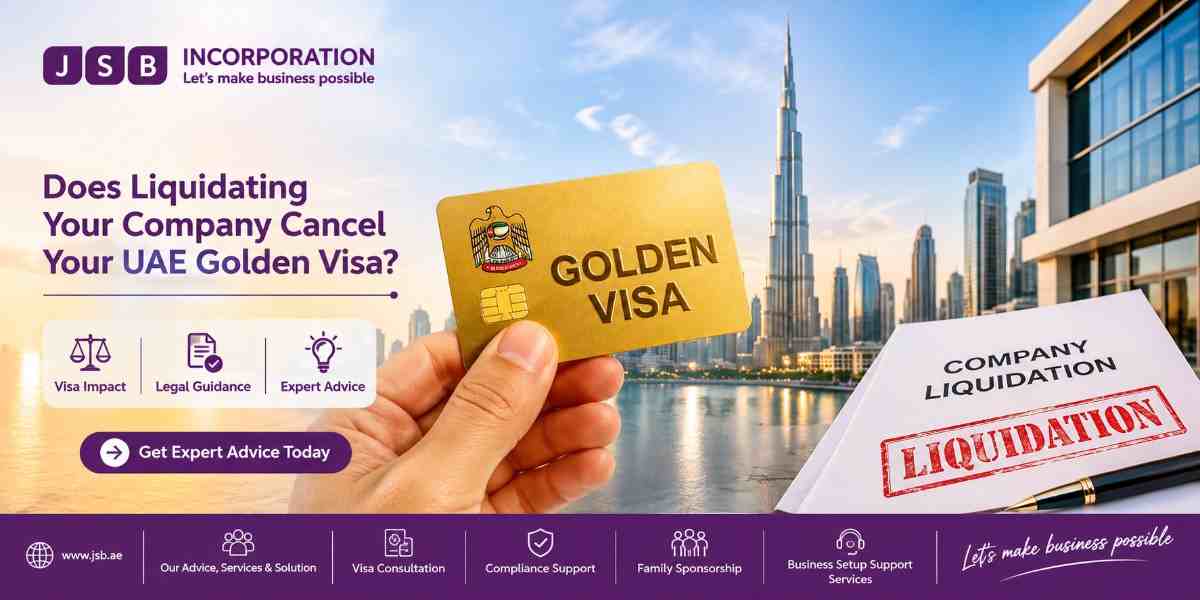
Liquidating your company does not automatically cancel your UAE Golden Visa if your residency is based on a separate qualifying asset. You lose your residency only if you obtained the visa specifically for the corporate investment that you are now formally dissolving.
The legal framework of the United Arab Emirates fundamentally separates corporate viability from personal immigration status for specific investors. This structure operates as an autonomous residence permit. A business failure does not equate to immediate deportation for long-term residents.
You can safely dismantle unprofitable entities without sacrificing your established life in the region. Historically, canceling a trade licence under the standard sponsorship system mandated the immediate cancellation of your residence visa.
The advent of the self-sponsored Golden Visa neutralizes this threat entirely. It allows your residency file to remain completely insulated from your corporate establishment card.
Your long-term viability post-liquidation depends entirely on your original qualifying category. The immigration framework demands that you continuously maintain your foundational qualifying asset. Dissolving the specific asset that qualified you for the visa triggers an immediate eligibility review.
If you acquired your residency through a channel independent of the liquidating company, your visa faces zero structural risk. According to the official UAE Government Portal, you must maintain a minimum capital investment of AED 2 million to retain a property-based Golden Visa.
Significant vulnerability arises if your visa was granted specifically for a corporate investment. When this specific corporate asset formally ceases to exist through liquidation, you lose your foundational eligibility.
Moreover, keep reading the article to learn more.
You must cancel all subordinate employee visas and clear labor files before you can cancel your mainland trade licence. The sequence requires appointing a liquidator, publishing public notices, settling debts, and finally securing a deregistration certificate from the relevant licensing authority.
Standard procedural sequences dictate that a company cannot surrender its establishment card before clearing its immigration and labor files. The established chronological order requires you to process the cancellation of all subordinate visas first.
You experience a distinct advantage as a Golden Visa holder here. You simply exclude your own self-sponsored residency from the mass cancellation batch. This keeps your personal life running smoothly while the business officially winds down.
The formal process begins with a notarized shareholder resolution declaring your intent to dissolve the company. You must also appoint a registered liquidator to oversee the financial wind-down pursuant to federal commercial laws.
Mainland entities registered with the Department of Economy and Tourism must then publish a prominent liquidation notice in two daily local newspapers.
The Department of Economy and Tourism mandates a 45-day statutory waiting period following newspaper publication for creditors to submit claims.
During this period, your company ceases active trading and parks any disputed funds in escrow. Concurrently, you must execute a total clearance of your human resources liabilities through the Ministry of Human Resources and Emiratisation.
You process the cancellation of labor contracts, which necessitates signed settlement agreements confirming the disbursement of final salaries and gratuities.
Following the creditor notice period and the resolution of all claims, your liquidator submits the final audit report. This crucial document secures your definitive deregistration certificate and legally ends the company’s existence.
You must submit a formal application for corporate tax deregistration within three months of closing your business. The Federal Tax Authority strictly enforces this timeline, and missing the deadline guarantees escalating monthly administrative fines that block your final licence cancellation.
The implementation of Corporate Tax has transformed deregistration into a high-stakes statutory obligation. Under current federal tax laws, corporate tax deregistration is a non-negotiable requirement for any liquidating entity.
You must submit a formal application within three months from the exact date of your business cessation or dissolution. Failing to meet this deadline triggers immediate administrative penalties under updated federal penalty schedules.
The Federal Tax Authority imposes a late deregistration penalty of AED 1,000 per month, which caps at AED 10,000, under Cabinet Decision No. 75 of 2023 and its amendments.
The tax authority systematically blocks the issuance of tax clearance certificates until you settle all accrued fines. This procedural block permanently stalls your final trade licences cancellation and leaves your corporate file open indefinitely.
Value Added Tax deregistration requires immediate attention following your decision to close the business. The Federal Tax Authority mandates that you submit your deregistration application within 20 business days from the date the deregistration obligation arises.
Missing this window results in an immediate administrative penalty. Former owners must also securely archive all corporate and accounting records for a minimum of seven years post-deregistration.
You remain liable for historical tax audits even after the company ceases to exist, making professional tax and VAT compliance support essential.
Free zone liquidations are generally faster and utilize fixed digital workflows, while mainland closures require variable court and publication fees.
You will pay separate charges for licence cancellation, establishment card surrender, and individual visa cancellations across both jurisdictional types.
The legal jurisdiction of your incorporating authority heavily dictates both the financial burden and the procedural timeline of your liquidation process. Mainland companies governed directly by federal commercial laws must navigate a paper-intensive process involving local courts and notary publics.
Free zone authorities operate as independent regulatory jurisdictions and typically utilize proprietary workflows. These digital processes are generally faster but impose bespoke fee schedules. You need a clear picture of these distinct costs before initiating any closure.
Analyzing specific free zone frameworks provides a clear benchmark for closure costs. The International Free Zone Authority charges a base business license cancellation fee of AED 2,000 for standard liquidations.
Human resources offboarding incurs separate charges, including distinct fees for each work permit cancellation and visa cancellation conducted within the country.
Costs and regulations are subject to change. Confirm current figures with the relevant UAE government authority or with JSB before making decisions.
Liquidation Requirement | Mainland (DET) Process | IFZA Free Zone Process |
Creditor Notice | 45 days in two Arabic newspapers | Condensed portal-based notice period |
Licence Cancellation | Variable based on court and notary fees | Fixed at AED 2,000 |
Establishment Card | Standard federal immigration fees | Fixed at AED 500 |
Visa Cancellation | Standard federal immigration fees | Fixed at AED 750 (inside UAE) |
Corporate Re-domiciliation | Permitted under Article 15 (bis) | Subject to specific authority approval |
For entrepreneurs facing prohibitive closure costs, the government provides advanced restructuring alternatives. Recent amendments to the Commercial Companies Law establish a statutory framework for corporate re-domiciliation.
This allows you to transfer your registration between competent authorities without triggering a formal liquidation event. Engaging specialized company formation experts ensures you select the most cost-effective exit or restructuring strategy for your unique situation.
Reviewer: Antonios Agiovlasitis | Google Reviews
“I have used JSB for company opening and liquidation and have been extremely satisfied with the professionalism, responsiveness, knowledge of the processes and governmental entities and in general in their efficiency and speed. Totally recommend them.”
Your dependent family members’ visas remain entirely secure during your corporate liquidation process. Because your primary UAE Golden Visa is self-sponsored and detached from the business; your spouse and children maintain their residency rights without any disruption.
Corporate liquidation traditionally threatened the residence visa status of the entire expatriate family unit. Under standard protocols, canceling a primary investor visa automatically mandates the concurrent cancellation of all dependents sponsored under that file.
Your long-term residency radically alters this dynamic, providing an unparalleled layer of security for your trailing spouse and children. Because your primary residency is decoupled from the corporate entity, the visas of all sponsored dependents remain entirely undisturbed during a business closure.
The scope of this family sponsorship is exceptionally broad and highly accommodating to your loved ones. You can sponsor your spouse, your parents, and your unmarried adult children.
Immigration authorities prioritize actual financial dependency over arbitrary age limits. An unmarried adult child who relies entirely on you remains eligible for sponsorship indefinitely.
According to the Federal Authority for Identity, Citizenship, Customs and Port Security, a generous 180-day grace period applies if a primary residence visa is ever formally canceled.
While corporate shocks do not threaten dependent visas, complex socio-legal events carry profound implications for your family structure. A dependent spouse’s visa status is strictly tethered to the legal validity of your marriage.
Once a marriage is legally dissolved, your spouse can no longer retain dependent status and faces the challenging prospect of securing an independent residency pathway.
Conversely, the visas of your dependent children remain highly secure during a divorce. Their status generally aligns with the custody arrangements of the primary sponsoring parent.
You must secure final tax clearances and disburse all local liabilities before closing your corporate bank account.
Repatriating your liquidation proceeds requires meticulous documentation to satisfy foreign exchange controls and prevent severe penalties from your home country’s tax authorities.
For expatriate investors, the conclusion of a corporate liquidation initiates a complex phase of cross-border financial compliance. The final distribution of your assets must be carefully managed against the foreign exchange controls of your home country.
You must secure final tax clearances and disburse all local liabilities before you can formally shutter your banking infrastructure.
A corporate bank account cannot be closed until all employee gratuities and federal tax settlements are fully disbursed. Moving money prematurely can trigger unwanted scrutiny from local financial regulators.
Under the Central Bank of the UAE regulations, cases and proceedings against a liquidating company are stayed for a period of six months to allow orderly resolution.
You must navigate this delicate financial window with seamless coordination between your appointed liquidator and your international tax counsel.
Obtaining a nil-balance confirmation letter is a mandatory prerequisite for the issuance of your final deregistration certificate by the licensing authority.
The failure to disclose foreign corporate assets or the proceeds of a liquidation can trigger catastrophic financial penalties under aggressive international tax frameworks.
Disinvestment proceeds remitted from your liquidated entity back to your home country must be reported meticulously.
To legally claim treaty benefits and avoid double taxation on repatriated liquidation dividends, you must often secure a Tax Residency Certificate from the federal authorities. Our integrated PRO services team assists in securing these vital compliance documents promptly.
Abandoning your company instead of formally liquidating it exposes you to compounding fines, personal liability, and systemic government blacklisting.
Allowing a trade licence to passively expire does not dissolve your legal entity or erase your ongoing tax obligations.
A unique vulnerability facing long-term residents is the psychological safety net provided by secure personal residency.
Because your personal right to reside is not threatened by an expiring trade license, you might face the temptation to simply abandon an unprofitable company.
This strategy of dormancy by abandonment is legally invalid and financially catastrophic under federal law.
A company that ceases operations but fails to formally deregister remains an active entity burdened with continuous statutory obligations. You cannot walk away without facing severe repercussions.
Any uncancelled employee visas tied to your abandoned establishment card will silently accrue severe overstay fines.
The Federal Authority for Identity, Citizenship, Customs and Port Security standardizes overstay penalties at AED 50 per day for expired residence visas. Costs and regulations are subject to change.
Furthermore, your entity remains fully registered for corporate tax and value-added tax. The failure to file mandatory zero-revenue returns triggers severe late filing penalties. Under federal commercial laws, the legal veil of limited liability does not protect directors from regulatory negligence.
You can be held personally and criminally liable for the debts and regulatory fines of an abandoned company. An unsurrendered establishment card carrying compounding fines will eventually trigger automated system blocks across all government networks.
This systemic blacklisting prevents you from sponsoring family members or incorporating subsequent business entities until all liabilities are cleared.
1. Does liquidating my company cancel my UAE Golden Visa?
Liquidating your company does not automatically cancel your long-term residency if your qualifying asset is separate from the business. You only lose your visa if you obtained it specifically for the corporate investment that you are now formally dissolving.
2. What is the penalty for missing the corporate tax deregistration deadline?
Failing to apply for corporate tax deregistration within three months of business cessation results in a penalty of AED 1,000 per month. This administrative penalty compounds monthly until it reaches a maximum statutory cap of AED 10,000.
3. How long is the grace period if a Golden Visa is canceled?
The immigration authorities grant a generous 180-day grace period after the cancellation or expiry of a long-term residence visa. This six-month window provides ample time to transition to a new qualifying asset, secure employment, or manage personal affairs.
4. Can a Golden Visa holder sponsor adult children?
Yes, adult children can be sponsored regardless of their age, provided they are legally unmarried and completely financially dependent on the primary applicant. You must provide official documentation proving this financial reliance during the family sponsorship application process.
5. What happens to dependent visas during a corporate liquidation?
Because your residency is self-sponsored and completely decoupled from your corporate entity, dependent visas remain entirely undisturbed during a business liquidation. Your family unit retains its legal residency as long as you maintain your foundational qualifying investment status.
6. How long is the creditor notice period for mainland company liquidation?
The Department of Economy and Tourism mandates a 45-day statutory waiting period following the publication of your liquidation notice in two Arabic newspapers. This mandatory timeframe allows potential creditors to submit financial claims before final deregistration occurs.
7. Can I simply let my trade licence expire instead of liquidating?
No, allowing your trade licence to passively expire exposes you to severe legal risks.
Abandoning an inactive company triggers compounding immigration overstay fines, corporate tax non-compliance penalties, and systemic government blacklisting that affects your personal sponsorship capabilities.
Reviewed by Gaurav Keswani, Founder, JSB Incorporation.
Gaurav Keswani is the Founder of JSB Incorporation, a Dubai-based business setup and immigration consultancy. He appeared on Talk 100.3 FM answering live listener questions on UAE Golden Visa eligibility, citing GDRFA and ICP guidelines directly on air. JSB Incorporation handles documentation preparation and application coordination; all visa and license decisions rest with the relevant UAE government authorities, including GDRFA, ICP, DET, and DLD.
The complexities of corporate liquidation while safeguarding your long term residency require precise execution and deep regulatory knowledge.
You should not risk compounding administrative penalties or jeopardizing your family visas by abandoning an inactive entity or mishandling tax deregistration timelines.
JSB Incorporation provides end-to-end guidance for seamless company closures across mainland jurisdictions and numerous free zones.
Our expert team ensures meticulous compliance with federal tax deregistration deadlines and labor offboarding protocols.
Related Reading:
Can You Start a New Business After Liquidation in Dubai? (2026 Legal Guide)
Complete Guide to Company Liquidation in UAE (2026)
Company Liquidation in Dubai, UAE: The Complete 2026 Guide (Mainland, Free Zone, DIFC, and ADGM)
Dubai Property Investor Visa vs. UAE Golden Visa: Key Differences
Can You Qualify for a UAE Golden Visa by Combining Basic Pay and Housing Allowance?
UAE Golden Visa vs. Green Visa vs. Standard Residence Visa: Which Is Right for You?

Office 2505, 25th Floor, Regal Tower, Business Bay, Dubai, UAE P.O Box 27614.
+971 4 824 4842
info@jsbincorporation.com
