
 Gaurav Keswani
Key Highlights
You’d done your homework. You spent two weekends researching free zones, picked one that sounded right, and found a consultant online who said he could get your trade license done in three weeks. You sent over your documents. He submitted the application. Then, silence. Three weeks later, you got an email: your application had been rejected.
The reason buried at the bottom of the email: no VARA approval on file. You didn’t know VARA existed. Your consultant never brought it up. Not one of the five guides you’d read mentioned it either.
Now you’re restarting the process, paying duplicate fees, and explaining to your co-founder why you’ve lost six weeks. This happens to Web3 founders in Dubai every single month. It doesn’t have to happen to you.
In 2022, Dubai enacted Law No. (4) of 2022 Regulating Virtual Assets, the first dedicated virtual assets law in the region, creating VARA as the authority for all virtual asset activities across the emirate.
The single thing most founders miss: VARA approval must come before your trade license, not after. This guide covers the legal framework, the correct sequence, official 2026 VARA costs, and the tax obligations you need to understand before you commit.
Dubai is one of the most active global hubs for virtual asset businesses, with VARA maintaining a public register of all licensed virtual asset service providers. The problem isn’t the market. It’s the setup sequence.
Most online guides treat a Dubai Web3 setup the same way they’d treat any other business registration: pick a free zone, apply for a trade license, open a bank account, and call it done.
But Web3 businesses that conduct regulated virtual asset activities have an extra legal step that comes before any of that. They need VARA authorization first. Skip it and your trade license application gets rejected. Start it after your trade license and you’ve already lost weeks you can’t get back.
The other thing that catches founders off guard is the cost. VARA application fees start at AED 40,000 and go up to AED 100,000 depending on your activity, and that’s before you factor in free zone or mainland registration fees on top. Getting clear on your full budget before you start will save you from running out of runway halfway through the process.
VARA, the Virtual Assets Regulatory Authority, is Dubai’s dedicated regulator for all virtual asset activities. It governs your business regardless of which Dubai jurisdiction you choose, whether mainland or free zone, as long as you conduct regulated virtual asset activities.
VARA was established under Dubai Law No. (4) of 2022 as a public corporation with legal personality and financial autonomy, linked to the Dubai World Trade Centre Authority. Its jurisdiction covers all of Dubai’s mainland, special development zones, and every free zone, with one exception.
The DIFC operates under its own separate regulator, the Dubai Financial Services Authority. Whether you’re in DMCC, IFZA, DSO, or on the Dubai mainland, VARA is your primary regulator the moment your business involves virtual asset activities.
VARA’s mandate covers licensing virtual asset service providers, regulating the issuance and trading of virtual assets and tokens, protecting client assets, and monitoring transactions to prevent market manipulation.
Not every Web3 business in Dubai needs a VARA permit. Whether you need one depends on what your business actually does, not what it calls itself.
Under Article 16 of Dubai Law No. (4) of 2022, these seven activities require a VARA permit with no exceptions:
VARA also holds authority to add more activities to this list by resolution at any time.
If your business doesn’t fall into these categories, you may not need a VARA permit at all. Pure blockchain software development, DLT infrastructure, or Web3 app development where you don’t handle, exchange, or hold virtual assets on behalf of third parties may only need a standard free zone trade license.
The distinction that matters: building a Web3 product isn’t the same as conducting a regulated virtual asset activity.
Both free zone and mainland Dubai setups give you 100% foreign ownership as a Web3 or technology business. Your real decision comes down to who your customers are, what tax treatment you qualify for, and how directly you need to reach the UAE market.
Mainland (via Dubai Department of Economy and Tourism) | Free Zone (DMCC, IFZA, DSO) | |
Foreign ownership | 100% for most tech activities | 100% always |
UAE market access | Direct | Needs a mainland license or branch |
Corporate tax | 9% on net income above AED 375,000 | 0% on qualifying income (QFZP rules) |
VARA required? | Yes, if regulated VA activity | Yes, if regulated VA activity |
Best suited for | VASPs serving UAE residents directly | Blockchain dev, NFT platforms, VA advisory |
Here’s a 2026 change worth knowing. Under Federal Decree-Law No. 20 of 2025, which took effect on October 14, 2025, free zone companies can now set up mainland branches without re-incorporating as a completely new entity.
The same law also confirms that all free zone companies carry UAE nationality. If you’re starting in a free zone and planning to serve the wider UAE market later, this removes a step that used to mean starting your registration from scratch.
Also Read: Dubai Launches AED 1 Billion Economic Incentive Package: What Businesses Need to Know
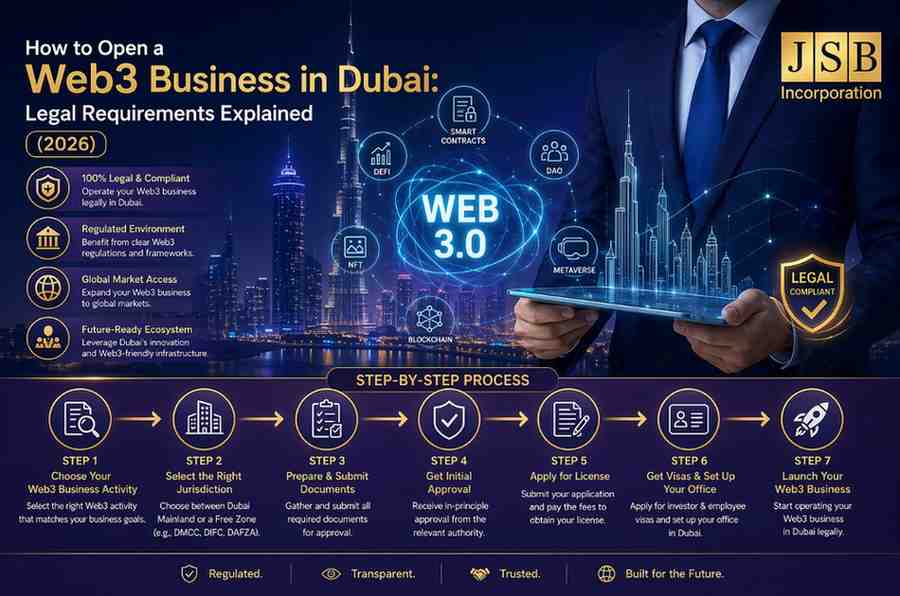
To open a Web3 business in Dubai legally in 2026, you follow five steps in a fixed order. Step 4 is where most founders lose time and money. VARA authorization must be in your hands before you submit any trade license application. Article 15(c) of Dubai Law No. (4) of 2022 requires this explicitly.
VA Activity | Application Fee (AED) | Annual Supervision Fee (AED) |
Advisory Services | 40,000 | 80,000 |
VA Transfer and Settlement Services | 40,000 | 80,000 |
Broker-Dealer Services | 100,000 | 200,000 |
Custody Services | 100,000 | 200,000 |
Exchange Services | 100,000 | 200,000 |
Lending and Borrowing Services | 100,000 | 200,000 |
VA Management and Investment Services | 100,000 | 200,000 |
Category 1 VA Issuance | 100,000 | 200,000 |
Three things to build into your budget before you apply:
These VARA fees are completely separate from the fees charged by DET or your chosen free zone authority. Budget for both.
Disclaimer: All fee figures above come directly from the official VARA Rulebook. VARA may update these fees at any time. Verify current figures before you submit your application.
Dubai doesn’t charge personal income tax or capital gains tax on individuals, including crypto holders. For your registered business, three tax obligations apply in 2026 that you need to plan around before you start.
Corporate Tax: The UAE applies a 9% corporate tax on net taxable income above AED 375,000 per year, effective June 2023, under Federal Decree-Law No. 47 of 2022, as confirmed by the FTA.
This applies to your business whether you’re on the mainland or in a free zone. If your free zone company qualifies as a Qualifying Free Zone Person (QFZP), you can access a 0% rate on qualifying income, but you’ll need to meet all QFZP conditions under the relevant cabinet decision.
VAT: Under Cabinet Decision No. 49 of 2023, effective November 15, 2024, virtual asset transfers and conversions are VAT-exempt in the UAE. Your platform service fees or advisory fees may attract VAT at 5%, though. You’ll need to register for VAT with the FTA once your taxable supplies cross AED 375,000 per year.
2026 Updates That Affect You: Under Federal Decree-Laws No. 16 and No. 17 of 2025, both effective January 1, 2026, a five-year limit now applies for claiming VAT refunds from the end of the relevant tax period.
The FTA can also deny your input tax deductions if it determines that a supply is part of a tax evasion arrangement, so verify the legitimacy of your supplies before claiming input tax. All your crypto transactions must be recorded in AED at the transaction date for UAE tax and accounting compliance.
Disclaimer: Tax rules change with new legislation. Always confirm your current corporate tax and VAT position directly with the FTA before making any financial or structural decisions.
Q: Does VARA approval come before or after the trade license in Dubai?
A: VARA approval must come before your trade license, not after. Article 15(c) of Dubai Law No. (4) of 2022 states this requirement explicitly, and you can verify it. If you submit a trade license application without VARA authorization, it gets rejected, and you have to restart.
Q: Can a foreigner own 100% of a Web3 company in Dubai?
A: Yes. 100% foreign ownership is permitted in all Dubai free zones and on the mainland for most digital and technology activities. You don’t need a local Emirati partner or sponsor. Verify the current DET approved activity list.
Q: Is Dubai tax-free for Web3 startups?
A: There’s no capital gains tax on crypto for individuals in the UAE, and there’s no personal income tax. Your business pays 9% corporate tax on net taxable income above AED 375,000 per year under Federal Decree-Law No. 47 of 2022, as confirmed by the FTA. If your free zone company qualifies as a QFZP, you can access a 0% rate on qualifying income. VAT at 5% may apply to certain service fees.
The VARA application, jurisdiction decision, legal structure selection, trade license, bank account, and FTA registration all need to happen in the right order. One step out of sequence and you’re back at the beginning.
JSB Incorporation is based at Regal Tower, Business Bay, Dubai, and works with founders across 24+ UAE jurisdictions, including DMCC and IFZA.
The team handles your setup from VARA application to trade license, bank account opening, and tax registration with transparent pricing and no hidden steps. You’ll know exactly what needs to happen, in what order, and what it costs before you commit to anything.
Book your free consultation call today with the experts of JSB Incorporation to learn more

Office 2505, 25th Floor, Regal Tower, Business Bay, Dubai, UAE P.O Box 27614.
+971 4 824 4842
info@jsbincorporation.com