
 Gaurav Keswani
Key Highlights
You’ve been freelancing for three years. You’re running paid campaigns for clients in three different time zones, billing a solid monthly retainer, and quietly wondering: what if I built something of my own?
Then one evening, you come across a forum post. A marketer from Toronto explains how she flew to Dubai, walked out of a licensing office four days later with a fully registered company, and within three months had her first local client. No 51% local partner. No bureaucratic maze. Just a clean, simple setup. You read it twice.
That story isn’t an exception. It’s becoming the norm. The UAE ranked ninth globally in the IMD World Digital Competitiveness Report 2025, surpassing several advanced economies and becoming the only Arab nation in the global top 10.
Dubai has 2,300+ technology companies, 237 cloud service providers, and a government-backed digital infrastructure that processes 173.7 million digital transactions annually. The UAE’s e-commerce market is forecast to reach $12.30 billion in 2026.
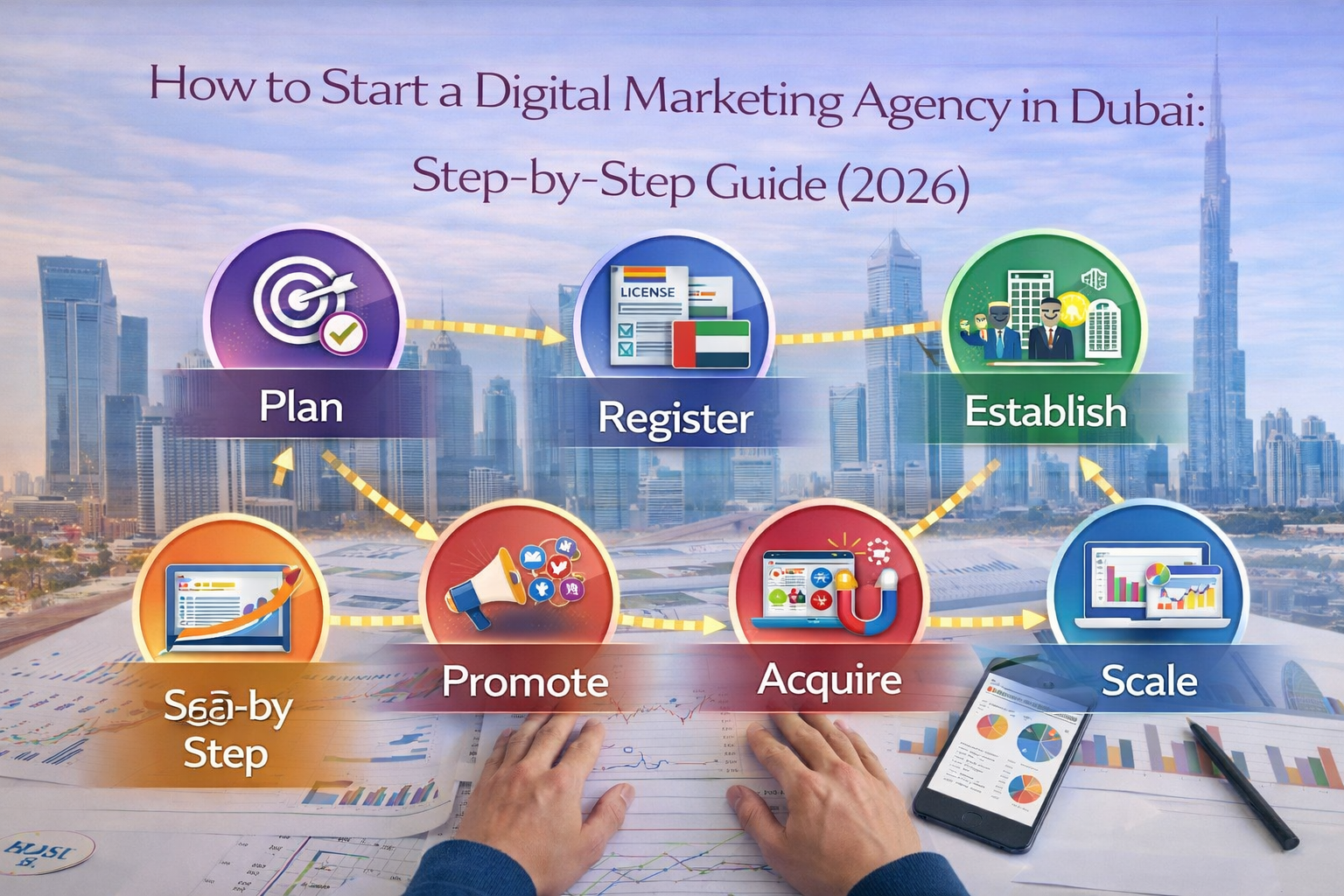
This guide is for you if you’re seriously considering launching a digital marketing agency in Dubai. You’ll learn exactly how to choose your jurisdiction, get your license, handle taxes, open a bank account, and secure your residency.
Disclaimer: This article is for informational purposes only and does not constitute legal, tax, or financial advice. Always verify current requirements with your chosen free zone authority before making any business decisions.
Let’s be honest about what’s keeping you from making a move.
If you’re on an H-1B visa in the US, you already know the anxiety. H-1B rejection rates have fluctuated wildly. In 2019, they hit 24%. In 2020, they dropped to 13%.
Even today, with a lower denial rate of 2.15% in FY 2025, the uncertainty is baked into every renewal cycle. Your visa is tied to an employer. You can’t freely build your own agency without risking your immigration status.
If you’re in India, the UK, or elsewhere, the challenge looks different. Complex tax structures, limited foreign ownership rights in many markets, and slow business registration timelines.
The World Bank data cited by the UAE Ministry of Economy shows that the average business setup time in high-income countries is 10 days. In the UAE via the Department of Economy and Tourism, it takes just 4 days. Via the Bashr platform, you can be licensed in 15 minutes.
The real pain points most founders share:
Dubai solves most of these. Not all, and not without effort. But the infrastructure exists to get your agency up, legal, and operating in weeks. Here’s how.
Before diving into the steps, you need to understand what makes Dubai structurally different from other markets.
You own your company. Federal Decree-Law No. 26 of 2020 removed the old 51% Emirati shareholding requirement. Dubai now allows 100% foreign ownership for more than 1,000 commercial and industrial activities on the mainland. In free zones, full foreign ownership has always been the default.
Your profits stay yours. The UAE offers 100% repatriation of capital and profits. There’s no dividend withholding tax, no personal income tax, and no capital gains tax on business income.
Setup is genuinely fast. The Ministry of Economy’s own published data shows 10 days on average in high-income countries, 4 days in the UAE via DED, and 15 minutes via the Bashr online platform, which connects you to all federal and local licensing authorities in a single session.
Digital trade has a legal framework. Federal Decree-Law No. 14 of 2023 Concerning Modern Technology-Based Trade governs digital commerce through websites, apps, and social media. Your agency doesn’t operate in a regulatory grey zone. It operates under a clear, recognized law.
Marketing agencies are explicitly recognized. The UAE government platform u.ae notes that UAE mainland businesses may use an “outsourced agency specialized in marketing” and confirms those agencies are aware of UAE marketing procedures and regulations.
More than 40 free zones. The UAE hosts more than 40 multidisciplinary free zones, each with its own sector focus, cost structure, and visa quota. For a digital marketing agency, you have serious options.
The UAE Digital Economy Strategy, launched in April 2022, aims to double the digital economy’s contribution to GDP from 9.7% to 19.4% within 10 years. That’s not just a policy number. It means real government investment in the infrastructure, regulation, and talent pipeline that digital agencies depend on.
Once licensed, your agency can operate across a wide range of service lines:
If you plan to serve clients in banking, insurance, mortgages, crypto, or investment, read this carefully.
Under the new UAE Central Bank Law (Federal Decree-Law No. 6 of 2025), Article 61(1)(h) classifies advertising, marketing, and promoting a licensable financial activity as a licensed financial activity in its own right.
That means your agency would need a separate CBUAE license to run campaigns for financial sector clients. You can verify which institutions are CBUAE-licensed through the official register of the UAE central bank.
This is a differentiating compliance point that most new agency founders miss. If you’re targeting fintech, mortgage, or banking clients, get legal advice before onboarding them.
This is the most consequential decision you’ll make before anything else. It determines who you can sell to, how you’re taxed, and what your setup looks like.
A mainland license from Dubai’s Department of Economy and Tourism lets you operate anywhere in the UAE and serve all local and government clients directly. You’re eligible to bid on government tenders. According to u.ae, businesses must register with the relevant government body to appear on approved supplier lists.
You’ll need a physical office with an Ejari lease agreement. All digital and eTrade activities additionally require approval from the Telecommunications and Digital Government Regulatory Authority (TDRA).
Best for: agencies targeting UAE SMEs, large local brands, or government entities.
Free zones offer 100% foreign ownership, 100% repatriation of capital and profits, and in many cases faster and more cost-effective setup. The trade-off: a free zone company is generally not permitted to carry out business on the UAE mainland without additional approvals from the free zone authority and DET.
If your primary clients are international or you’re building a remote-first agency, this restriction won’t affect you much. If you want to serve mainland UAE clients, you’ll need a mainland branch or additional approvals.
Best for: remote-first agencies, lean startups, and founders with international client bases.
Free Zone | Best For | Key Advantage |
Tech-forward digital agencies | Dedicated tech ecosystem; home to regional HQs of Meta, Microsoft, Visa, Intel | |
Creative, content, and media agencies | Leading regional Arabic and digital media hub, 1,300+ companies | |
Solo founders, lean startups | Dubai address, rapid license issuance, cost-effective packages | |
Multi-activity agencies, scaling businesses | 600+ business activities, premium infrastructure, strong visa quota |
Always verify current costs and packages directly with each free zone authority. Your specific activity combination affects the final fee.
Step 1: Define Your Business Activity
Identify the exact activity codes relevant to your agency: “Digital Marketing Services,” “Social Media Management,” “Content Creation,” “SEO Services.”
You can add multiple activities in your first application, which is smarter than adding them later and paying incremental fees. If your activities include digital trade through social media or platforms, the requirements of Federal Decree-Law No. 14 of 2023 apply.
Step 2: Choose Your Legal Structure
Step 3: Reserve Your Trade Name
Apply through the DET portal (mainland) or your chosen free zone authority. Your trade name must comply with UAE naming conventions. Offensive, religious, or abbreviated references are not permitted without context. Collect the trade name reservation certificate. It’s a required document for the license application.
Step 4: Prepare Your Documents
Per the official investindubai.gov.ae checklist:
Step 5: Submit Your License Application
You’ll need your trade license, Articles of Association, passport copies, and a business plan. All corporate bank accounts in the UAE must be opened with a CBUAE-licensed financial institution. The full register of licensed institutions is available at the UAE central bank website. When you hire employees, you must also register for a Wages Protection System (WPS) account.
Step 7: Register for Corporate Tax
You must register for corporate tax within 3 months of obtaining your trade license. This applies to all businesses in the UAE, including free zone companies. There’s no fee for registration itself, but missing the deadline can attract penalties.
Taxable Income | Rate |
Up to AED 375,000 | 0% |
Above AED 375,000 | 9% |
Small Business Relief: If your agency’s revenue is AED 3 million or below, you can elect for Small Business Relief and pay zero corporate tax for that period. This relief is valid for tax periods ending on or before 31 December 2026.
You must actively elect it through your corporate tax return on the EmaraTax portal each tax period. Qualifying Free Zone Persons and members of multinational groups with consolidated global revenues of AED 3.15 billion or more cannot claim this relief.
Free zone entities may qualify for 0% on qualifying income if conditions under the corporate tax law are met. Verify current criteria directly with the Federal Tax Authority at tax.gov.ae.
Digital marketing services fall under standard UAE VAT rules per Federal Decree-Law No. 8 of 2017, with updates under Federal Decree-Law No. 16 of 2025 effective 1 January 2026. Key 2026 changes include a five-year limit to claim VAT refunds, strengthened anti-evasion provisions, and the FTA’s authority to issue binding directions.
Maintain all invoices, contracts, income records, and financial statements for a minimum of 5 years for FTA audit compliance. These records are also required for corporate banking facilities and investor reporting.
One of the most underrated advantages of launching in Dubai is the direct path to long-term residency tied to your own business, not an employer.
Visa Type | Duration | Key Requirements |
Investor Visa | 2-3 years | Standard for business owners; allows sponsoring employees and family dependents |
Green Visa | 5 years | Self-employed professionals; no employer sponsor; proof of financial solvency or AED 360,000 annual income |
Golden Visa (Entrepreneur) | 5 years | Project value min. AED 500,000 (certified auditor letter); confirmed as innovative or technological by approved incubator or relevant authority; no sponsor; includes spouse and children |
Golden Visa (Investor) | 10 years | Min. AED 2 million capital investment or AED 250,000 annually in taxes |
Virtual Working Visa | 1 year | Live in Dubai while running a remote agency; no full company setup required |
If you scale your digital marketing agency to an AED 500,000 valuation and operate in a tech-driven space, the Entrepreneur Golden Visa is a realistic and attainable next step. The UAE Golden Visa carries no sponsor requirement, no minimum stay obligation, and extends to your immediate family.
Getting licensed is step one. Staying compliant is what keeps you running.
Setup costs vary based on your chosen jurisdiction, legal structure, number of business activities, office type, and visa quota. Official guidance confirms the UAE offers “numerous options at competitive costs.” Key cost categories to budget for:
Use the Bashr platform’s fee calculator at investindubai.gov.ae for a real-time estimate before you commit. Avoid third-party cost estimates, as they’re often outdated or jurisdiction-specific.
Disclaimer: All fees, costs, and pricing referenced in this article are subject to change. Verify current figures directly with the Department of Economy and Tourism or the Federal Tax Authority before making any financial decisions.
Yes. In free zones, 100% foreign ownership has always been the standard. On the mainland, Federal Decree-Law No. 26 of 2020 removed the 51% Emirati shareholding requirement, allowing full foreign ownership across more than 1,000 activities.
2. Do I need a physical office to start a digital marketing agency in Dubai?
It depends on your setup. A mainland license requires a physical office with an Ejari lease. Free zones offer virtual offices and flexi-desk arrangements, which are significantly more cost-effective for early-stage founders.
3. What documents do I need?
A passport copy, residence visa, or entry permit (non-GCC nationals), Articles of Association (multi-shareholder setups), trade name reservation certificate, and an office lease. A one-person LLC does not require Articles of Association.
4. How fast can I get a digital marketing license in Dubai?
As fast as 15 minutes through the Bashr platform. Standard DET processing takes approximately 4 business days, compared to the World Bank’s average of 10 days in high-income countries.
5. Is VAT applicable on digital marketing services in Dubai?
Yes, if your taxable annual turnover exceeds AED 375,000. The standard rate is 5% on services to UAE-based clients. Services provided to clients outside the GCC VAT territory are generally zero-rated.
6. What is the corporate tax rate for a digital marketing agency in Dubai?
0% on taxable income up to AED 375,000 and 9% above that. If your revenue is AED 3 million or below, you can elect for Small Business Relief (0%) for tax periods ending on or before 31 December 2026.
7. Can a free zone digital marketing agency serve UAE mainland clients?
Generally, no. A free zone company cannot conduct business on the mainland without additional approvals from the free zone authority and DET. A mainland branch or specific approvals are required.
8. Can a digital marketing agency founder get a UAE Golden Visa?
Yes. The Entrepreneur category (5 years) is open to founders of innovative or tech-driven projects valued at AED 500,000 or more, with a letter from an approved business incubator or relevant authority confirming the project’s innovative nature.
9. Do I need TDRA approval for a digital marketing license in Dubai?
Yes. All eTrade and online business licenses require TDRA approval in addition to the DET trade license.
10. Can a digital marketing agency in Dubai market financial products like mortgages?
Under the new CBUAE Law (Article 61(1)(h)), advertising or marketing of a licensable financial activity is itself a licensed financial activity. A separate CBUAE license may be required. Verify current requirements at rulebook.centralbank.ae and consult a licensed legal advisor before serving financial sector clients.
You’ve seen how the framework works. The real question now is execution, and that’s where most founders stall. Not because they lack ambition, but because navigating 24+ jurisdictions, activity codes, bank account requirements, and visa categories while trying to run a business is genuinely complex.
JSB Incorporation exists to take that complexity off your plate. Here’s what working with JSB looks like:
Get in touch with JSB Incorporation today and start with a clear path forward.
Book your free consultation call today with the experts of JSB Incorporation to learn more.

Office 2505, 25th Floor, Regal Tower, Business Bay, Dubai, UAE P.O Box 27614.
+971 4 824 4842
info@jsbincorporation.com