
Key Highlights
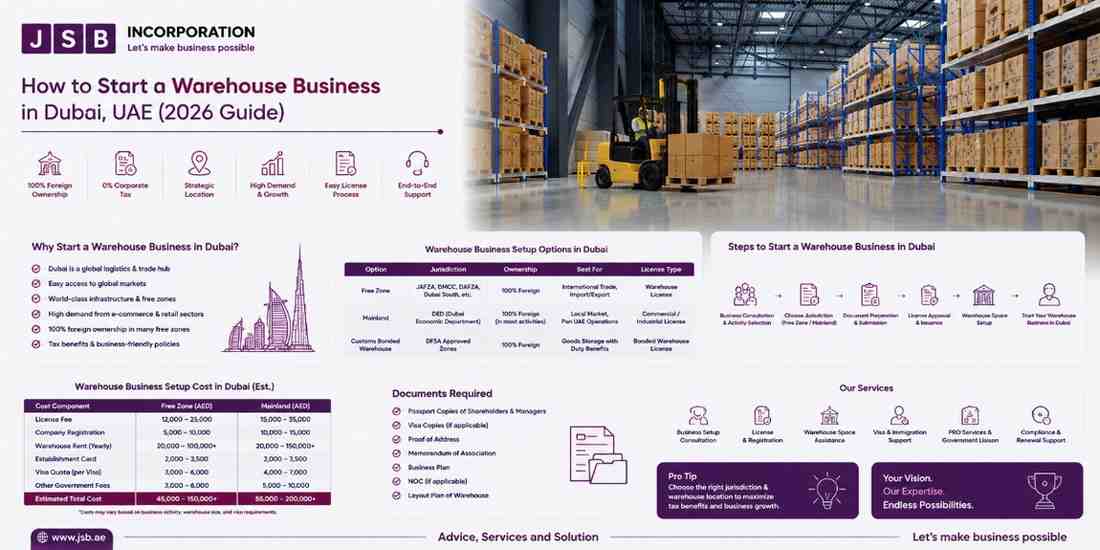
Starting a warehouse business in Dubai requires a license that specifically authorizes storage activity, either a JAFZA Logistics license at AED 15,000 per year, a Dubai South last-mile and warehousing license from AED 12,500 per year, or an IFZA Commercial license starting at AED 11,900 for a zero-visa package. This also includes a separate customs-bonded license if you plan to defer import duty.
Read more to learn about setting up your warehouse business in Dubai.
Storing goods commercially in Dubai requires a license that specifically permits warehousing or logistics activity, not a general trading license alone. At JAFZA, the Logistics license lets you hold inventory and manage orders, but you cannot buy, sell, or manufacture goods under it since it only permits transport-related packaging.
This distinction catches a lot of first-time entrepreneurs off guard. If your business model involves purchasing goods and reselling them later, you’ll need a Trading license instead, which explicitly allows buying, selling, and distributing stored inventory.
Mainland licensing, issued through the Dubai Department of Economy and Tourism, gives you full access to sell across the UAE local market, while free zone licensing gives you 100 percent foreign ownership but confines your operations to the zone itself.
If most of your customers are inside Dubai, mainland setup avoids the extra step of arranging a distributor for local sales.
Factor | Mainland | Free Zone |
Market access | Full access to sell across the UAE local market | Selling into mainland Dubai generally requires a distributor or local permit |
Ownership | Standard UAE ownership framework | 100 percent foreign ownership under free zone rules |
Location | Any DET-approved commercial site in Dubai | Confined to the free zone premises |
Best for | Businesses selling directly to UAE-based customers | Import, export, and re-export focused operations |
If your warehouse mainly serves as a distribution hub for shipments passing through the UAE to other markets, free zone setup often reduces the extra steps needed to sell locally.
JAFZA, Dubai South, and IFZA each offer a different warehousing license structure, and the best fit depends on whether you plan to buy and sell goods or purely store and distribute them.
Setting up a warehouse business in Dubai follows seven steps, from defining your activity to receiving your license and establishment card.
A customs-bonded warehouse license lets you store imported goods under Dubai Customs supervision without paying duty upfront, and it requires a separate application through Dubai Trade in addition to your standard trade license.
Required documents include your trade license copy, ownership or lease verification certificate, an inventory management system, and your last audit report.
You’ll also need a financial guarantee: AED 50,000 cash or bank guarantee for a private warehouse, or AED 1,500,000 for a public warehouse. That’s a significant jump between categories, so confirm your classification with Dubai Customs early in the process.
Warehouse licensing costs range from AED 11,900 to AED 20,900 for IFZA’s commercial packages, AED 15,000 flat for JAFZA’s Logistics license, and from AED 12,500 for Dubai South’s warehousing license, before factoring in lease costs and customs guarantees.
Item | Cost |
JAFZA Logistics license | AED 15,000 per year, flat rate |
Dubai South last-mile and warehousing license | From AED 12,500 per year |
IFZA Commercial license, zero visas, 1 year | AED 11,900, inclusive of VAT |
IFZA Commercial license, 4+ visas, 1 year | AED 20,900, inclusive of VAT |
IFZA establishment card, initial application | AED 2,000 |
Customs bonded warehouse guarantee, private warehouse | AED 50,000 |
Customs bonded warehouse guarantee, public warehouse | AED 1,500,000 |
Both JAFZA and IFZA state that these figures are subject to change without prior notice. Treat these numbers as a planning baseline, not a locked-in quote.
The most common mistake is assuming a Logistics license covers buying and selling, when JAFZA’s version explicitly excludes the purchase or sale of stored goods.
Other frequent errors include skipping a distributor arrangement before selling free-zone-stored goods into Dubai’s mainland market, underestimating the customs guarantee jump to AED 1,500,000 for public warehouse status, and confusing free zone lease confinement with the mainland’s freedom to choose any DET-approved location.
A Trading license lets you buy, sell, and distribute stored goods. JAFZA’s Logistics license only permits holding inventory and order management, not buying or selling.
2. Can a free zone warehouse sell directly to mainland Dubai customers?
Generally, no, not without a distributor or a mainland sales arrangement in place.
3. How much guarantee is needed for a customs-bonded warehouse?
AED 50,000 for a private warehouse or AED 1,500,000 for a public warehouse, submitted through Dubai Trade’s official portal.
4. How fast can I get a warehousing license in a Dubai free zone?
Dubai South’s digital license process can issue a license within one business day once your application and documents are complete.
5. Which free zone is best for warehousing?
JAFZA suits businesses wanting proximity to Jebel Ali Port with a flat-fee Logistics license. Dubai South suits last-mile and fulfillment operations near Al Maktoum International Airport. IFZA suits businesses wanting warehousing activity bundled into a broader Commercial license.
Disclaimer: License fees, guarantee amounts, and activity scopes mentioned here are based on official free zone and government sources at the time of writing, but JAFZA and IFZA both note that pricing is subject to change without prior notice. Always confirm current fees, activity codes, and documentation requirements directly with the relevant authority or Dubai Customs before making financial commitments.
Sorting through license types, jurisdiction rules, and customs requirements on your own can eat up weeks you don’t have, especially with supplier deadlines pressing.
JSB Incorporation has helped entrepreneurs move through this process across JAFZA, Dubai South, IFZA, and other UAE jurisdictions with transparent pricing and clear timelines.
From picking the right license type to handling bank account opening and PRO services, the team manages the parts that typically slow founders down.
Book your free consultation call today with the experts of JSB Incorporation to learn more.

Office 2505, 25th Floor, Regal Tower, Business Bay, Dubai, UAE P.O Box 27614.
+971 4 824 4842
info@jsbincorporation.com
