
 Gaurav Keswani
Quick Answer
Dropshipping is a legal business model in the UAE, but you can only run it under a valid trade licence covering e-commerce or trading activity.
Federal Decree by Law No. 14 of 2023 on Modern Technology-Based Trade governs this, and the official UAE government eCommerce page confirms that anyone selling goods or services online, through websites, apps, social media, or digital marketplaces, needs the appropriate licence and approvals.
Operating without a licence counts as unlicensed commercial activity, regardless of whether you physically stock goods yourself. The law treats the sale, not the fulfillment method, as the licensable activity.
Once you have the right licence in place, the next question is which licence type actually covers dropshipping, and that is where jurisdiction choice starts to matter.
Keep reading the article to learn more.
Yes. All UAE e-commerce activity, including dropshipping, requires a commercial trading licence with an e-commerce activity code, and this licence also needs approval from the TDRA.
There is no separate “dropshipping license” as a standalone category; it sits inside your existing mainland or free zone trading structure.
You have two licensing routes:
Both routes require the same TDRA sign-off, so the real decision is which jurisdiction fits your sales model, not whether you can avoid TDRA.
Free zone licences suit dropshippers selling online to UAE and international customers, since the setup cost is lower with no mandatory office lease.
Mainland licensing suits sellers wanting a direct retail or fulfillment presence in Dubai. Free zone companies selling directly into the mainland may need a local distributor or additional approvals.
Jurisdiction | Setup cost range | Office requirement | Mainland market access | Visa eligibility | Best for |
Free zone | AED 11,900-AED 20,900 for a 1-year license, by visa tier | No leased office required; a flexi-desk is included in most packages | Needs a local distributor or extra approval to sell directly on the mainland | 0 to 4+ visas depending on package | Online-first dropshippers selling UAE-wide and internationally |
Mainland | Varies by DET activity, licence type, and office lease; confirm current fees with DET before budgeting | A physical office or flexi-desk typically required, per DET rules | Direct access to sell across UAE mainland without a distributor | Visa allocation tied to office size and activity | Sellers who want a Dubai-based retail or fulfilment footprint |
Costs and regulations are subject to change. Confirm current figures with the relevant UAE government authority or with JSB before making decisions.
Neither route is automatically cheaper once you factor in the mainland distributor requirement for free zone sellers targeting mainland customers directly. JSB’s formation team can map your sales channels against both structures first.
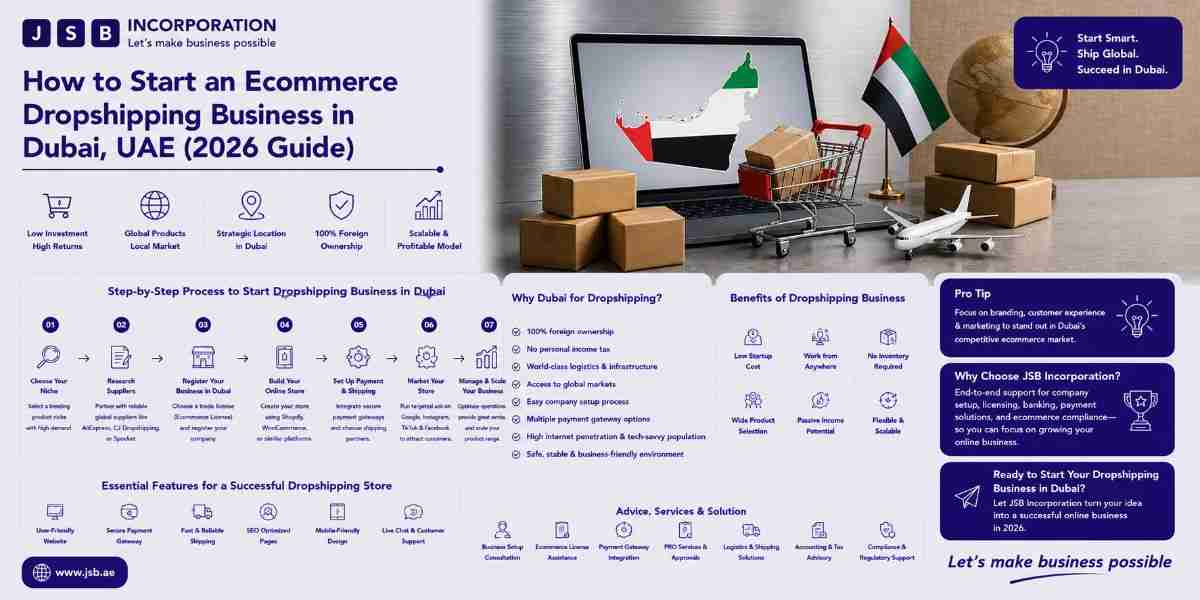
Registration follows a fixed sequence: choose your jurisdiction, select the activity code, reserve a trade name, submit your application, secure TDRA approval, and open your bank account.
JSB Incorporation Founder Gaurav Keswani notes the process has sped up: “Before COVID, opening a business license in Dubai required a minimum of one week of personal time investment. Today, the process has been streamlined to just a few steps, sometimes completed on the same day.”
The full sequence:
Most of these steps can move quickly once your documents and activity code are finalized, though processing times still depend on the authority handling your application.
“We have recently incorporated our company through JSB Incorporation. Gaurav Keswani has been a tremendous help throughout the entire process. His support enabled us to complete everything seamlessly, even accommodating last-minute changes. It was a wonderful experience working with JSB Incorporation. We look forward to a long-term engagement.” – Veena Talegaonkar, Google Reviews
You’ll need a standard set of documents regardless of jurisdiction, though free zones may request one or two extras. Having these ready shortens processing time.
Free zone commercial trading licence packages start from AED 11,900 for a one-year, zero-visa license, inclusive of VAT.
Costs rise with each additional visa, plus separate government fees for the establishment card and residence visas.
Item | Approximate cost (AED) | Notes |
Zero-visa 1-year licence | 11,900 | Inclusive of VAT; IFZA standard pricing, April 2026 |
1-visa, 1-year licence | 14,900 | Includes 1 residence visa; issuance fee waived under current promotion |
2-visa, 1-year licence | 16,900 | Includes 1 residence visa free of the standard issuance charge |
4-visa 1-year licence (and above) | 20,900 | Includes 1 residence visa; additional allocations priced per visa |
Establishment card, initial application | 2,000 | Government fee, separate from the licence package |
UAE residence visa, 2-year validity | 3,750 | Standard DNRD issuance charge; may be waived under the visa promotion terms |
General trading activity fee | 10,000 | Currently waived for new applications and the next three renewals under the active promotion |
Costs and regulations are subject to change. Confirm current figures with the relevant UAE government authority or with JSB before making decisions.
These figures reflect IFZA’s own fee schedule, and IFZA explicitly reserves the right to amend pricing without prior notice.
Your final number depends on visa count, additional activities, and licence mix, so treat the table above as a starting point rather than a fixed quote.
VAT registration becomes mandatory once your taxable supplies and imports exceed AED 375,000 over a rolling 12-month period, per Federal Tax Authority rules. Voluntary registration is available from AED 187,500 if you want to reclaim input VAT earlier.
Dropshippers should track turnover from their first sale, since online revenue counts toward this threshold the same way in-store revenue does.
Non-resident businesses face a separate rule and must register regardless of turnover, unless another party in the UAE already settles the VAT on those supplies.
Yes. Trading and e-commerce licence packages with a visa allocation, typically zero to four or more visas depending on the package, entitle the owner to apply for a UAE residence visa. This differs from the Golden Visa investor category, which sits at a considerably higher threshold.
The UAE Golden Visa investor category requires a minimum capital of AED 2 million through property ownership, a public investment, or a contribution to an establishment paying at least AED 250,000 annually in taxes.
If you’re scaling toward that level, JSB’s Golden Visa team can assess your route separately.
Yes, dropshipping is legal, but only under a trade licence with an e-commerce activity code and TDRA approval, per Federal Decree by Law No. 14 of 2023.
Selling online without this licence counts as unlicensed commercial activity, regardless of whether you hold inventory yourself.
2. Do I need a physical office to run a dropshipping business from a UAE free zone?
No. Most free zone trading licences include a flexi-desk rather than requiring a leased office, which is one reason free zones suit online-first dropshippers. Mainland licences more often require a physical office or flexi-desk arrangement under DET rules, adding to your setup cost and timeline.
3. Which UAE free zone is cheapest for an e-commerce trading license?
Pricing varies by free zone and visa tier, so there’s no single fixed answer. IFZA’s current one-year, zero-visa commercial licence starts from AED 11,900, inclusive of VAT, though other free zones may price differently and packages change without notice at any time.
4. Can a free zone dropshipping licence sell to customers inside Dubai mainland?
Free zone companies can sell within the free zone and internationally without restriction. To sell directly to mainland customers, you may need a local distributor or additional approvals and arrangements.
5. What happens if I dropship in the UAE without a trade license?
Operating without a valid trade licence and TDRA approval counts as unlicensed commercial activity under UAE law and carries penalties.
This applies whether you stock goods yourself or ship directly from a supplier, since the sale itself, not the fulfillment method, triggers the licensing requirement.
6. How long does it take to get a dropshipping licence in Dubai?
Processing has shortened considerably in recent years, with some free zone applications completed in a matter of days once your documents are complete.
Exact timelines still depend on the authority, your activity code, and how quickly TDRA processes the e-commerce approval.
7. Do I need a UAE bank account to receive dropshipping payments?
A UAE corporate bank account is standard practice for a licensed dropshipping business, since it separates business revenue from personal funds and supports VAT record-keeping.
Most payment gateways and suppliers also expect a UAE-based account before they process settlements to you.
8. Can I add general trading activity to my dropshipping licence later?
Yes, most free zones allow you to add general trading as an additional activity, though a separate fee typically applies.
Some free zones, including IFZA, are currently waiving this fee for new applications and the next few renewals under promotional terms that can change at any time.
9. Does my dropshipping licence let me sponsor family visas?
A licence with a visa allocation lets you hold a residence visa yourself and, depending on the package, sponsor dependents through the standard residence visa process once your establishment card and visa quota are in place. This is separate from the higher-threshold Golden Visa investor route.
10. Is a UAE trade licence enough, or do I also need TDRA approval?
You need both. A trade licence with an e-commerce activity code establishes your right to trade, while TDRA approval specifically authorizes the digital trading component of your business. Skipping either step leaves your dropshipping operation non-compliant.
Reviewed by Gaurav Keswani, Founder, JSB Incorporation.
Gaurav Keswani is the Founder of JSB Incorporation, a Dubai-based business setup and immigration consultancy. He appeared on Talk 100.3 FM answering live listener questions on UAE Golden Visa eligibility, citing GDRFA and ICP guidelines directly on air. JSB Incorporation handles documentation preparation and application coordination; all visa and license decisions rest with the relevant UAE government authorities—GDRFA, ICP, DET, and DLD.
You don’t need to figure out jurisdiction, activity codes, and TDRA approval alone.
JSB Incorporation handles free zone and mainland trade licence selection, cost estimation, PRO document preparation, residence visa processing, and VAT registration as one coordinated process, taking you from idea to a licensed, bank-ready business.

Office 2505, 25th Floor, Regal Tower, Business Bay, Dubai, UAE P.O Box 27614.
+971 4 824 4842
info@jsbincorporation.com