
 Gaurav Keswani
Key Highlights
You’ve likely spent many sleepless nights thinking about the risks of moving your capital across borders, especially if you’re feeling the pressure of changing tax laws or visa restrictions in your home country.
You’re not alone in wanting a safe haven that offers both stability and growth. The dream of setting up a business in Dubai is often matched by the confusion of where to actually put your money.
Should you go for the shiny new off-plan towers or the immediate rental income of an existing property?
This guide is designed to help you cut through the noise with hard data and official regulations. You’re entering a market that has matured into a demographic-led economy where your success depends on strategic timing.
You need a partner who can align your residency, your corporate structure, and your property portfolio into one seamless plan for the future. Keep reading the article to learn more.
Disclaimer: All costs, including DLD fees, trustee charges, and visa application fees, are subject to change and require official confirmation from the UAE government and the Dubai Land Department at the time of your transaction.
The primary struggle you’re facing right now isn’t whether Dubai is a good place to invest, but how to handle its transition into a highly regulated global hub.
You’re entering a landscape where record-breaking stats are the new normal. In 2025, the market reached a historic milestone with total real estate transactions crossing AED 917 billion.
This isn’t just a big number for a press release. It represents over 270,000 transactions, which is a 20% increase in volume that shows the city is moving toward sustainable leadership.
If you’re still waiting on the sidelines, you’re missing a period where the average residential transaction price has climbed to AED 2.71 million. You should also note that the median price point has settled at AED 1.53 million, giving you a clear midpoint for serious planning.
You’re likely feeling the urgency as you see off-plan sales taking up 69.6% of all transactions in 2025. This shows that other investors have deep confidence in the city’s future development. But you’re also probably worried about the “Easy Money” era ending. You now have to be more calculated because of the projected 2027 supply wave.
There are 70,537 units forecasted for delivery in 2027, which is a massive 98% above the five-year average. This is the highest supply Dubai has seen in over ten years. It could lead to localized volatility in areas like Jumeirah Village Circle and Business Bay if your entry isn’t timed right. You’re also dealing with new rules like the 2026 Direct Payment Mandate, which changes how you receive your funds as an overseas seller.
Your path to a successful UAE business setup needs a framework that combines property wealth with the new realities of corporate law. You shouldn’t just look at rental yields; you should focus on your Return on Equity (ROE).
At JSB Incorporation, we make this easier by aligning your property choice with your long-term residency goals. This starts with Golden Visa reforms, which finally removed the AED 1 million upfront payment hurdle.
You can now get a 10-year residency with any property valued at AED 2 million or more, regardless of your payment plan or mortgage status. This flexibility is a game-changer for you. It means you can keep more of your capital for your company’s daily operations while still enjoying the security of a long-term visa.
You’ve also got to consider the major changes to the UAE Commercial Companies Law (CCL) that took effect in early 2026. These updates, under Federal Decree-Law No. 20 of 2025, bring common-law protections directly into the mainland legal system. You can now include drag-along and tag-along rights in your company’s Memorandum of Association.
This means you don’t have to rely only on side agreements that might not be as strong in a local court. By setting up an onshore LLC with different classes of shares, you can have the same sophisticated governance found in the DIFC or ADGM while still operating on the mainland. This integrated approach makes sure your real estate assets and your company structure work together to protect your wealth.
To know where to invest in 2026, you’ve got to understand the 2025 data. This year showed that Dubai is decoupling from regional volatility and becoming a standalone global hub. You can see this in the record of 203,000 residential transactions valued at AED 547 billion.
City-wide residential values rose by about 12% to 13% year-on-year. This growth is being pushed by a population that has now passed 4 million residents.
You’re investing in a city that added almost 18,000 new residents in just one month during 2025. This creates immediate and lasting demand for high-quality homes, which is great for your future returns.
2025 Performance Metric | Statistical Value | YoY Growth |
Total Real Estate Transactions | 270,000+ | +20% |
Total Transaction Value | AED 917 Billion | +20% |
Residential Sales Value | AED 543.9 Billion | +28.3% |
Average Transaction Price | AED 2.71 Million | +7.5% |
New Investors | 129,600 | +23% |
You’ve also got to notice that women investors are now a major force in the market. They contributed AED 154 billion through 76.7 thousand deals in 2025. This tells you the market is becoming more inclusive and stable.
You’re no longer in a market run by speculators who just want to flip properties. In 2025, about 56.6% of investors were residents, proving that the demand is coming from people who live and work in the city. This shift is vital because it lowers the risk of a bubble. You’re seeing the average time for a renter to become an owner drop to just 4.8 years.
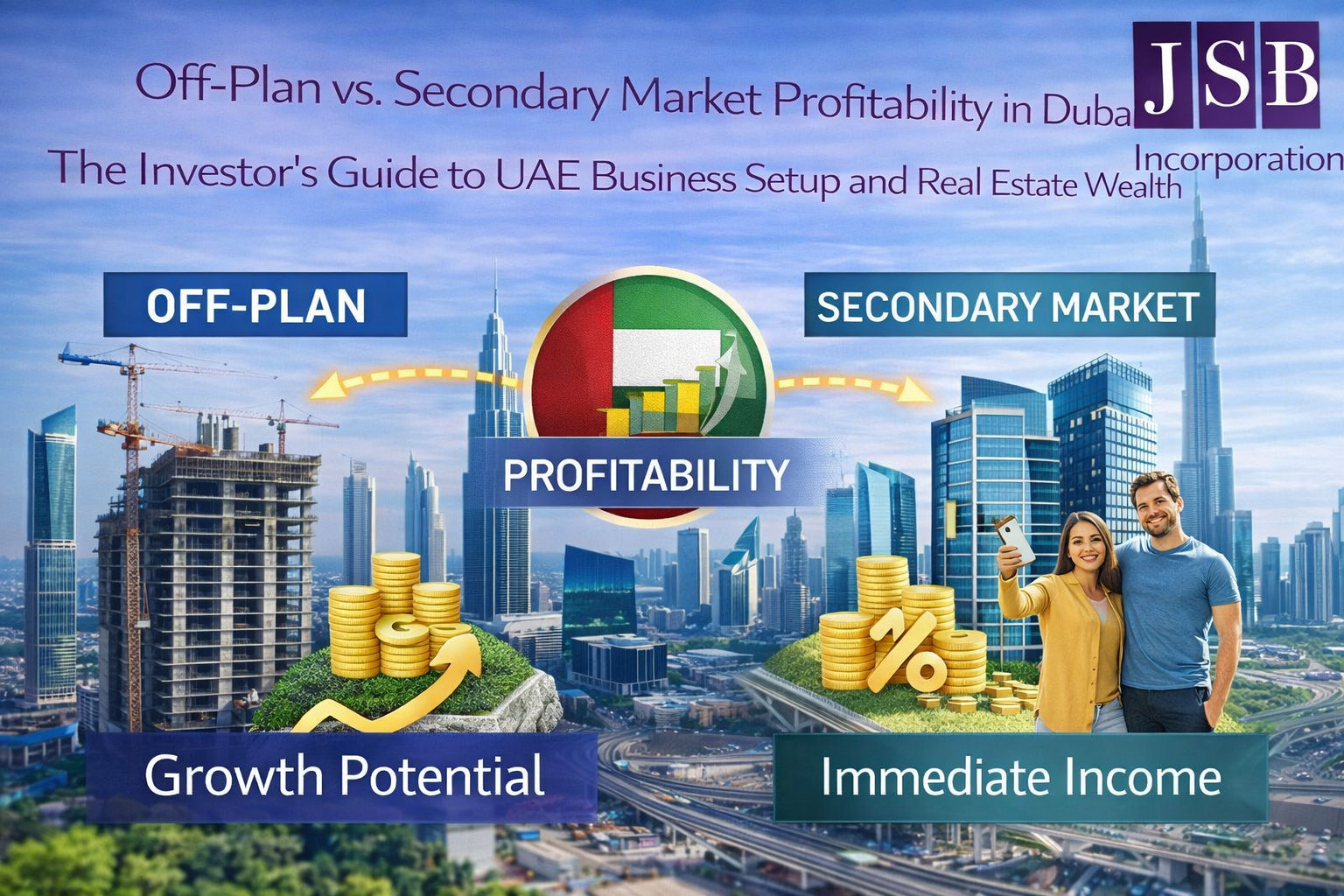
If you’re looking for the biggest capital gains, the off-plan sector is your best tool. You can use leverage to control a 100% asset while only putting in 40% to 50% of the equity yourself.
This is how the pros measure success. While most people only look at the total price, you’ve got to look at your Return on Equity (ROE).
For instance, if you get a 50/50 payment plan for a property worth AED 2,000,000, you’re only paying AED 1,000,000 during the building process. If that property goes up by 20% by the time it’s finished, you’ve made AED 400,000. That’s a 40% return on the money you actually spent.
Developers like Danube have built their market position on 1% monthly plans, while major developers like Emaar favor 80/20 and 60/40 structures. DAMAC offers both—choose the plan that matches your cash flow, not the developer’s marketing.
It keeps the market from being flooded by speculators who can’t afford to hold the properties. You should also look for the “Completion Premium.” Data from areas like Dubai Hills Estate and Emaar Beachfront shows a typical value jump of 15% to 25% from launch to handover. You can see how different payment plans impact your cash flow in the table below.
Payment Plan Structure | Equity Paid During Build | Capital Efficiency | Typical Handover Payment |
50/50 Plan | 50% | Moderate | 50% |
70/30 Plan | 70% | Lower | 30% |
30/70 Plan | 30% | Very High | 70% |
80/20 Plan | 20% | Highest | 80% |
Don’t forget the math of the “Smart Investor.” Let’s look at a luxury project in Downtown Dubai. If you put down 30% equity on a property priced at AED 2,000,000, which is AED 600,000, and the market grows by 15% by completion; the new value is AED 2,300,000.
Your profit of AED 300,000 on an investment of AED 600,000 gives you a 50% ROE. If you’d paid 100% cash, your return would only be 15%. This is the power of making your capital work harder for you by using developer payment plans.
Also Read: How Much Do Real Estate Brokers Earn in Dubai? Commissions, Salary & Income Breakdown (2026)
If you need immediate cash flow to support your business, the secondary market is where you should focus. You can skip the three-year wait for construction and start getting rent right away. Dubai’s average yields of 6.8% to 7% are much better than what you’d see in London or New York.
You can even find much higher returns in specific micro-markets. Discovery Gardens and International City often give you yields in the 7.7% to 9% range. This is ideal if you’re looking for steady monthly income to fund your lifestyle or your new company.
Community | Avg Apartment Gross Yield | Avg Villa Gross Yield |
Jumeirah Village Circle (JVC) | 7.59% | 5.56% |
Discovery Gardens | 7.70% | N/A |
Dubai Investment Park (DIP) | 9.36% | N/A |
Dubai Marina | 6.16% | N/A |
Town Square | 7.72% | 4.95% |
You’ve got to calculate your “Net Yield” to be a truly savvy investor. This means you must subtract service charges, which usually range from AED 15 to AED 28 per square foot in mid-market areas like Business Bay. In luxury towers like the Burj Khalifa, these charges can go up to AED 72 per square foot.
You should use the Mollak system to check for service charge transparency. This government-audited system makes sure you aren’t being overcharged by management companies. It ensures your money is actually being used to keep your property’s value high.
You’re entering a market that is getting smarter every day. Two major legal updates in 2025 now directly work in your favor as a business owner and property investor.
The first is Federal Decree-Law No. 20 of 2025, which brought sweeping amendments to the UAE Commercial Companies Law (CCL), entering into force on October 15, 2025. This is a game-changer for your corporate structure. For the first time, mainland LLCs can issue multiple classes of shares, meaning you can give investors preferred dividends or priority returns while keeping control through high-vote founder shares.
The law also gives statutory recognition to drag-along and tag-along rights, which can now be embedded directly into your company’s Memorandum of Association. This makes your shareholder agreements stronger and enforceable in a UAE court, without relying on side agreements that may not hold up locally.
The second is Dubai Executive Council Resolution No. 11 of 2025, the specific law governing the new dual license framework. Under this resolution, free zone companies—except those in the DIFC — can now apply through the Dubai Department of Economy and Tourism (DET) for one of three official pathways to operate in mainland Dubai: a mainland branch, a dual license that lets you operate on the mainland while remaining registered in your free zone, or a short-term temporary permit for specific activities.
The dual license costs AED 10,000 per year and is renewable annually. This is ideal if you want to bid on government contracts or serve mainland clients directly.
One important note: mainland branch activities are subject to the standard 9% corporate tax, and operating on the mainland can affect your free zone Qualifying Free Zone Person (QFZP) status.
You’ve also got to follow the new Direct Payment Mandate. The Dubai Land Department now requires all property sale proceeds to go into a UAE bank account in the name of the Title Deed holder.
If you’re an overseas seller, you can’t have the money paid to a family member or even a Power of Attorney holder. You’ll need to open a non-resident account. This rule is part of Dubai’s commitment to global anti-money laundering standards. It protects you from fraud, but it means you’ve got to have your documents in perfect order before you sell.
You’ve probably heard talk about a market correction coming in 2027. It’s true that the supply pipeline is large, with over 70,537 units expected. But you shouldn’t fear this supply if you’re strategic.
The risk is mostly in specific areas and property types. Studios and one-bedroom apartments make up about 66% of the new units. If you’re buying these in JVC or Business Bay, you should expect it to take longer to find tenants. You can see the high-supply zones in the table below.
Area | Projected Units (2025-2027) | Risk Level |
Jumeirah Village Circle (JVC) | 16,852 | High Supply |
Business Bay | 10,127 | High Supply |
Dubai South | 9,810 | Moderate |
MBR City | Significant Pipeline | Luxury Bias |
Dubai Residence Complex | 7,802 | Emerging |
You can lower your risk by focusing on villas and townhouses. These types only make up about 14% of the new supply, while demand for family homes is at an all-time high. Villa prices and rents are still doing better than apartments because there just aren’t enough of them.
You should also look at the impact of the Metro Blue Line.
Dubai Creek Harbour will gain a brand-new Blue Line station in 2029, likely generating a fresh metro premium for early buyers. Al Jaddaf, already served by the Green Line, will become a key interchange point between the two lines, potentially amplifying its existing connectivity premium.
Properties near a metro station usually get a 10% to 15% “metro premium” in price and rent.
You’ve got to follow a specific path to make sure your investment and your visa are secure.
The process is faster in 2026, but the government is less patient with mistakes in your paperwork. You’ve got to start by making sure your passport is valid for at least six months and that your name is exactly the same on your Title Deed and your bank account.
You’ve got to choose a property valued at AED 2 million or more to get the Golden Visa. You can even combine a few smaller properties to reach this total. If you’re buying off-plan, you’ll get an “Oqood.”
This is a temporary title deed registered with the Dubai Land Department. This document is your official proof of ownership while the building is being finished.
You’ve got to pay the 4% DLD transfer fee. Even though the law says this can be split, you’ll almost always pay the whole amount yourself. For off-plan projects, this is your Oqood fee. You should also budget for the registration trustee fees. These are AED 4,200 for properties worth more than AED 500,000.
You’ll submit your visa application through the Dubai REST app. Final residency stamping and Emirates ID issuance are processed through the General Directorate of Residency and Foreigners Affairs Dubai (GDRFA) or via the ICP Smart App.
You’ll need your Oqood or Title Deed, a police clearance certificate, and a medical fitness report. If you have a mortgage, you’ll need a No Objection Certificate (NOC) from your bank confirming you’ve met the AED 2 million threshold.
Required Document | Purpose | Authority |
Title Deed / Oqood | Proof of Ownership | DLD |
Valuation Certificate | Verify AED 2M Value | DLD Valuer |
Health Insurance | Medical Compliance | Approved Provider |
Police Clearance | Security Background | Dubai Police |
Bank NOC | Mortgage Approval | Your Bank |
1. Can I get a Golden Visa with a mortgaged property in 2026?
Yes, you certainly can. The old rule requiring you to have 50% of the property paid off is gone. As long as the total value is AED 2 million or more, you’re eligible. You just need a letter from your bank confirming the amount you’ve paid and that they don’t object to your visa.
2. What exactly is the “Oqood” fee?
The Oqood fee is just the 4% DLD registration fee for off-plan properties. It’s not an extra cost. It pays for the registration of your ownership while the building is under construction. It turns into a final Title Deed for free once the project is done.
3. Is off-plan or secondary better for my ROI in 2026?
It depends on what you need. Off-plan gives you higher capital gains, usually between 15% and 30% by the time you get the keys. Secondary property gives you cash in your pocket right away, with yields typically from 6% to 9%. If you want to build wealth fast, go off-plan. If you need income to run your business, the secondary market is your winner.
4. How do the 2026 VAT changes affect my commercial units?
Commercial property sales have a 5% VAT. The new laws mean you only have a five-year window to reclaim any excess refundable tax. You’ve got to make sure your tax records are perfect and submitted on time, or you might lose that money.
5. Should I be worried about too many apartments in 2027?
The supply is high in JVC and Business Bay, especially for studios and 1-bedroom units. But villas and townhouses are still in short supply. Smart investors are moving toward family communities and areas near the new Metro Blue Line to avoid the competition.
You’ve seen the data, and you’ve seen how the market is changing. Dubai isn’t a place for casual speculation anymore. It’s a place for serious entrepreneurs who know that real estate and business setup go hand in hand.
You can try to figure out these complex 2026 rules alone, or you can partner with someone who knows every detail of the new mandates.
At JSB Incorporation, we don’t just help you start a company; we help you build a legacy. You deserve a partner who can connect your residency, your corporate governance, and your property wealth.
The move toward a mature, demographic-driven economy means your chance to build long-term wealth has never been better. You can secure your 10-year residency, protect your business with the new Commercial Companies Law, and get some of the highest yields in the world.
Your next step is to make sure your setup is optimized for the 2027 cycle.
Book your free consultation call today with the experts of JSB Incorporation to learn more.

Office 2505, 25th Floor, Regal Tower, Business Bay, Dubai, UAE P.O Box 27614.
+971 4 824 4842
info@jsbincorporation.com