
Key Highlights:
The UAE Golden Visa program has transformed into one of the most successful long-term residency initiatives in the world since its launch in 2019.
What began as a strategic tool to attract global talent and investment has evolved into a cornerstone of the UAE’s economic diversification strategy, offering 10-year renewable residency permits to exceptional individuals across various sectors.
Understanding the statistics and trends behind this program matters now more than ever. For professionals, investors, and families considering the UAE as their long-term home, these numbers reveal patterns of opportunity, growth, and policy evolution that directly impact application strategies and success rates.
Read on to learn more.
The numbers tell a remarkable story of exponential growth that has exceeded all initial projections.
1. Annual Visa Issuance Trends
2019-2022: A total of 151,666 visas were issued in Dubai alone, establishing the foundation for what would become unprecedented growth.
2021: The program gained significant momentum with 47,150 visas issued, demonstrating early success despite global challenges.
2022: Issuance numbers increased substantially to 79,617 visas, reflecting growing international awareness and confidence in the program.
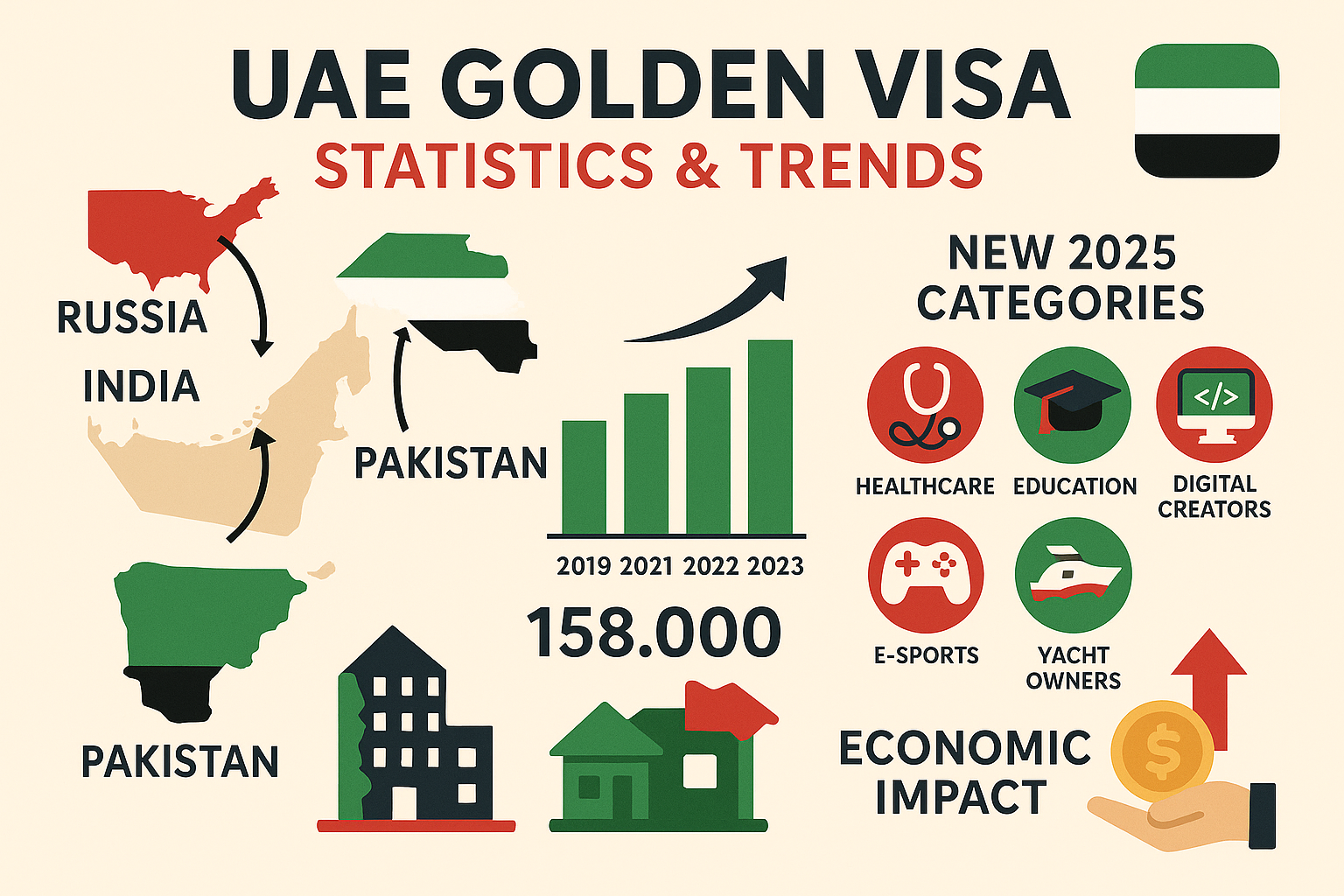
2023: The program experienced explosive growth with 158,000 visas issued—nearly doubling 2022 figures and more than tripling 2021 numbers. This surge represents one of the most dramatic increases in any residency program globally.
2. Institutional Growth Metrics
The General Directorate of Residency and Foreigners Affairs (GDRFA) reported a 43% increase in overall transactions between 2020 and 2021, indicating systematic expansion beyond just Golden Visa processing.
By 2023, GDRFA processed over 19 million total transactions, with more than 60 million travelers passing through Dubai’s ports.
1. Policy Changes Creating Impact
2024 Breakthrough: The removal of the AED 1 million minimum down payment requirement for real estate investors marked a watershed moment.
Previously, property buyers needed to pay at least 50% of their property’s value upfront to qualify for the Golden Visa through real estate investment. This change opened doors for mortgage-financed property purchases, significantly expanding the eligible applicant pool.
2025 Program Expansion: The introduction of five new categories demonstrates the UAE’s commitment to diversifying its talent pool:
2. Economic and Geopolitical Catalysts
The program’s growth has been significantly influenced by global events and economic shifts.
Russian property investment in Dubai surged following the 2022 geopolitical developments, with an estimated $6.3 billion in real estate purchases—representing a tenfold increase compared to pre-2022 levels. This influx contributed substantially to the 2023 visa surge.
High-net-worth individual migration has also accelerated, with approximately 4,500 HNWIs relocating to the UAE in 2023. The UAE is projected to attract 6,700 HNWIs in 2024, maintaining its position as the global leader in millionaire migration.
Also Read: UAE Golden Visa Denied? Common Property Investment Mistakes to Avoid
1. Leading Nationalities
Russian Nationals: Following 2022 geopolitical events, Russians have become among the largest groups of Golden Visa recipients, driven primarily by luxury real estate investments. Their market share in Dubai’s luxury property segment is expected to exceed 30% in 2025.
Indian Community: Indians represent the largest expatriate population in the UAE (nearly 30% of all expatriates) and continue to secure significant numbers of Golden Visas. High-profile recipients include Bollywood superstars Shah Rukh Khan, Sanjay Dutt, and, most recently, Rajinikanth.
Pakistani Applicants: The Pakistani community, representing another major expatriate group, has shown consistent interest in the program.
2. Sectoral Distribution
The program spans multiple categories, each with distinct growth patterns:
Real Estate Investors: This remains the largest category, requiring a minimum AED 2 million property investment. The removal of down payment requirements has made this route more accessible to international buyers using mortgage financing.
Entrepreneurs and Business Leaders: Including company founders, CEOs, and significant shareholders, contribute to the UAE’s economic development.
Healthcare Professionals: Beyond the new nursing category, doctors and medical specialists earning over AED 30,000 monthly with UAE experience continue to qualify.
Outstanding Students and Graduates: High-achieving individuals in science, technology, and research fields.
The five new categories introduced in 2025 represent the most significant expansion since the program’s inception. Early indicators suggest substantial interest across all new categories.
1. Healthcare Expansion
The nursing category specifically targets professionals with 15+ years of Dubai Health Authority service, recognizing their critical role during the pandemic and ongoing healthcare development. This category allows family sponsorship and provides 10-year renewable residency.
2. Creative Industries Focus
The content creator category, launched through the Creators HQ initiative, aims to attract 10,000 professionals in digital media, filmmaking, and social media. This aligns with Dubai’s goal of becoming a global creative hub and capitalizing on the $1.8 billion gaming industry.
3. Maritime Sector Development
The luxury yacht category, particularly through Abu Dhabi’s Golden Quay program, targets ultra-high-net-worth individuals and maritime industry executives. While entry costs are substantial (requiring 40+ meter yachts worth approximately $12-15 million), this category strengthens the UAE’s position as a luxury destination.
1. Economic Impact
The correlation between Golden Visa issuance and economic indicators is striking. Real estate transactions have surged alongside visa approvals, with luxury property values increasing 9.2% in Q1 2025 alone.
Foreign direct investment flows have similarly benefited from the stability and confidence the program provides to international investors.
The program contributes to GDP growth projections of 5.1% for 2025, supporting the UAE’s economic diversification beyond oil dependency.
2. Social and Workforce Evolution
The expansion into new professional categories is strategically reshaping the UAE’s talent landscape. Healthcare improvements, educational excellence, and creative industry development directly result from attracting specialized professionals through the Golden Visa program.
The program’s family-friendly provisions (spousal and children sponsorship) support long-term community development rather than temporary workforce solutions.
Also Read: How Long Do You Need to Hold Property for a Golden Visa?
1. How many Golden Visas are issued annually?
Issuance has grown from 47,150 in 2021 to 158,000 in 2023, with continued growth expected through 2025.
2. Which nationalities receive the most Golden Visas?
Russians, Indians, and Pakistanis represent the largest recipient groups, though exact breakdowns by nationality aren’t publicly disclosed by GDRFA.
3. What drives the most applications?
Real estate investment remains the primary pathway, accounting for the majority of approvals. The 2024 removal of minimum down payment requirements significantly increased accessibility.
4. How do 2025 policy changes affect numbers?
The five new categories are expected to diversify the applicant pool significantly, with healthcare and creative industries showing early strong interest.
5. What are future projections?
Based on current trends and policy expansions, annual issuance could exceed 200,000 visas by 2026, though official projections aren’t published.
6. How does the UAE compare to similar programs?
The UAE Golden Visa has become the largest program in the MENA region and rivals European programs in terms of annual approvals while offering unique benefits like tax advantages and family sponsorship.
The UAE Golden Visa program has evolved from an experimental initiative into a global benchmark for residence-by-investment programs. The statistics reveal a trajectory of sustained growth, strategic policy adaptation, and expanding demographic reach.
From 47,150 visas in 2021 to 158,000 in 2023, the program has consistently exceeded expectations while maintaining quality standards and contributing meaningfully to the UAE’s economic objectives. The 2025 expansion into healthcare, education, creative industries, e-sports, and maritime sectors signals continued evolution to meet changing global talent needs.
For professionals and investors considering this pathway, the data suggests optimal timing. Policy changes have made the program more accessible, while the UAE’s economic stability and strategic global position continue attracting international talent. The program’s success reflects not just numerical growth, but the UAE’s commitment to building a knowledge-based economy supported by global expertise.
Book your free consultation call today with the experts of JSB Incorporation to learn more about securing your UAE Golden Visa.
Note: Statistics and policies are subject to change. Always verify current requirements and costs with official UAE government sources before making investment or application decisions, as these can evolve based on economic conditions and policy updates.

Office 2505, 25th Floor, Regal Tower, Business Bay, Dubai, UAE P.O Box 27614.
+971 4 824 4842
info@jsbincorporation.com
