
 Gaurav Keswani
Key Highlights
The UAE has committed AED 150 to 200 billion in clean energy investments by 2030. It was the first country in the Middle East to commit to Net Zero by 2050.
Solar tariffs at the Mohammed bin Rashid Al Maktoum Solar Park hit a world-record low of $0.016953 per kWh. And by December 2025, the UAE’s Ministry of Energy projected clean energy capacity could exceed 22 GW by 2031, ahead of its own targets.
The opportunities are real. But they’re concentrated in specific sub-sectors. This guide maps exactly where they are, how you enter legally, and what the genuine challenges look like on the ground.
Disclaimer: All figures related to UAE Energy Strategy targets, corporate tax rates, free zone QFZP eligibility, license fees, and regulatory approval requirements are subject to change. Verify all critical business and compliance information against official UAE government sources, the Federal Tax Authority, the Ministry of Energy and Infrastructure, and the relevant free zone authority portals before making investment or business setup decisions.
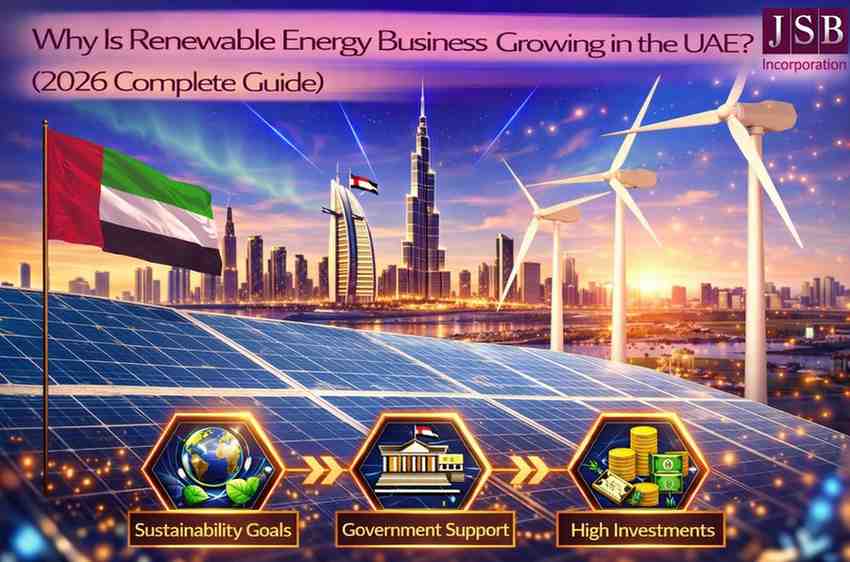
The UAE’s clean energy market in 2026 is driven by three forces working at the same time: legally binding government targets creating direct procurement demand, record-low solar costs making projects commercially viable without subsidies, and a new wave of AI data center expansion pushing electricity demand beyond what original forecasts predicted.
The UAE Energy Strategy 2050, updated in July 2023, targets installed clean energy capacity growing from 14.2 GW to 19.8 GW by 2030. That’s not a projection. It’s a binding government commitment that requires contractors, equipment suppliers, grid technology companies, and maintenance providers to make it happen.
The AI data center signal changed the timeline further. By December 2025, the UAE’s Ministry of Energy projected clean energy capacity could exceed 22 GW by 2031, partly because AI infrastructure needs a massive, reliable power supply.
Large corporates are now actively looking for power purchase agreements with renewable providers, and that creates direct demand for solar businesses, storage integrators, and energy management companies.
The UAE has also committed AED 150 to 200 billion in clean energy investments by 2030, the largest single energy investment commitment in UAE history. When a government backs that scale with legally binding targets, the supply chain opportunity for private businesses is enormous.
The UAE’s clean energy policies directly create procurement categories for private businesses. The UAE Energy Strategy 2050 targets 19.8 GW of installed clean energy capacity by 2030, with 30% of the total energy mix from clean sources. Here’s what each major target creates commercially:
Target | 2030 Goal | Commercial Opportunity for You |
Installed clean energy capacity | 19.8 GW (from 14.2 GW) | EPC contracts, equipment supply, operations and maintenance |
Clean energy share of energy mix | 30% | Grid-scale solar and storage projects |
Energy efficiency improvement | 42-45% vs. 2019 baseline | Retrofit, energy auditing, and ESCO markets |
New green jobs | 50,000 | Workforce training and staffing services |
Mobilized clean energy investments | AED 150-200 billion | Finance, advisory, and infrastructure services |
Grid emission factor | 0.27 kg CO₂/kWh | Decarbonization advisory and carbon services |
Dubai’s Clean Energy Strategy 2050 targets 75% of its energy from clean sources by 2050. Two of its initiatives create open commercial markets right now.
The Shams Dubai Initiative lets any building owner or business connect rooftop solar to DEWA’s grid and sell surplus power back, with no large government project clearance needed.
The Mohammed bin Rashid Al Maktoum Solar Park targets 5,000 MW by 2030 with AED 50 billion in total investment, generating supply chain demand for equipment suppliers, maintenance providers, and project consultants.
The Dubai Green Fund provides soft loans at reduced interest rates for clean energy investors in Dubai.
The UAE Net Zero 2050 Strategy covers 6 sectors through 25+ programs and is expected to create 200,000 job opportunities across solar, battery storage, and hydrogen sub-sectors, contributing roughly 3% to national GDP. Each program is a potential contracting opportunity for your business.
The UAE’s renewable energy sector has accessible entry points in five subsectors: solar installation, energy efficiency services, battery storage integration, green hydrogen supply chain, and clean technology consulting. Your right entry point depends on your company size and whether you need direct government contract access.
Yes. Solar is the most accessible sub-sector for foreign entrepreneurs right now. Here’s how a smaller company enters this market. A European solar installation firm sets up under the Shams Dubai initiative, selling rooftop solar design, installation, and grid connection services to commercial building owners in Dubai.
They’re not competing for DEWA megaprojects. They’re selling directly to businesses that want to cut electricity costs and earn money from surplus power sent back to the grid. That’s a commercially open market today with no government project clearance required.
The UAE has one of the world’s highest solar irradiation rates, meaning solar systems perform near their rated capacity more days per year than almost anywhere else.
Phase 5 of the Mohammed bin Rashid Al Maktoum Solar Park confirmed commercial viability at scale with a world-record low bid of $0.016953 per kWh. For actual payback period data for your system size and DEWA tariff tier, check DEWA’s published Shams Dubai portal directly before committing capital.
Green hydrogen infrastructure in the UAE is under active construction, but revenue at scale is a 2028 to 2031 story. Masdar’s green hydrogen electrolyzer project at Al Ruwais in Abu Dhabi is the country’s flagship domestic development and is currently being built.
Real 2026 business opportunities are in the project development supply chain: technology consulting, electrolyzer component supply, engineering services, and compliance advisory.
If you build specialist positioning now, you’re set up for the market that monetizes in three to five years. Trying to enter as a revenue-generating hydrogen producer in 2026 is too early for the domestic infrastructure.
The UAE Net Zero 2050 Strategy identifies buildings as one of its six core compliance sectors, and the Energy Strategy 2050 mandates a 42 to 45% improvement in energy consumption efficiency versus 2019.
That’s a legal mandate, not an aspiration, creating real retrofit demand across commercial and residential stock. Viable business models include energy auditing firms, building retrofit contractors, smart building technology providers, and Energy Service Company (ESCO) structures.
Battery Energy Storage Systems are becoming a structural necessity as UAE’s grid turns more solar-heavy. In October 2025, Masdar and EWEC broke ground on the world’s first gigascale round-the-clock renewable energy project in Abu Dhabi, integrating a 5.2 GW solar plant with a 19 GWh battery energy storage system, the largest BESS of its kind in the world.
This scale of BESS deployment creates direct demand for technology integrators, component suppliers, and engineering service providers entering the UAE market now.
Masdar City Free Zone in Abu Dhabi is the dedicated clean tech ecosystem, hosting over 1,000 organizations, including IRENA’s global headquarters and Siemens Energy. The Catalyst accelerator, a joint venture between Masdar and BP, gives cleantech startups fast-track entry into this community through funding, training, and mentorship.
Also Read: Why Logistics and Trading Businesses Thrive in Dubai: The 2026 Guide for Global Entrepreneurs
The UAE combines four advantages most markets don’t offer together: 100% foreign ownership, AED 150 to 200 billion in committed clean energy investment, a legal framework updated as recently as October 2025, and access to the world’s fastest-growing clean energy import markets.
Yes. 100% foreign ownership is available in all UAE free zones and on the mainland for most sectors, following the Commercial Companies Law reforms. In October 2025, Federal Decree-Law No. 20 of 2025 updated the CCL with four provisions directly relevant to energy investors:
The UAE’s 9% corporate tax has been in effect since June 2023. It’s no longer a zero-tax market by default, and that needs to be in your business plan before you choose a jurisdiction. Free zone businesses that meet Qualifying Free Zone Person (QFZP) conditions pay 0% on qualifying income, but those conditions require proper legal structuring upfront.
Federal Decree-Laws No. 16 and No. 17 of 2025 amended the UAE VAT Law and Tax Procedures Law, both effective January 1, 2026. These changes directly affect any renewable energy company launching this year:
Change | What You Need to Do |
5-year limit on VAT refund claims | Identify outstanding credit balances and submit eligible refund requests promptly |
FTA may deny input tax if supply is linked to evasion | Strengthen supplier checks before claiming input tax |
Self-invoice no longer required for reverse charge | Update records to store supporting documents per Executive Regulation |
FTA can issue binding directions on tax law | Monitor FTA guidance and update internal compliance accordingly |
Post-limitation audits permitted in refund-linked cases | Keep all audit evidence beyond the ordinary limitation period |
Disclaimer: Corporate tax rates, QFZP qualifying income conditions, and VAT compliance requirements are subject to change. Verify all tax-related decisions against Federal Tax Authority guidance and UAE Ministry of Finance publications before making any business or investment decisions.
Setting up a renewable energy company in the UAE takes 2 to 8 weeks depending on your jurisdiction, license type, and the regulatory approvals your project requires. Here are the four steps.
Step 1: Free Zone or Mainland? Your jurisdiction choice determines what contracts you can bid on and what tax rate applies:
Factor | Free Zone | Mainland |
Foreign ownership | 100% | 100% (post-2021 CCL reform) |
Government/DEWA/EWEC tenders | Generally restricted | Fully eligible |
Corporate tax | 0% on qualifying income (QFZP) | 9% standard rate |
Mainland branch (2025 CCL) | Now permitted | N/A |
Best suited for | R&D, consulting, manufacturing, startups | Government tenders, EPC, grid projects |
Step 2: Which Free Zone? Masdar City Free Zone in Abu Dhabi is the primary recommendation for clean energy businesses. It’s UAE’s only dedicated cleantech and sustainability free zone, hosting IRENA’s global headquarters and over 1,000 organizations. For Dubai-focused businesses, multiple Dubai free zones offer alternatives depending on your activity. Confirm current activity lists and fee structures with the authority before applying.
Step 3: What License Do You Need? Three license categories apply:
Step 4: What Regulatory Approvals Does Your Project Need?
Grid-connected renewable projects in the UAE require approvals from the electricity authority responsible for your emirate. Here’s the correct breakdown by location:
Managing approvals from multiple bodies takes time. Build regulatory advisory support into your plan from day one.
Also Read: What Is the Best Import-Export Business in UAE? (Complete Guide 2026)
Q1: What is UAE’s renewable energy capacity target by 2030?
UAE Energy Strategy 2050 targets installed clean energy capacity of 19.8 GW by 2030, up from 14.2 GW, with clean energy at 30% of the total energy mix. The Ministry of Energy projected capacity could exceed 22 GW by 2031 due to AI data center demand growth.
Q2: Can a foreign investor own 100% of a renewable energy company in the UAE?
Yes. 100% foreign ownership is available in all UAE free zones and on the mainland for most sectors, following CCL reforms under Federal Decree-Law No. 32 of 2021, updated by Federal Decree-Law No. 20 of 2025.
Q3: What is the best free zone to start a clean energy company in the UAE?
Masdar City Free Zone in Abu Dhabi is UAE’s only dedicated cleantech free zone, hosting IRENA’s global headquarters and over 1,000 clean energy organizations. For Dubai-focused businesses, multiple Dubai free zones offer alternatives depending on your specific activity.
Q4: Does UAE’s 9% corporate tax apply to renewable energy companies?
Free zone businesses meeting QFZP conditions pay 0% on qualifying income. Mainland businesses pay the standard 9%. Federal Decree-Laws No. 16 and No. 17 of 2025 introduced additional compliance requirements effective January 1, 2026.
Q5: Is green hydrogen a real business opportunity in the UAE in 2026?
Yes, but revenue at scale arrives in 2028 to 2031. The Al Ruwais electrolyzer project is under active construction. Real 2026 opportunities are in the supply chain: technology consulting, engineering services, and component supply.
Q6: What is the Dubai Green Fund and can private businesses access it?
The Dubai Green Fund provides soft loans at reduced interest rates for clean energy investors and projects in Dubai.
Q7: What approvals does a solar energy company need in Dubai?
You need a trade license (from Masdar City, a Dubai free zone, or DED for the mainland); DEWA approval for grid-connected projects under Shams Dubai; and MOCCAE clearance depending on project scale.
Q8: Are solar panels financially viable for businesses in the UAE?
The UAE has one of the world’s highest solar irradiation rates. Phase 5 of the Mohammed bin Rashid Al Maktoum Solar Park confirmed commercial viability with a world-record low bid of $0.016953 per kWh. Check DEWA’s Shams Dubai portal for project-specific payback data before committing capital.
Q9: What renewable energy businesses work best for SMEs in the UAE?
Solar EPC and installation via Shams Dubai, energy auditing, energy efficiency consulting, BESS integration, and AI-powered energy management don’t require large-scale government project access. These are the right starting points for SMEs and startups today.
Q10: What does UAE’s Net Zero 2050 target mean for businesses?
The UAE commits to net zero greenhouse gas emissions by 2050, covering 6 sectors through 25+ programs. Businesses in buildings, industry, and transport face mandatory clean energy compliance requirements, creating sustained long-term demand for renewable energy services.
The UAE’s renewable energy sector has AED 150 to 200 billion in committed government investment by 2030, legally binding capacity targets of 19.8 GW, and a January 2026 regulatory framework that gives companies launching today the clearest compliance foundation this market has ever had. The window to get your company set up, secure the right license, and position ahead of the 2030 buildout is open right now.
Getting your jurisdiction, license type, and corporate tax position right from the start is what separates businesses that scale from ones that stall. JSB Incorporation helps foreign entrepreneurs set up renewable energy companies, cleantech startups, and energy consultancies across 24+ UAE jurisdictions, including Masdar City Free Zone, Dubai free zones, and the mainland.
Book your free consultation call today with the experts of JSB Incorporation to learn more

Office 2505, 25th Floor, Regal Tower, Business Bay, Dubai, UAE P.O Box 27614.
+971 4 824 4842
info@jsbincorporation.com