
 Gaurav Keswani
Key Highlights
You just got off a call with a potential enterprise client. The demo went perfectly. They loved the product. Then their legal team sends one email: “We need to confirm your entity’s regulatory standing before we proceed.” You’re incorporated in a country where virtual asset businesses sit in a gray zone.
There’s no dedicated regulator, no clear framework, and no straight answer you can give them. You’ve been putting off the Dubai decision for six months because you think it’s expensive or complicated.
Meanwhile, three founders in your network set up there, got their licences in weeks, and are now closing deals you’re losing because your jurisdiction doesn’t inspire confidence. You don’t need a year and a law firm to figure this out. You need the right steps, the right regulator, and the right costs.
This guide gives you all three. Keep reading it.
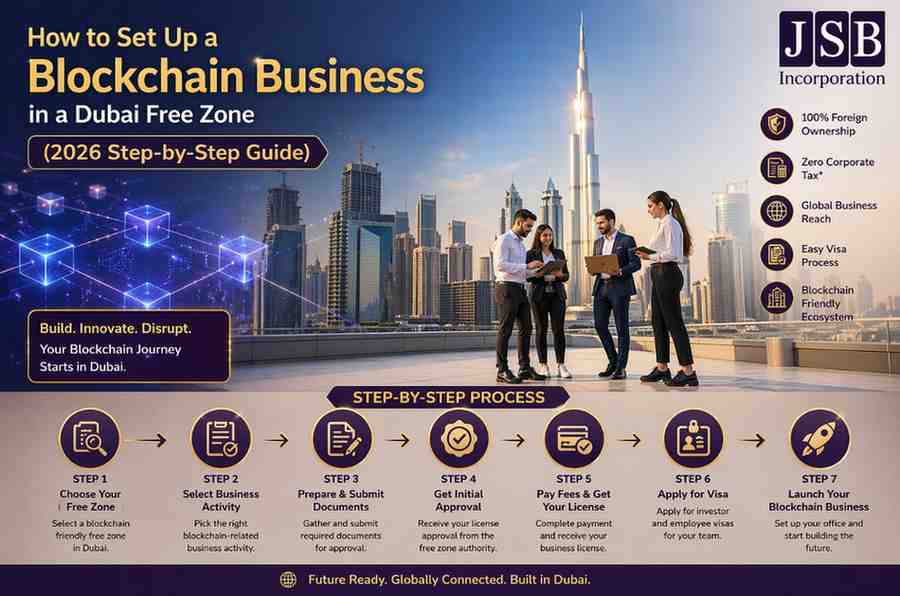
Dubai free zones give you 100% foreign ownership, 0% corporate tax on qualifying income, and full freedom to move your capital internationally, all under a government-backed structure with ready-built infrastructure.
Here’s exactly what the UAE government confirms you’re entitled to as a free zone company owner:
Your free zone company runs under its own free zone authority’s rules, not under federal commercial law. That gives you more governance flexibility and a cleaner regulatory structure than a mainland setup, which matters when you’re dealing with institutional clients or investors.
This is the single most important question you’ll answer before you register anything. Founders confuse DLT software businesses with virtual asset service providers all the time, and getting it wrong means either wasting money on compliance you don’t need or running an unauthorized operation that puts your entire licence at risk.
Here’s how to tell the difference:
A standard free zone tech, professional, or consultancy licence is enough if you only build blockchain software, develop DLT infrastructure, provide tech consulting, or offer services to other businesses using distributed ledger technology. You don’t handle, exchange, transfer, or have custody of virtual assets on behalf of clients.
A VARA VASP licence is mandatory if your business carries out any of these eight activities anywhere in Dubai, including all free zones except DIFC:
Law No. 4 of 2022 covers all of Dubai, including every special development zone and free zone, but not DIFC. If you run any of the above without authorization, you’re exposed to administrative penalties under Cabinet Resolution No. 99 of 2024, including a fine of AED 100,000 for a first violation and AED 200,000 plus suspension of activity for a second violation.
Cabinet Resolution No. 83 of 2025 sets the fees that the Securities and Commodities Authority (SCA) collects for VASP registration, licensing, and renewal services across the UAE. DIFC has its own regulator, the Dubai Financial Services Authority (DFSA), and sits entirely outside VARA’s scope.
You can set up a blockchain company in a Dubai free zone in 11 steps, from confirming your activity type to opening your corporate bank account. Here’s the full sequence in order.
Item | Cost (AED) |
Zero Visa Licence (1-year) | 11,900 |
1-Visa Licence (includes 1 free-for-life residence visa) | 14,900 |
2-Visa Licence (includes 1 free-for-life residence visa) | 16,900 |
3-Visa Licence (includes 1 free-for-life residence visa) | 18,900 |
4-Visa Licence and above (includes 1 free-for-life residence visa) | 20,900 |
Establishment Card, initial application | 2,000 |
UAE Residence Visa (2-year validity) | 3,750 per person |
Extra activity beyond 3 included, up to 7 maximum | 1,000 each |
Cross-business activity fee (April 2026 promo) | Waived |
Amendment fee (April 2026 promo) | Waived for licence lifetime |
FlexiDesk, Year 1 | Free |
2-year licence discount | 15% off |
3-year licence discount | 20% off |
5-year licence discount | 30% off |
Disclaimer: All IFZA pricing above is sourced directly from the official IFZA April 2026 promotional pricelist and IFZA Schedule of Fees, Revision 0201, February 2026.
The free-for-life residence visa is valid only upon continuous renewal of the business licence package, as per IFZA’s promotional terms and conditions. IFZA reserves the right to amend pricing without prior notice. Verify all current costs directly with IFZA or through your registered agent before making any financial commitment.
If your blockchain business involves any of the eight licensed virtual asset activities listed above, you need to complete both VARA licensing stages before you can legally serve a single client. You can’t skip Stage 1 to get to Stage 2, and Stage 1 alone doesn’t give you permission to start operating.
Stage 1: Approval to Incorporate (ATI)
Stage 2: Full VASP Licence
Each of the eight VA activity categories has its own set of compliance rules.
On top of that, every licensed VASP in Dubai must follow four rulebooks that apply across the board: the Company Rulebook, Compliance and Risk Management Rulebook, Technology and Information Rulebook, and Market Conduct Rulebook.
VARA is linked to the Dubai World Trade Centre Authority (DWTCA) and works alongside the Central Bank of the UAE and the Securities and Commodities Authority (SCA) in its oversight role.
Q1: Do I need a VARA licence for every blockchain business in a Dubai free zone?
No. You only need a VARA licence if you conduct one of VARA’s eight licensed virtual asset activities, such as exchange, custody, advisory, lending, or token issuance. If you’re building blockchain software or providing DLT consulting, a standard free zone tech or consultancy licence is enough.
Q2: Can a foreigner own 100% of a blockchain company in a Dubai free zone?
Yes. UAE free zones allow up to 100% foreign ownership with no local UAE partner or sponsor required, as confirmed by the official UAE government free zone guide.
Q3: What is the cheapest free zone for a blockchain tech startup in Dubai?
Among commonly used free zones for tech startups, IFZA at Dubai Silicon Oasis offers a Zero Visa Licence from AED 11,900 under 2026 pricing, with a free FlexiDesk in Year 1 and the amendment fee waived for the lifetime of your licence, and the cross-business activity fee waived under the current April 2026 promotion.
Q4: What is the difference between an ATI and a full VASP licence from VARA?
The ATI is Stage 1 of the VARA process. It lets you form your legal entity and set up operations but doesn’t authorize you to start any virtual asset activity. The full VASP licence (Stage 2) is what you need before you can legally serve clients or process transactions.
Q5: Which Dubai free zones are excluded from VARA’s jurisdiction?
DIFC is the only Dubai free zone outside VARA’s jurisdiction. It operates under the Dubai Financial Services Authority (DFSA) under a separate regulatory framework.
Q6: What are the penalties for operating a virtual asset business in Dubai without a VARA licence?
Cabinet Resolution No. 99 of 2024 sets out administrative penalties for operating virtual asset activities without authorization: a fine of AED 100,000 for a first violation and AED 200,000 plus suspension of activity for a second violation. Operating without a VARA licence isn’t a technicality. It’s a sanctionable offense.
You now have every step, every cost, and every regulatory requirement you need for 2026.
The framework is clear. What separates founders who get through this in weeks from those who spend months going in circles is knowing which free zone fits their visa and activity needs, how to prepare VARA documentation so it isn’t sent back for revisions, and how to present their company to UAE banks from day one.
JSB Incorporation works with founders across 24+ UAE free zone jurisdictions and handles your end-to-end setup.
Your setup is completed in weeks, not months, with every stage managed so nothing stalls.
Book your free consultation call today with the experts of JSB Incorporation to learn more

Office 2505, 25th Floor, Regal Tower, Business Bay, Dubai, UAE P.O Box 27614.
+971 4 824 4842
info@jsbincorporation.com