
 Gaurav Keswani
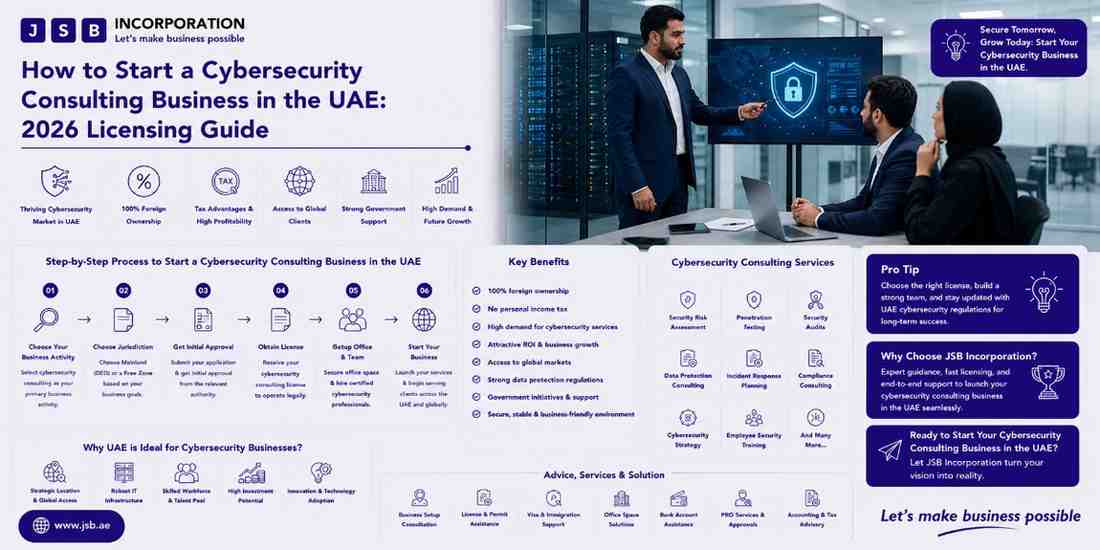
Quick Answer
Demand for cybersecurity services in the UAE is widely reported across industry channels.
Dubai’s government has built dedicated licensing categories for cybersecurity firms well ahead of most jurisdictions in the region.
That groundwork matters more than any growth statistic. A market only becomes a business opportunity once you can legally register, bill, and staff a company in it. The real question isn’t whether demand exists. It’s what it actually takes to operate legally.
Gaurav Keswani, Founder of JSB Incorporation, addressed this shift directly on Talk 100.3 FM: “Before COVID, opening a business license in Dubai required a minimum of one week of personal time investment. Today, the process has been streamlined to just a few steps, sometimes completed on the same day.”
That shift applies to cybersecurity consultancies just as it does to any other professional services firm, provided you pick the correct activity from the start.
Keep reading the article to learn more.
Cybersecurity consulting is licensed under a professional or consultancy activity, and it’s treated differently from a general IT licence because it involves advisory work on risk, compliance, and security architecture rather than software development or hardware sales.
Getting the activity wrong at the registration stage can limit what you’re legally allowed to invoice for later.
Dubai’s Electronic Security Center (DESC) has developed a dedicated batch of trade licence activities for cybersecurity firms in collaboration with the Department of Economy and Tourism.
The categories DESC has confirmed include the following:
The exact activity code attached to each of these names varies by emirate and by free zone.
Confirm your specific code with the licensing authority before you file. Matching your actual service line to the correct activity is what keeps your licence from boxing you out of work you plan to do later.
“What a fabulous service by Gaurav. He literally solved our problems for opening a company in the UAE. Has a professional team to assist. Amazing customer service. High recommended for company formation. He also assisted us with banking services. Thank you once again.” Dhaval Shah, Google Reviews.
Free zone registration generally suits export-facing, SME, and GRC advisory consultancies. Mainland registration suits firms pursuing UAE government or critical-infrastructure clients, where local presence carries more weight.
Neither option is universally better, and the right choice depends entirely on who you plan to bill.
Founders comparing options often start with an IFZA company formation review or a RAKEZ business setup guide, since both free zones commonly issue professional and consultancy licences.
The UAE’s amended Commercial Companies Law abolished the requirement for a majority Emirati shareholder on many mainland activities, according to the UAE’s official government portal. Foreign investors can now fully own onshore companies established in the UAE for eligible activities.
That single change removed the biggest historical reason founders defaulted to free zones.
Jurisdiction | Typical Client Base | Approval or Clearance Needs | Ownership | Best For |
Free zone | Export clients, SMEs, international GRC and advisory work | Standard trade licence approval; activity-specific approvals still apply | Up to 100% foreign ownership | Advisory-first consultancies without government contracts |
Mainland | UAE government, semi-government, and critical-infrastructure clients | Standard DET registration; sector-specific clearance may apply for regulated engagements | Up to 100% foreign ownership on eligible activities | Firms targeting local enterprise or public-sector work |
Costs and regulations are subject to change. Confirm current figures with the relevant UAE government authority or with JSB before making decisions.
Once you know your client base, the jurisdiction choice tends to answer itself. What’s harder to self-assess is whether your specific service line, especially anything touching penetration testing or government infrastructure, triggers an extra approval layer.
Government-linked cloud hosting and security operations center (SOC) work in Dubai falls under mandatory DESC certification, while general GRC and advisory consulting typically doesn’t. This distinction comes directly from DESC’s published certification framework.
DESC’s Cloud Service Provider (CSP) Security Standard is mandatory for any CSP that wants to offer cloud services to Dubai government and semi-government entities, with compliance demonstrated through a certification process aligned with ISO/IEC 27001 principles.
Separately, DESC’s Security Operations Centre (SOC) Security Standard is mandatory for any SOC provider, whether in-house or outsourced, serving those same government and semi-government clients.
Use this checklist to see where your service line stands:
This is a fast-moving regulatory area, and requirements can be updated without much notice. Confirm your specific obligation directly with DESC or a licensing consultant before committing to a service scope.
“We have been working very closely with the JSB Team right from inception of our company, visa processing and all compliance related work. They have been amazing. Very responsive, prompt and dependable. It has been pleasure working with the efficient team like Gaurav, Meenakshi and entire team. Keep up the great support and continue building confidence. Thanks a lot for all the help and support.” Sushil Gujrathi, Google Reviews, Local Guide.
Licensing cost depends on your jurisdiction, your visa quota, and your office type rather than any single fixed number. Treat published starting-from figures as a floor, not a quotation.
A free zone consultancy with zero visas and a flexi-desk costs meaningfully less than a mainland firm with a physical office and a five-visa allocation.
Cost Driver | What It Affects | Notes |
|---|---|---|
Jurisdiction (free zone vs. mainland) | Base trade licence fee | Mainland registration typically involves DET fees plus tenancy (Ejari) registration |
Visa quota | Establishment card and immigration fees | Each visa slot adds separate government processing costs |
Office type | Annual lease or flexi-desk fee | Free zones often bundle a flexi-desk into the licence package; mainland requires a physical tenancy |
Activity count | Licence amendment fees | Adding activities such as auditing or managed services alongside consultancy adds fees |
Sector-specific approval | Regulatory review fees | Applies only if your service line requires DESC or another authority’s sign-off |
Costs and regulations are subject to change. Confirm current figures with the relevant UAE government authority or with JSB before making decisions.
Regulated or government-facing cybersecurity work generally expects recognized company-level security credentials, while general advisory work carries lighter requirements.
This split follows directly from DESC’s certification framework rather than a single blanket rule.
Staff visa processing and credential documentation are two separate workstreams that often get tangled together at the setup stage.
Getting your activity code and your team’s paperwork aligned early avoids delays once you’re ready to onboard your first government-adjacent client.
Tech-focused free zones such as Dubai Media City are one option worth comparing if your consultancy also plans to hire specialized technical staff.
Entrepreneurs and specialized talents in fields of science and technology can potentially qualify for the UAE Golden Visa, though eligibility depends on specific criteria set by the Federal Authority for Identity, Citizenship, Customs and Port Security (ICP).
The Golden Visa isn’t a guaranteed outcome of starting a business. It’s a separate application with its own documentation trail.
According to the UAE’s official government portal, the Entrepreneur category offers a residence visa to applicants who can provide proof of an innovative or technical project, documentation proving the project’s value, and a letter from a business incubator or the relevant authority in the emirate.
ICP also lists specialized talents and researchers in various fields of science and knowledge among its Golden Visa categories, a route that some cybersecurity specialists may fit depending on their individual credentials and recognition.
Use this checklist to gauge where you might fit:
Costs and regulations are subject to change. Confirm current figures with the relevant UAE government authority or with JSB before making decisions.
“Gaurav and team have done a great job in arranging the visa and helping with the completion of the formalities. Highly recommend for golden visa application in Dubai.” Kaustav Ray, Google Reviews.
Industry sources report growing demand, though no verified UAE government market-size figure exists for the sector. Dubai has built dedicated licensing categories for cybersecurity firms, which removes a major setup barrier founders face in less-regulated markets.
2. What is the minimum cost to licence a cybersecurity company in the UAE?
There’s no single fixed figure. Cost depends on jurisdiction, visa quota, activity count, and office type. Free zone packages with no visas typically cost less than mainland registration with a physical office and multiple visa allocations.
3. Do I need a UAE national sponsor to open a cybersecurity consultancy?
For most mainland professional activities, no. The UAE’s Commercial Companies Law amendment removed the requirement for a majority Emirati shareholder on many activities, allowing up to 100% foreign ownership where the activity qualifies.
4. What is the difference between a cybersecurity consultancy licence and a managed security services license?
A consultancy licence covers advisory work such as risk assessment and compliance guidance. A managed services licence covers ongoing operational work such as monitoring, firewall management, and outsourced SOC functions, which can trigger different DESC requirements.
5. How long does it typically take to get a cybersecurity business licence approved?
Processing time varies by jurisdiction and whether your activity needs extra approval. Standard professional licensing in Dubai has been streamlined considerably, though sector-specific clearance can extend the timeline.
6. Do I need special government approval if I only offer GRC advisory services, not penetration testing?
Based on DESC’s published framework, general GRC and compliance advisory for private clients isn’t listed among the mandatory certification categories. Cloud and SOC services for government or semi-government clients are the categories DESC has confirmed as mandatory.
7. Which free zones commonly issue cybersecurity-related activity licenses?
Multiple UAE free zones issue professional and consultancy licences that cover cybersecurity activities. The specific activity list and code vary by free zone, so confirm availability with your chosen authority before reserving a trade name.
8. Can a foreign-owned cybersecurity consultancy get 100% ownership in the UAE?
Yes, for most professional activities, both in free zones and on the mainland for eligible activities, following the UAE’s Commercial Companies Law amendment. Confirm your specific activity’s eligibility before assuming full ownership applies.
9. Is VAT registration mandatory for a new cybersecurity consulting business?
VAT registration becomes relevant once your business meets the threshold set by the Federal Tax Authority. Confirm your specific registration obligation with the FTA or a tax advisor as your revenue develops.
10. Can I apply for a Golden Visa immediately after registering a cybersecurity consultancy?
Not automatically. Golden Visa eligibility depends on separate criteria, such as incubator-approved project value for entrepreneurs or recognized standing for specialized talents, and requires its own application through ICP. JSB’s UAE Golden Visa eligibility guide breaks down each category in more detail.
Reviewed by Gaurav Keswani, Founder, JSB Incorporation.
Gaurav Keswani is the Founder of JSB Incorporation, a Dubai-based business setup and immigration consultancy. He appeared on Talk 100.3 FM answering live listener questions on UAE Golden Visa eligibility, citing GDRFA and ICP guidelines directly on air. JSB Incorporation handles documentation preparation and application coordination; all visa and license decisions rest with the relevant UAE government authorities, including GDRFA, ICP, DET, and DLD.
Licensing a cybersecurity consultancy in the UAE comes down to three decisions: the right activity code, the right jurisdiction, and an honest look at whether your service line touches DESC-regulated territory.
Get those three right, and the rest of the setup moves quickly. Get any one wrong, and you’ll spend more time correcting your licence than growing your client base.
Book your free consultation call today with the experts of JSB Incorporation to learn more.

Office 2505, 25th Floor, Regal Tower, Business Bay, Dubai, UAE P.O Box 27614.
+971 4 824 4842
info@jsbincorporation.com