
 Gaurav Keswani
Key Highlights
Most people don’t find out until it’s too late: when you die, that POA becomes legally void. Automatically. Every authority you granted disappears under UAE Civil Transactions Law.
Your estate doesn’t pass to your family exactly the way you’d want by default. The distribution rules that apply, whether Sharia for Muslims or the civil framework under Federal Decree-Law No. 41 of 2022 for non-Muslims, may not reflect your actual wishes. The only way to direct your estate precisely is through a registered Will.
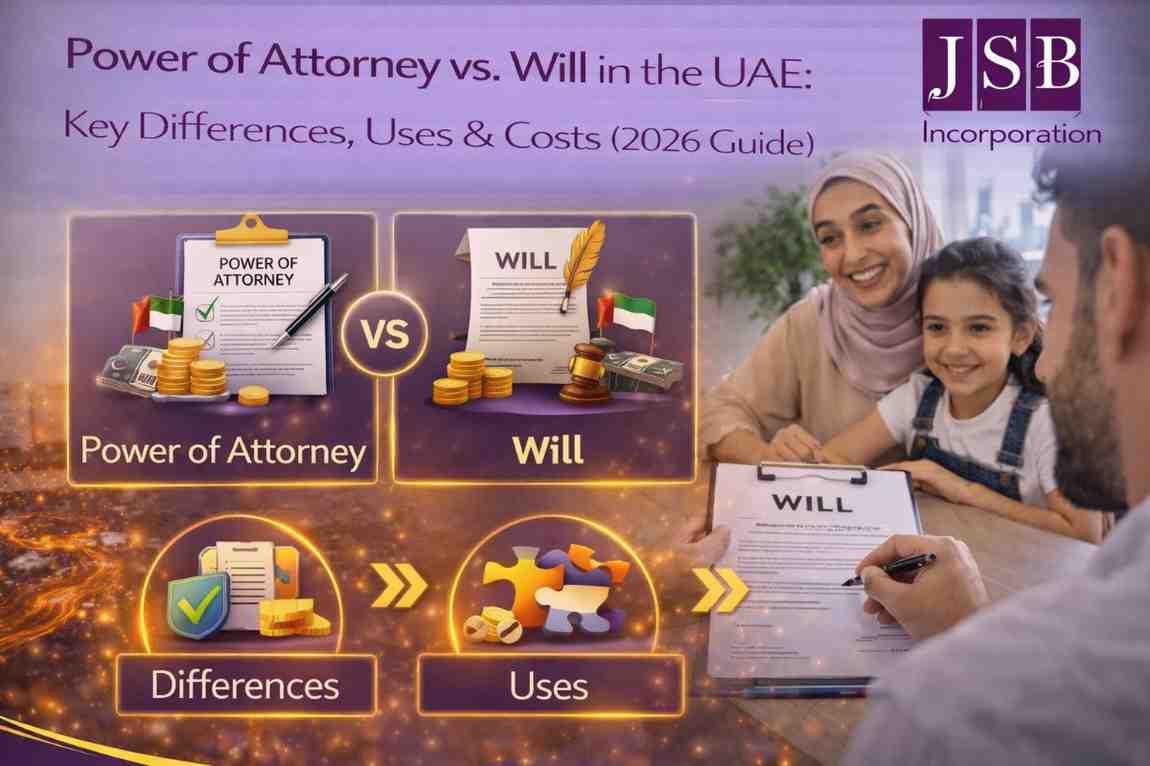
A POA protects your interests while you’re alive. A Will protects your beneficiaries after you’re gone. This guide covers both: what each document does, how they differ legally, when you need one or both, and step-by-step registration.
Disclaimer: All legal information in this article is for knowledge purposes only. UAE laws and regulations are subject to change. Verify all requirements and fees directly with the relevant UAE government authority before taking action. This article is for informational purposes only and does not constitute legal advice.
The inheritance framework that applies to your estate depends on your religion and whether you’ve registered a Will.
For Muslims, Sharia inheritance rules apply by default. For non-Muslim residents, Federal Decree-Law No. 41 of 2022, which came into force on 1 February 2023, established a civil personal status framework covering inheritance, providing the right to have your estate governed by your home country’s laws or a UAE civil framework.
The official UAE Government portal confirms this under Federal Decree-Law No. 41 of 2022.
However, without a registered Will that explicitly states your wishes, you leave the outcome to whichever default rules apply. That default may still not reflect what you actually want: specific assets going to specific people, a guardian appointed for your children, or clarity on how your business shares are handled.
Regardless of which framework applies, intestacy always triggers frozen bank accounts, court proceedings, and significant delays in asset distribution.
Most expats assume their home-country Will covers UAE assets. It doesn’t, reliably. A foreign Will can potentially be recognized, but it requires certified Arabic translation, full attestation, and formal UAE court validation, which is a lengthy and uncertain process.
The second most common assumption is that a well-drafted POA can substitute for a Will. Under Federal Law No. 5 of 1985, a POA terminates automatically at the principal’s death. Any instructions left in the POA carry zero legal force from that moment forward.
Gaurav Keswani, founder of JSB Incorporation, observed that entrepreneurs who once planned to “come, spend time, and go back to their home country” are now choosing to stay permanently in the UAE, buying property and enrolling their children in local schools.
For those building long-term lives here, estate planning isn’t optional. If you hold UAE company shares and die without a Business Owners Will, those shares enter estate proceedings with no authorized representative to manage them.
This became even more layered after October 2025. Federal Decree-Law No. 20 of 2025, effective 15 October 2025, amended the UAE Commercial Companies Law and introduced Article 14 provisions allowing company constitutional documents to include rules about the transfer of shares upon a shareholder’s death.
However, a constitutional provision only governs what the company does with those specific shares. A personal Will covers your entire estate, including how the value of those shares flows to your beneficiaries. Both documents are needed, and neither replaces the other.
A Power of Attorney (POA) is a legal document that authorizes a named agent to act on your behalf in legal, financial, or administrative matters. In the UAE, it’s governed by Federal Law No. 5 of 1985 (UAE Civil Transactions Law), Articles 924 to 959.
To grant a POA in the UAE, you need to meet three conditions: be at least 21 years old (lunar calendar), be of sound mind at the time of signing, and hold a valid passport or Emirates ID.
The document must be drafted in Arabic or as a bilingual document where Arabic text legally prevails in all cases. It’s then notarized by the Dubai Courts Notary Public (Dubai), an MOJ-authorized notary (in other emirates), or the Abu Dhabi Judicial Department (ADJD) for Abu Dhabi.
The single most important legal fact about a POA: it becomes automatically void the moment you die. Nothing written into the document changes this. It’s an absolute rule under UAE Civil Transactions Law.
Type | Scope | Best Used For | Key Limitation |
General POA | Broad authority across multiple affairs | Company management, banking, trade licence renewal, immigration | Frequently rejected by banks and DLD for high-value property transactions |
Special / Limited POA | Restricted to one specific act | Single property sale, court representation, share transfer | Authority ends automatically once the act is completed |
Business / Corporate POA | Company operations and governance | Trade licence renewal, shareholder resolutions, MOHRE submissions | Must reference your specific trade licence and company registration number |
Litigation POA | Court and legal proceedings only | Filing lawsuits, attending hearings, RERA and MOHRE disputes | Must explicitly grant litigation authority. Vague wording is rejected by UAE courts |
The Ministry of Economy and Tourism accepts POA submissions within 30 days of a company registration application.
To cancel a POA, DLD operates a formal POA Cancellation Notarization e-service at dubailand.gov.ae: visit the DLD Customer Happiness Centre, submit your documents, and receive the cancellation approval after an audit.
Banks may apply their own internal validity timelines on top of legal rules, so confirm the accepted window directly with each institution.
A Will is a legal document that directs how your assets are distributed, names an executor (the person responsible for carrying out your wishes), and can designate guardians for your minor children.
It takes effect only after you pass away. Without one, the applicable default inheritance framework applies, whether Sharia for Muslims or the civil framework under Federal Decree-Law No. 41 of 2022 for non-Muslim residents, and that default may not reflect your specific wishes.
In 2026, there are three official bodies through which you can register a Will in the UAE.
Body | Covers | Who Can Register | Language | Legal Basis |
DIFC Wills Service Centre | Dubai assets | Non-Muslims only | English | Dubai Law No. 2 of 2025 |
Dubai Courts | Dubai assets | Muslims and Non-Muslims | Arabic | Dubai Judicial Authority |
ADJD | Abu Dhabi assets | Muslims and Non-Muslims | Arabic | Abu Dhabi Judicial Dept |
The DIFC Wills Service Centre operates under Dubai Law No. 2 of 2025, issued on 3 March 2025 by HH Sheikh Mohammed bin Rashid. Under Article 31(5) of this law, DIFC Courts hold exclusive jurisdiction over the enforcement of non-Muslim Wills that are registered in the DIFC, whether the assets are located inside or outside the DIFC boundary.
This means executors can present DIFC probate orders directly to DLD, UAE banks, and the RTA without requiring separate mainland court proceedings. You and two witnesses must be present simultaneously at the time of signing, whether you register in person at DIFC Courts or via scheduled video conference.
Five Will types are currently available at the DIFC Wills Service Centre in 2026:
An MoU between Dubai Land Department and DIFC Courts, signed in 2015, established the enforcement framework for DIFC probate orders with DLD. Dubai Law No. 2 of 2025 now provides the legislative basis for direct enforcement, making DIFC-registered Wills the strongest enforcement option available for non-Muslim expats with Dubai assets.
The core legal difference between a POA and a Will is timing: a POA operates during your lifetime and becomes void at death, while a Will operates only after your death and has no force while you’re alive. Neither document can substitute for the other under UAE law.
Dimension | Power of Attorney | Will |
When it activates | During your lifetime | After your death |
When it becomes void | Upon your death or formal revocation | It never becomes void. It takes effect at death |
Can it distribute your assets | No | Yes |
Can it appoint a child guardian | No | Yes, via DIFC Guardianship Will |
Does it cover your incapacity | Yes, if explicitly drafted | No |
Legal framework | Federal Law No. 5 of 1985 | Muslims: Sharia default. Non-Muslims: Federal Decree-Law No. 41 of 2022. DIFC-registered Wills governed by Dubai Law No. 2 of 2025 |
Language requirement | Arabic is mandatory | Arabic for Dubai Courts and ADJD. English for DIFC |
Registered by | Dubai Courts, MOJ, or ADJD | DIFC, Dubai Courts, or ADJD |
Survives your death | No | Yes |
A question that comes up repeatedly in the UAE expat community: “Can a POA manage my affairs after I pass away?” The answer is no. Post-death instructions written into a POA are legally unenforceable under UAE Civil Transactions Law. A registered Will is the only instrument that takes effect at death.
If you’re an expat with UAE property, a bank account, minor children, or a business licence, you need a Will. If you regularly manage UAE affairs from abroad or need someone to represent you locally, you need a POA. If you’re an active investor or business owner with UAE assets, you need both. Here’s the breakdown.
You need a POA if:
You need a Will if:
You need both if:
Here’s what this looks like in practice. A 38-year-old British entrepreneur owns a Dubai apartment with a mortgage, holds a 60% stake in a DMCC-registered trading company, and has two children at a UAE school. He has a General POA naming his business partner as his representative.
If he dies unexpectedly, the POA becomes void immediately. His property enters estate proceedings, his 60% company stake has no authorized representative to manage or transfer it, and his children have no legally appointed guardian.
Without a registered Will, his estate is distributed under the applicable default framework, not according to his specific wishes. His business partner has no standing to act.
Registering a POA requires an in-person notarization appointment in the UAE or a full attestation chain if you’re abroad. Registering a DIFC Will requires confirming eligibility, selecting a Will type from five options, and signing with two witnesses before a DIFC Wills Officer. Both processes are straightforward with the right preparation.
Disclaimer: All fees below are subject to change. Verify current fees directly with the relevant official authority before making any financial decisions.
Dubai Courts published a new Private Notary fee schedule in the Official Gazette of Dubai, Issue No. 752, December 2025, effective from January 2026. The following rates apply:
Fee Component | Amount (AED) | Notes |
Electronic registration of parties (per party) | 100 | Payable per party to the instrument |
Signature fee | 100 | Payable per signature on the document |
Off-site notary visit | 1,000 | If the notary travels outside their registered office |
These rates cover private notary services regulated under the December 2025 Official Gazette schedule. Government notary counters at Dubai Courts may apply a separate fee schedule. Verify directly at the official Dubai Courts portal before proceeding.
DIFC Will registration fees vary by Will type: Full Will, Property Will, Financial Assets Will, Business Owners Will, and Guardianship Will. Fee schedules are updated periodically by DIFC Courts. Check the current fee applicable to your chosen Will type directly at the official DIFC Courts fee schedule page.
For Dubai Courts Will registration and ADJD Will fees, verify directly at the respective official portals. A non-refundable booking fee applies at DIFC for all Will types. Will modifications carry a separate fee per Will.
Q: Can a Power of Attorney replace a Will in the UAE?
No. A POA becomes void the moment you die and cannot distribute assets, appoint guardians, or direct estate distribution. Only a registered Will performs those functions. Under UAE Civil Transactions Law, any post-death instructions in a POA carry zero legal force.
Q: What happens to UAE assets if an expat dies without a Will?
The applicable default inheritance framework depends on the deceased’s religion. For Muslims, Sharia inheritance rules apply. For non-Muslim residents, Federal Decree-Law No. 41 of 2022, effective 1 February 2023, established a civil personal status framework covering inheritance, distinct from Sharia.
The official UAE Government portal confirms this. In either case, without a registered Will stating your explicit wishes, estate settlement triggers frozen bank accounts, court proceedings, and delays regardless of which framework applies.
Q: Does a UAE Power of Attorney expire automatically?
Not by statute, unless you write a specific expiry date into the document itself. A POA terminates automatically upon your death or formal revocation via DLD’s e-service notarization. Banks and government bodies may also apply their own internal validity windows, so confirm directly with each institution.
Q: Is a Will made in my home country valid for UAE assets?
A foreign Will can potentially be recognized, but it requires certified Arabic translation, full attestation, and formal UAE court validation. It’s a lengthy process with no guaranteed outcome. Registering locally through the DIFC Wills Service Centre (for non-Muslims) or Dubai Courts is far more reliable for UAE-based assets.
Q: Can a General POA be used for a UAE property sale?
Not reliably. The Dubai Land Department applies specific standards for POAs accepted in property transactions. A properly scoped Special or Limited POA that meets current DLD requirements is needed.
Q: Can I appoint a guardian for my children through a POA?
No. Child guardianship, both interim and permanent, can only be directed through a registered Will. The DIFC Guardianship Will is specifically designed for non-Muslim expats and allows you to name guardians and include short-term care arrangements.
Q: Do I need separate Wills for Dubai and Abu Dhabi assets?
Potentially yes. A DIFC Will covers Dubai assets. Assets in Abu Dhabi may require a separate Will registered with the ADJD. Verify current cross-emirate provisions directly with the DIFC Wills Service Centre and ADJD before registering.
Q: Can a non-Muslim use Dubai Courts instead of DIFC for a Will?
Yes. Dubai Courts accept Will registrations from non-Muslims. Note that under Dubai Law No. 2 of 2025, Article 31(5), exclusive enforcement jurisdiction applies only to Wills registered with DIFC, not to Wills registered at Dubai Courts.
This means a Will registered at Dubai Courts would not benefit from direct DIFC probate enforcement with DLD and UAE banks. For non-Muslims with Dubai assets, registering at DIFC is strongly recommended for enforcement certainty.
A POA handles your day-to-day representation while you’re active and present in the UAE. A Will directs where everything goes after you’re gone. For most expat investors and business owners building long-term lives here, you genuinely need both.
JSB Incorporation works with entrepreneurs across the UAE to structure both documents properly.
Book your free consultation call today with the experts of JSB Incorporation to learn more

Office 2505, 25th Floor, Regal Tower, Business Bay, Dubai, UAE P.O Box 27614.
+971 4 824 4842
info@jsbincorporation.com