
 Gaurav Keswani
Key Highlights
So, you’ve narrowed it down to Fujairah. Smart choice. It’s cost-effective and strategically positioned, and it’s the only UAE emirate sitting on the east coast with direct access to the Port of Fujairah. From there, you’re connected to markets in more than 50 countries across Asia, Europe, and the Arab region, per the UAE Ministry of Economy and Tourism.
But now you’re stuck. Free zone or mainland? You’ve probably read a dozen articles that say free zones are cheaper and the mainland gives you more freedom. They’re not wrong. But they’re not giving you the full picture either.
Here’s the thing: since Federal Decree-Law No. 32 of 2021 on Commercial Companies, both the Fujairah Free Zone and Fujairah Mainland allow up to 100% foreign ownership for most business activities. The ownership debate is settled.
What actually determines the right setup for you today is trading geography, tax efficiency, visa scale, and market reach.
This guide breaks all of that down using only current UAE government sources and verified 2026 legislation, so you can make this decision with confidence.
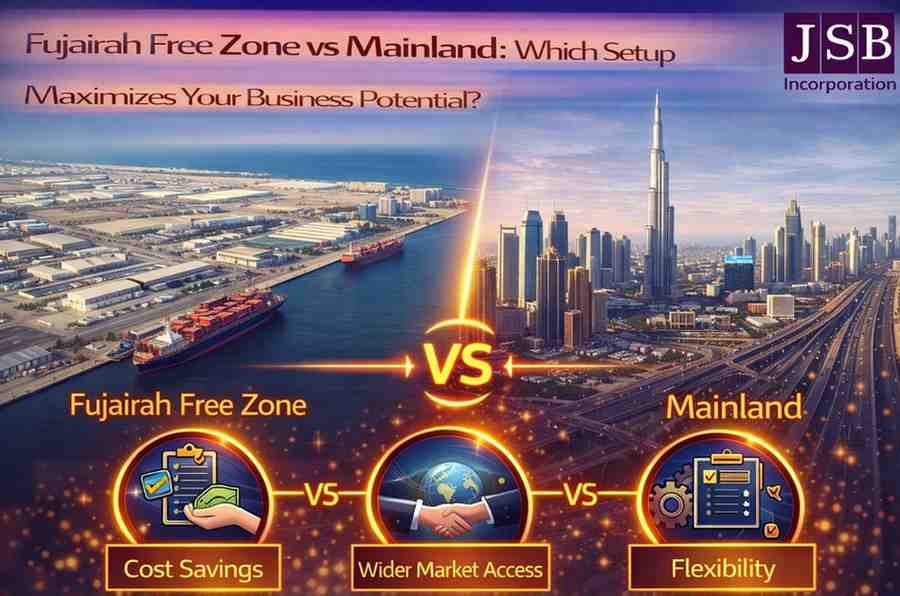
There are two officially listed free zones in Fujairah: the Fujairah Free Zone Authority (FFZA) and Fujairah Creative City. This article focuses on FFZA and how it compares to Fujairah Mainland for your Fujairah business setup in 2026.
Most founders choose a setup based on cost or ownership, then discover the trade-offs six months later when a UAE client asks for an invoice their license type can’t legally issue.
Here’s the scenario that plays out constantly. You register in FFZA because the entry cost is lower and the process is faster. Three months later, a Dubai-based distributor wants to buy your product. You invoice them. They push back.
Your FFZA license doesn’t allow you to sell directly to UAE mainland customers. Free zone companies can only trade internationally and within the free zone itself. To sell to UAE mainland customers, you need either a registered mainland distributor or a formal mainland branch. Nobody told you that upfront.
This is consistently the number one misunderstood aspect of UAE free zone vs mainland setup, and it regularly comes up as the top concern in UAE entrepreneur communities online. It’s not a new rule. But it catches first-time founders off guard because most early business planning focuses on incorporation cost, not distribution rights.
Then there’s the tax question. The UAE introduced a 9% corporate tax rate under Federal Decree-Law No. 47 of 2022. Free zone companies can access a 0% rate on qualifying income, but only if they satisfy all Qualifying Free Zone Person (QFZP) conditions set by the Federal Tax Authority.
That 0% rate is not automatic. And if your free zone company earns income from UAE mainland customers, that income is generally classified as non-qualifying and taxed at 9%, the same rate your mainland competitor pays above AED 375,000 in taxable income.
On top of that, two federal decrees are now in force as of 1 January 2026. Under Federal Decree-Law No. 16 of 2025, the FTA can deny your input tax deductions if your supply is linked to a tax evasion arrangement.
This applies to both free zone and mainland businesses equally per Federal Decree-Law No. 16 of 2025. You’ll need to verify supplier legitimacy before claiming input tax, which adds a compliance layer many new founders don’t anticipate.
Banking is another pain point that doesn’t get enough attention. Free zone companies operating from flexi-desks or virtual offices face more scrutiny from UAE banks during the account opening process.
Banks apply stricter due diligence to free zone entities without genuine physical substance. Mainland companies with physical, Ejari-registered premises move through corporate banking onboarding considerably faster.
Getting the setup wrong doesn’t just cost you more at incorporation. It means restructuring later, missing client opportunities, losing banking access, and paying tax you expected to avoid. None of that is cheap.
FFZA is built around Fujairah’s biggest advantage: its port. Located right next to the Port of Fujairah, it facilitates importing from and supplying goods across the Indian Ocean, with access to markets in more than 50 countries in Asia, Europe, and the Arab region.
The infrastructure covers high-end offices, virtual and flexible spaces, and warehouses with effective operational costs. Company setup is quick and flexible.
FFZA offers these license categories:
Your options include the Free Zone Establishment (FZE), Free Zone Company (FZ Co.), Free Zone LLC, and branches of local or international companies. Not every form is available for every activity. Confirm your exact options with FFZA directly before incorporating.
A Fujairah Mainland license gives you unrestricted UAE market access. It’s issued by Fujairah Municipality under the UAE Federal Commercial Companies Law, with no geographic trading restrictions. You can sell to customers across all seven emirates from day one, both B2B and B2C.
Over 2,000 business activities are available across industrial, commercial, professional, tourism, agricultural, and crafts license categories. Your legal form must match your intended activity. The available forms are General Partnership, Limited Partnership, LLC, PJSC, and PrJSC.
One requirement you can’t skip: you must maintain a physical registered address at all times. Your premises must comply with Fujairah Municipality land-planning regulations, and a rental agreement is mandatory.
All data points below are sourced exclusively from UAE government portals and current legislation.
Dimension | FFZA Free Zone | Fujairah Mainland | Official Source |
Governing Authority | Fujairah Free Zone Authority | Fujairah Municipality | fujairah.ae, u.ae |
Foreign Ownership | Up to 100% | Up to 100% for most activities | moet.gov.ae, u.ae |
Legal Forms | FZE, FZ Co., FZ LLC, Branch | General Partnership, LP, LLC, PJSC, PrJSC | moet.gov.ae, u.ae |
UAE Market Access | International and within free zone. Mainland sales via distributor or branch only | Unrestricted across all 7 emirates, B2B and B2C | moet.gov.ae |
Office Requirement | Virtual/flexi-desk permitted for certain licenses. Physical office tied to activity and headcount | Physical registered address mandatory at all times. Must comply with Fujairah Municipality regulations | moet.gov.ae, u.ae |
Customs Duties | Low tariff (0-5%). Free capital transfer permitted | Standard UAE customs apply | moet.gov.ae |
Profit Repatriation | Up to 100% | Standard | moet.gov.ae |
Govt Contract Eligibility | Not eligible without a formal mainland branch | Fully eligible | moet.gov.ae |
Visa Sponsorship | Issued and sponsored by FFZA authority | Sponsored directly by the company | u.ae: Recruiting in free zones |
Corporate Tax | 0% on qualifying income if QFZP conditions are met. 9% on non-qualifying income | 9% on taxable profit above AED 375,000 | Federal Decree-Law No. 47 of 2022, tax.gov.ae |
VAT from 1 Jan 2026 | Applies when taxable supplies exceed the registration threshold | Same VAT rules apply | Federal Decree-Law No. 16 of 2025 |
Disclaimer: License fees, visa quota packages, and facility costs vary by activity type, facility size, and current fee schedules from FFZA and Fujairah Municipality. Verify all pricing before committing to any structure. Always rely on official fee schedules rather than third-party estimates for final budgeting.
The UAE amended its Commercial Companies Law through Federal Decree-Law No. 20 of 2025, effective 14 October 2025. Five changes directly affect your setup decision.
Yes. Your FFZA company can now formally establish a branch or representative office on the UAE mainland, provided FFZA’s own legislation permits it. When that branch exists, the CCL expressly governs its onshore operations, per Federal Decree-Law No. 20 of 2025. This gives the dual-entity structure a legally codified foundation that didn’t exist in statute before.
Yes, for the first time. The CCL now expressly states that companies incorporated in UAE free zones carry UAE nationality, per Federal Decree-Law No. 20 of 2025. This matters for national preference considerations in government procurement.
Yes, but with important conditions. Article 15 bis of Federal Decree-Law No. 20 of 2025 permits re-domiciliation from a free zone to the mainland, or the other way around, without loss of legal personality or business continuity.
Per verified legal analysis from Al Tamimi and Company and Gibson Dunn, the law also requires a special shareholder resolution, the absence of any registration blocks, and approvals from both the outgoing and incoming competent licensing authorities.
Implementing regulations are still pending as of this writing. Don’t act on this provision until those regulations are confirmed through the Ministry of Economy and Tourism or the Federal Tax Authority and you’ve taken qualified legal advice.
Yes. LLCs can now issue Class A and Class B shares with differential voting rights, profit entitlements, and liquidation preferences, per Federal Decree-Law No. 20 of 2025. This makes the Fujairah Mainland substantially more attractive for businesses planning to bring in investors or structure joint ventures with differentiated rights.
Yes. These joint venture mechanics now have formal statutory recognition in company constitutional documents, per Federal Decree-Law No. 20 of 2025. It removes the reliance on purely private contractual arrangements to enforce these rights, which is a meaningful improvement in investor protection.
Also Read: 18 Common Business Setup Mistakes in Dubai and How to Avoid Them
The 0% corporate tax rate for FFZA companies is real, but it’s not automatic. To access it, your company must qualify as a Qualifying Free Zone Person (QFZP) under Federal Decree-Law No. 47 of 2022.
Here’s what QFZP qualification requires:
Here’s the critical point for your trading strategy: income from UAE mainland customers is generally classified as non-qualifying and gets taxed at 9%, even if the rest of your revenue qualifies for 0%.
One consequence that often surprises founders: if you breach the de minimis threshold, you don’t just lose your QFZP status for that year.
Per the QFZP conditions framework under Federal Decree-Law No. 47 of 2022 and FTA guidance, breaching the threshold disqualifies your company from the 0% regime for the current tax period and the four subsequent tax periods, a five-year disqualification in total.
That’s a material financial risk if your mainland sales creep above the threshold without a proper structure in place. Annual FTA tax return filing is mandatory regardless of your tax rate.
Mainland businesses pay 9% on taxable income above AED 375,000 per year under Federal Decree-Law No. 47 of 2022. Small Business Relief may apply below certain revenue thresholds.
Two federal decrees took effect on 1 January 2026 and apply to both free zone and mainland businesses without exception.
Under Federal Decree-Law No. 16 of 2025 (VAT Amendment):
Under Federal Decree-Law No. 17 of 2025 (Tax Procedures Amendment):
Fujairah Free Zone companies can sell freely within the free zone and internationally. But you can’t sell directly to UAE mainland customers without either a registered mainland distributor or a formal mainland branch in place.
This isn’t a technicality. It has real commercial consequences. If you’re a product-based business and your target market includes UAE retail or distribution channels, a free zone-only setup creates a structural barrier from day one.
What’s changed recently helps. Under Articles 3 and 5 of Federal Decree-Law No. 20 of 2025, opening a mainland branch from your FFZA entity is now legally codified. If FFZA’s own legislation permits it, you establish the branch, and the CCL governs everything that branch does onshore. This gives you a legally certain path to both markets without running two completely independent entities.
For international-first businesses, the free zone advantages are genuine and measurable. You get free capital transfer, unrestricted profit repatriation of up to 100%, and customs tariffs between 0 and 5% on goods moving through the free zone. If most of your revenue comes from outside the UAE, those advantages often outweigh the mainland trading restriction entirely.
If your model is UAE-domestic-first, go with mainland. You get unrestricted B2B and B2C trade across all seven emirates plus full eligibility for UAE government procurement contracts, with no workarounds required.
In FFZA, visas are issued and sponsored by the free zone authority itself, not your company. Your visa quota is tied directly to your facility type. FFZA-specific quotas vary by facility arrangement. A flexi-desk at FFZA can support as few as one visa per FFZA package.
Private office spaces allow more, scaling with size. Warehouses and industrial plots support larger headcounts. Confirm FFZA’s current quota structure directly before choosing your facility, as these terms are updated regularly. Don’t rely on visa quota figures from other UAE free zones when planning for FFZA specifically.
On the Fujairah Mainland, your company sponsors its own employees directly. There’s no statutory visa cap. Your quota scales with your registered office space and operational headcount. If you’re planning to hire a team of 20, 50, or more, this unlimited scalability is a practical advantage that a free zone-only structure simply can’t match.
One issue worth addressing directly: if you set up in FFZA with a flex desk or virtual office, you may face additional scrutiny when opening a UAE corporate bank account.
UAE banks apply more due diligence to free zone entities without genuine physical substance. Mainland companies with physical, Ejari-registered premises move through corporate banking onboarding faster and more smoothly. Factor your banking timeline into your facility decision before you sign.
Setting up in FFZA follows three phases:
For corporate applicants, you’ll need:
For freelancer applicants: registration application form, CV, bank reference letter, and the notarized RIC form.
After initial approval:
The Fujairah mainland business license process is managed by Fujairah Municipality.
The Bashr platform allows eligible businesses to complete the process in as little as 15 minutes online.
You don’t have to pick one setup and give up the other’s advantages. A dual-entity structure lets you access both markets simultaneously, and it’s now legally codified.
Here’s how it works. You establish an FFZA entity to handle international trade and preserve your 0% QFZP corporate tax rate on qualifying income. Then you open a mainland branch under that entity to serve UAE domestic clients and bid on government contracts.
Under Articles 3 and 5 of Federal Decree-Law No. 20 of 2025, this structure has a clear legal foundation. The CCL governs your mainland branch. Your FFZA entity preserves its QFZP status on qualifying international income.
One critical tax planning point: if your mainland branch generates income that pushes your non-qualifying revenue above the de minimis threshold at the free zone entity level, your FFZA entity could lose its 0% rate for five years, per the QFZP conditions framework under Federal Decree-Law No. 47 of 2022 and FTA guidance. Structure the dual-entity arrangement carefully and take qualified tax advice before operating it.
If your strategy evolves later, Article 15 bis of the same law gives you a re-domiciliation path. You can migrate from a free zone to the mainland, or vice versa, without dissolving and re-incorporating, subject to a special shareholder resolution, the absence of registration blocks, and approvals from both licensing authorities, per Al Tamimi and Company’s verified legal update.
Implementing regulations for this provision are still pending. Keep monitoring the Ministry of Economy and Tourism and Federal Tax Authority portals before making any restructuring decisions based on it.
Also Read: Mainland vs Free Zone Business Bank Accounts in UAE 2026: What Really Makes Banking Easier for You
FFZA is your fit if you are:
Fujairah Mainland is your fit if you are:
Q1: Can a foreigner own 100% of a Fujairah Mainland company?
Yes, Federal Decree-Law No. 32 of 2021 on Commercial Companies extended 100% foreign ownership to most mainland activities, including in Fujairah. A number of restricted activities remain, including security and defense, telecommunications, banking, and commercial agencies. The full restricted activities list is published. Check it before finalizing your activity with Fujairah Municipality.
Q2: Can a Fujairah Free Zone company sell to customers anywhere in the UAE?
No, not directly. FFZA companies can trade within the free zone and internationally. To sell to UAE mainland customers, you need either a registered mainland distributor or a formal mainland branch. This is the most common and costly misunderstanding among first-time UAE founders.
Q3: Is FFZA setup cheaper than Fujairah Mainland?
FFZA license fees are generally lower at the entry level. But your total cost depends heavily on office requirements. Mainland mandates physical space, which adds ongoing rent to your cost base. FFZA entry-level packages reduce upfront costs for freelancers but come with limited visa quotas.
Q4: What is the corporate tax rate for FFZA companies in 2026?
It’s 0% on qualifying income if your company meets all QFZP conditions under Federal Decree-Law No. 47 of 2022. Qualifying Income is defined per Ministerial Decision No. 229 of 2025, effective retroactively from 1 June 2023. Income from UAE mainland customers is generally non-qualifying and taxed at 9%.
If your non-qualifying revenue exceeds the de minimis threshold (the lower of 5% of total revenue or AED 5 million), you lose QFZP status for five years, per the QFZP conditions framework under Federal Decree-Law No. 47 of 2022 and FTA guidance. Annual FTA tax return filing is mandatory even at the 0% rate.
Q5: Can I open a UAE bank account as an FFZA company?
Yes, but it’s more complex if you’re operating from a flex desk or virtual office. UAE banks apply additional due diligence to free zone entities without genuine physical substance. If corporate banking from day one is a priority, a mainland setup or an FFZA entity with real physical presence will give you a smoother experience.
Q6: Can I transfer my free zone company to the mainland without shutting it down?
Yes. Article 15 bis of Federal Decree-Law No. 20 of 2025 (effective 14 October 2025) permits re-domiciliation without loss of legal personality or continuity, per the law and Al Tamimi and Company’s legal update.
The process requires a special shareholder resolution, no outstanding registration blocks, and approvals from both the outgoing and incoming licensing authorities. Implementing regulations are still pending. Don’t restructure based on this provision until those regulations are published and you’ve taken qualified legal advice.
Q7: How do the 2026 VAT changes affect my Fujairah business?
Federal Decree-Laws No. 16 and No. 17 of 2025, effective 1 January 2026, affect both free zone and mainland businesses equally. The FTA can deny input tax deductions on suspected evasion arrangements.
A five-year VAT refund limitation period is now in force. Binding FTA directions are legally enforceable. Self-invoicing under reverse charge is no longer required, though supporting documents must be retained per the Executive Regulation.
Q8: How many visas can I get with an FFZA license?
It depends on your specific facility package. FFZA flexi-desk packages can support as few as one visa. Private offices scale with size. Warehouses and industrial plots support larger teams. Don’t rely on visa quota figures from other UAE free zones when planning for FFZA.
Q9: What’s the difference between an FZE and a Free Zone LLC in FFZA?
An FZE has one shareholder. A Free Zone LLC has multiple shareholders. Not all legal forms are available for every activity in FFZA. Verify your options directly with FFZA before you incorporate.
Four founder profiles. One right answer for each.
If you’re an international trader, re-exporter, or manufacturer, FFZA fits. You get Port of Fujairah access; reach into markets across more than 50 countries; have 0% corporate tax on qualifying income when QFZP conditions are met; and have a faster, lower-cost setup process.
If your business is UAE-domestic-first, whether that’s retail, F&B, services, or construction, go with Fujairah Mainland. You get unrestricted trade across all seven emirates, full government contract eligibility, and no distribution workaround.
If you’re scaling a large local team, mainland wins. There’s no statutory visa cap, and your allocation grows with your office space and headcount.
If you’re a global operator who wants tax efficiency on international qualifying income and full UAE domestic market access at the same time, the dual-entity structure is built for you. FFZA covers your qualifying international revenue at 0%.
Your mainland branch handles UAE domestic sales and government procurement. This is formally codified under Federal Decree-Law No. 20 of 2025. Structure it carefully to stay within the QFZP de minimis threshold and preserve your 0% rate.
Whatever your profile, getting your Fujairah business setup 2026 decision right from day one is always cheaper than restructuring it later.
At JSB Incorporation, our team of UAE business setup specialists handles everything from license selection and document preparation to bank account opening and ongoing compliance, so you’re not piecing it together alone. We work across 24-plus UAE jurisdictions, including FFZA and Fujairah Mainland.
We’re known for a higher success rate on approvals, transparent pricing with no hidden costs, and end-to-end support from your first consultation to your first operational day.
Whether you’re choosing between free zone and mainland or considering a dual-entity structure, we’ll walk you through the right option for your specific business model and goals.
Book your free consultation call today with the experts of JSB Incorporation to learn more

Office 2505, 25th Floor, Regal Tower, Business Bay, Dubai, UAE P.O Box 27614.
+971 4 824 4842
info@jsbincorporation.com