
Key Highlights
You’ve been freelancing for three years. Your income hit AED 30,000 a month last year. You’re working with clients across the US, Europe, and increasingly the UAE.
And every time someone asks where you’re based, you’re still giving a home address that doesn’t reflect how you actually live or work. Dubai has been in the back of your mind for a while now. No personal income tax. A freelance visa that lets you sponsor your spouse and kids.
A work permit that now takes 5 working days to process instead of 30. You finally sit down to research it properly. Two hours later, you have 11 browser tabs open, three different visa types, and you’re more confused than when you started.
This guide closes every one of those tabs.
Most freelancers who struggle with this aren’t making careless mistakes. They’re getting tripped up by three specific problems that nobody addresses clearly upfront.
Problem 1: Dubai freelance visa isn’t an official term.
No UAE government document uses that phrase. What actually exists are two separate legal requirements. You need a MOHRE Freelance Work Permit (Type 12) AND a UAE Residence Visa. Both are mandatory.
A residence visa without the work permit doesn’t authorize you to work. A work permit without a residence visa doesn’t let you live here legally. Working without both violates Article 6 of Federal Decree-Law No. 33 of 2021 on the Regulation of Employment Relationships and its amendments, known as the UAE Labour Law.
Problem 2: Mixing up the freelance visa with the Virtual Work Visa costs you UAE clients.
A large number of freelancers apply for the UAE Virtual/Remote Work Visa thinking it’s the same thing. It isn’t. The Virtual Work Visa is a 1-year visa for employees or business owners of overseas companies working remotely from Dubai while staying employed abroad.
That visa does not include a MOHRE work permit, which means holders are not authorized to serve UAE-based clients under UAE labor law.
Problem 3: Choosing the wrong residency route costs years of stability.
After you get your work permit, you choose between two residency visa options: a standard 2-year visa through a UAE free zone or a 5-year Green Visa through the Federal Authority for Identity, Citizenship, Customs, and Port Security (ICP) that’s fully self-sponsored.
Many freelancers who qualify for the Green Visa end up on the shorter free zone route because no one walked them through the income threshold. That’s 3 extra years of residency stability you’re leaving behind, plus family sponsorship rights you could have had from day one.
Getting this right from the start means less money wasted, fewer delays, and a legal status that actually matches how you work.
A Dubai freelance visa is the combination of two legally required documents: an MOHRE Freelance Work Permit (Type 12) and a UAE Residence Visa. Both are mandatory to live and work legally as a self-employed professional in the UAE.
A Type 12 permit is issued to individuals who wish to engage in freelance work independently, generating income by providing services to individuals or companies without being considered an employee of those entities. You’re not your client’s employee. You hold your own permit and your own legal standing in the UAE.
After your work permit is issued, you choose one of two residency paths:
One more thing worth stating clearly: this is not the UAE Virtual/Remote Work Visa. That’s a separate 1-year visa for employees of overseas companies working remotely from Dubai. The two cannot substitute each other under any circumstances.
There are two routes to a Dubai freelance visa in 2026, and picking the right one from the start is the most important decision you’ll make in this process. Here’s the full comparison based on verified UAE government source data.
Feature | Free Zone Permit + Standard Visa | MOHRE Type 12 + Green Visa (5-Year) |
Duration | 2 years | 5 years, renewable |
Sponsor | Free zone authority | Self-sponsored |
Income Threshold | None is stated for the permit. | AED 360,000/year (past 2 years) |
Education | Varies by free zone | Bachelor’s degree or specialized diploma |
Family Sponsorship | Subject to free zone conditions | Spouse and children per ICP-approved terms |
Best For | New entrants, lower-income earners | Established professionals with verified income |
If your freelance income was at least AED 360,000 per year (about AED 30,000/month) in both 2024 and 2025, and you hold a bachelor’s degree or equivalent, go for the Green Visa.
You’ll get 5-year self-sponsored residency and the right to sponsor your family. If your income doesn’t meet that threshold yet, the free zone route is your fully legal starting point. Just confirm your profession is on that free zone’s active activity list before you commit.
Eligibility works differently depending on which of the two routes you’re taking. Here’s exactly what each one requires, sourced directly from UAE government portals.
You must meet these conditions to get the Type 12 permit issued:
A university degree is not required for the Type 12 permit itself. That requirement only applies if you’re going for the 5-year Green Visa residency.
You must meet all four of these conditions to qualify for the Green Visa as a freelancer:
If you meet conditions 1 and 2 but your income hasn’t reached AED 360,000 yet, condition 4 (stable income or financial solvency) gives you an alternative path. Speak to a consultant about whether your savings or assets qualify before ruling the Green Visa out.
The MOHRE Type 12 permit covers professional service activities only. It does not cover trading in physical goods or product-based businesses. If your work involves selling products rather than providing services, this permit doesn’t apply to your situation.
Your freelance permit occupation must match your registered business activity precisely. A mismatch between what you actually do and what’s listed on your permit gives MOHRE grounds to refuse or cancel your permit at any stage. It’s an avoidable problem, but only if you set up your activity correctly from the beginning.
Free zones restrict permits to their own registered activity clusters. Before committing to a free zone route, confirm directly with the free zone that your specific profession is within their current approved list. Some free zones have paused freelance permit issuance at various points, and approved activity lists are updated periodically.
Disclaimer: Approved profession lists and free zone activity categories are subject to periodic updates by MOHRE and individual free zone authorities. Always verify current status directly with the relevant authority before submitting any application.
A Dubai freelance visa requires the following documents. Start collecting these in parallel with your eligibility check, not after permit approval.
Don’t underestimate the attestation step. Getting your educational certificates attested for UAE use can take several weeks depending on your country. If you leave it until after you’ve started the permit process, it will delay everything else.
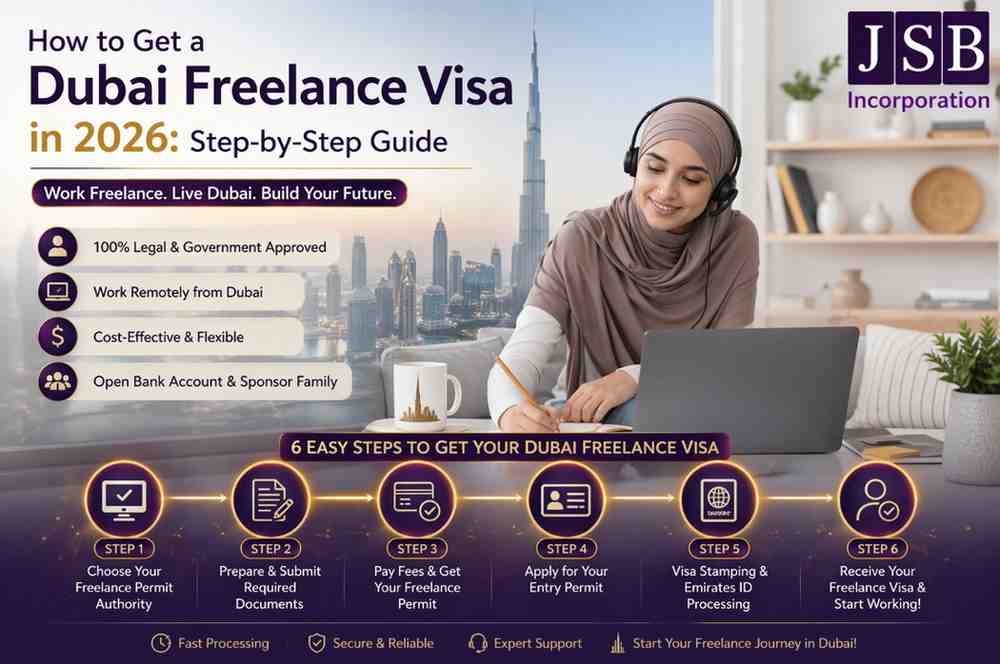
The full Dubai freelance visa process involves five steps, starting with your work permit application and ending with your Emirates ID. Here’s exactly what happens at each stage.
Decide between the free zone route and the MOHRE Type 12 plus Green Visa route before doing anything else. The key deciding factor is your income. Did you earn at least AED 360,000 per year from freelancing in both 2024 and 2025, and do you hold a bachelor’s degree or equivalent?
If yes, apply for the Green Visa. If not, choose a UAE free zone whose activity list covers your profession and confirm it’s currently issuing freelance permits.
Apply through the UAE’s Work Bundle system, launched in 2025 and fully operational in 2026.
The Work Bundle consolidated 5 platforms into a single unified system, streamlined 8 services into 1 integrated experience, cut required steps from 15 to 5, reduced required documents from 16 to 5, dropped in-person visits from 7 to 2, and reduced MOHRE processing time from 30 working days to 5 working days.
If you’re outside the UAE, an entry permit is issued after your work permit is approved. You use it to enter the UAE and complete your medical and biometrics in person. If you’re already inside the UAE on a valid visa, you can apply for a status change without exiting.
A medical fitness test is mandatory for every UAE residence visa, with no exceptions. It must be completed in person at an approved UAE facility. After medical clearance, your Emirates ID biometrics (fingerprints and photograph) are captured at an ICP-approved center. This step cannot be done remotely or deferred.
Your residence visa is stamped after biometrics are cleared. Green Visa holders receive a 5-year self-sponsored visa, renewable upon re-meeting eligibility conditions. Free zone visa holders receive a 2-year visa sponsored by the free zone.
Your Emirates ID is issued after stamping, giving you official proof of UAE residency and legal authorization to work as a freelancer in the country.
Also Read: UAE Advertiser Permit 2026: Complete Guide for Influencers, Bloggers & Freelancers
The numbers behind the Dubai freelance visa tell you exactly why this process is worth understanding now rather than later.
The UAE introduced the Green Visa as a long-term residency pathway specifically designed to give independent professionals and freelancers a self-sponsored route without needing an employer.
The Green Visa is part of the UAE’s strategic initiatives to enhance the living and working environment and attract global talent, investors, and freelancers by providing a flexible long-term residency model that ensures greater stability. It replaced a system in which independent professionals without employer sponsorship had limited long-term residency options.
The Work Bundle initiative made the process dramatically faster. It consolidated 5 separate government platforms into 1, streamlined 8 services into a single integrated experience, and cut processing time from 30 working days to 5 working days. The initiative sits under the UAE Government’s Zero Bureaucracy Program, which signals that this isn’t a one-time change. It’s a policy direction.
On the tax side, the UAE levies no income tax on individuals. For a freelancer earning AED 360,000 per year, keeping your full income rather than paying the income tax rates that apply in many OECD countries represents a substantial financial difference.
The Green Visa’s AED 360,000 income threshold (roughly AED 30,000/month) tells you exactly what segment of the international freelance market the UAE is targeting: established, mid-to-high-earning professionals in service industries. If you’re earning at that level and you’re still living under employer-dependent visa arrangements elsewhere, the Dubai freelance visa is worth running the numbers on seriously.
The Dubai freelance visa gives you long-term legal residency, full self-sponsorship, and the ability to work with UAE clients, all without an employer. Here are the ICP-confirmed benefits:
If you’ve spent years on employer-dependent visa structures, the ability to hold your own 5-year residency without needing a company or a sponsor is the single most meaningful change in this system.
These two visa types get confused constantly, and the consequences of choosing the wrong one are real. Here’s the direct comparison so you can see exactly why they’re different.
Feature | Dubai Freelance Visa (MOHRE Type 12) | UAE Virtual/Remote Work Visa |
Duration | 2 years (free zone) or 5 years (Green Visa) | 1 year |
Who it’s for | Self-employed professionals providing services independently | Employees or owners of overseas companies |
Includes MOHRE work permit? | Yes | No |
UAE residency status | Full UAE resident | Temporary visitor status |
Sponsor | Free zone or self (Green Visa) | Self |
Substitutable? | No | No |
The Virtual Work Visa does not include an MOHRE work permit. That means holders are not authorized to work under UAE labor law, including serving UAE-based clients. If you want to build a UAE-based client base and live here long-term with your family, the Virtual Work Visa doesn’t cover that.
MOHRE work permit fees range from AED 250 to AED 3,450, depending on your establishment’s classification (Category A, B, or C) based on Wages Protection System compliance and applicable MOHRE resolutions under Cabinet Resolution No. 37 of 2022.
At renewal, you must satisfy all original issuance conditions again. That means resubmitting documents, certificates, and qualifications and paying fees based on your classification at the time of renewal. For Green Visa holders, the AED 360,000 annual income threshold (or stable income or financial solvency proof) must be demonstrated again at the 5-year mark.
Budget separately for your free zone registration fee if you’re taking that route, plus your medical fitness test, Emirates ID fee, and health insurance. These vary by provider and authority, so get specific quotes before finalizing your total budget.
Disclaimer: All permit fees and government service charges are subject to change by MOHRE and relevant free zone authorities.
You know what the process looks like. Here’s how to move from reading about it to actually completing it in five clear actions you can start right now.
Step one: check your Green Visa eligibility before anything else.
Go to icp.gov.ae/en/green-residency/ and check the current eligibility criteria. Pull your bank statements or invoice records from 2024 and 2025 and calculate your actual annual freelance income. If it’s above AED 360,000 in both years and you hold a bachelor’s degree, you’re a Green Visa candidate. Don’t skip this step. Many people who qualify don’t know they do.
Step two: start your attestation process now, not later.
If your educational certificates aren’t already attested for UAE use, submit them to the UAE embassy in your home country this week. Attestation can take several weeks depending on your country. Starting it now means it won’t delay your application later.
Step three: verify your free zone’s current status if you’re taking that route.
Call or email the free zone directly and ask whether they’re currently issuing MOHRE Type 12 freelance permits for your activity. Some free zones have paused this in the past. A quick confirmation call can save you weeks of misdirected effort.
Step four: arrange health insurance before you apply.
Valid UAE health insurance is a mandatory document for your visa application, not something you sort out after approval. Get quotes this week and have a policy ready before you submit.
Step five: don’t make relocation commitments until your permit is confirmed.
Your MOHRE work permit process takes 5 working days under the Work Bundle. Wait for that confirmation before signing a lease, booking a move, or giving notice anywhere.
Once you have the permit approval, you’ll receive your entry permit if you’re outside the UAE, or initiate your status change if you’re inside, then complete your medical and Emirates ID biometrics at an ICP-approved center.
Also Read: Freelance License in Dubai Under 10,000 AED: Cheapest Options Compared
Q1: Is the Dubai freelance visa the same as the Green Visa?
No, but they overlap. The Green Visa is one of two residency options for freelancers: the 5-year self-sponsored route through ICP. The other option is a standard 2-year visa through a UAE free zone. Both routes require a MOHRE Type 12 work permit as a first step. Neither replaces the other.
Q2: Do I need a degree to get a Dubai freelance permit?
For the MOHRE Type 12 work permit itself, no degree is required. A bachelor’s degree or specialized diploma becomes mandatory only when you’re applying for the 5-year Green Visa. Free zone requirements vary by zone and must be confirmed directly with that authority.
Q3: Can I legally work for UAE-based companies on a freelance visa?
Yes. The MOHRE Type 12 permit explicitly authorizes you to provide services to individuals or companies inside the UAE without being considered an employee of those entities under UAE labor law.
Q4: Can I convert my tourist or visit visa to a freelance visa inside the UAE?
Yes. If you’re already inside the UAE on a valid visa, a status change is available. You don’t need to exit the country.
Q5: How long does the full process take in 2026?
Your MOHRE work permit processes in 5 working days under the Work Bundle initiative, down from 30 working days previously. The full residency process, including your medical examination and Emirates ID, takes additional time after that. Confirm the complete end-to-end timeline directly with MOHRE or ICP when you apply.
Q6: Can I sponsor my family on a Dubai freelance visa?
Yes, if you’re on the Green Visa route. You can sponsor your spouse and children under ICP-approved terms. For the standard free zone visa, family sponsorship conditions vary by free zone and must be confirmed directly with that authority before making any family sponsorship plans.
Q7: Should I get a freelance visa or set up a company instead?
A freelance permit suits individual professionals providing services independently to multiple clients. If you plan to hire employees, trade in physical goods, or operate with a team, a company setup is the right structure.
Some free zones have also paused freelance permit issuance at various points, so verify current availability before committing to that route.
Q8: What happens if I freelance in Dubai without a permit?
It’s illegal under Article 6 of Federal Decree-Law No. 33 of 2021 and its amendments. Penalties include fines under UAE labor law. This applies whether or not you hold an active UAE residence visa. The work permit and residence visa are two separate legal requirements, and you need both.
Getting a Dubai freelance visa right means choosing the correct route for your income level, preparing the right documents in the right order, and meeting every legal condition before you submit. One mismatched activity code, one missing document, or the wrong visa type means lost fees and starting over.
JSB Incorporation helps freelancers and self-employed professionals get legally set up across both the free zone and Green Visa routes.
From confirming your eligibility on day one to managing your full MOHRE submission and ICP application, the team handles everything end-to-end. You get transparent pricing with no hidden fees, clear timelines from the first call, and a dedicated consultant who knows exactly what each UAE authority requires in 2026.
Book your free consultation call today with the experts of JSB Incorporation to learn more

Office 2505, 25th Floor, Regal Tower, Business Bay, Dubai, UAE P.O Box 27614.
+971 4 824 4842
info@jsbincorporation.com
