
Key highlights
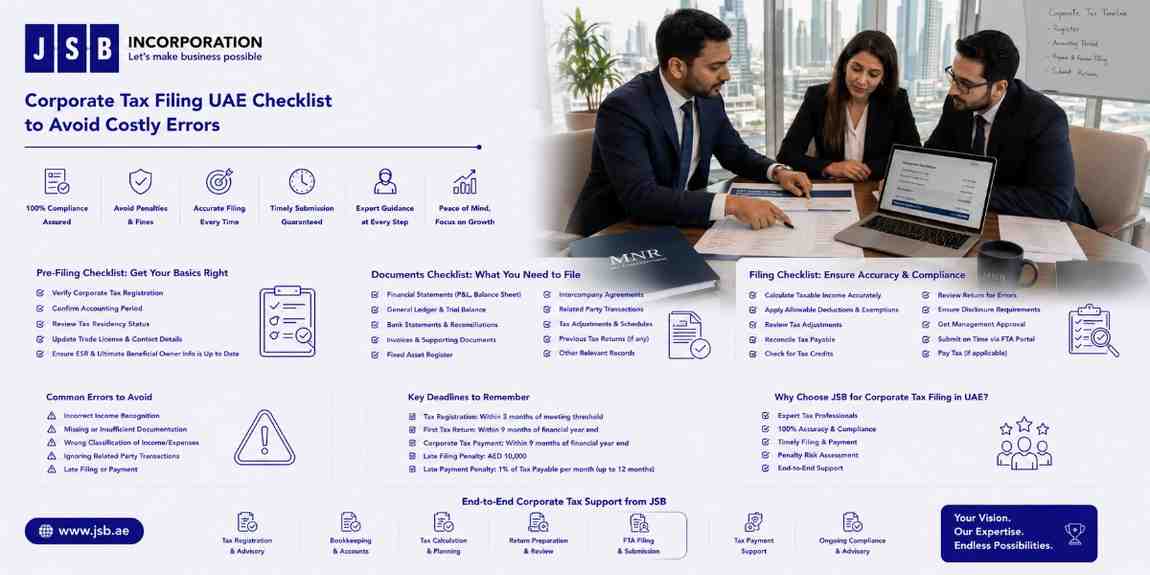
A corporate tax filing UAE checklist helps you separate registration, return filing, and record preparation before deadline pressure turns into a compliance problem.
Low revenue, no activity, or incomplete books do not automatically remove filing risk for an existing UAE business.
A cleaner filing process starts when your records, tax position, and review timeline are checked before the return reaches the Federal Tax Authority.
The lower-risk time to get accountant support is before free zone treatment questions, weak bookkeeping, or late corrections complicate the return.
As of July 2026, the Federal Tax Authority (FTA) applies corporate tax at 9% on taxable income above AED 375,000, and corporate tax registration applies to all UAE-resident juridical persons.
The risk for many existing UAE businesses starts earlier than the submission date. It starts when you assume low activity, delayed invoicing, or incomplete books mean the return can wait.
This article explains what corporate tax filing in the UAE actually involves, which pre-filing mistakes create the most exposure, and when a professional review becomes the safer choice.
Filing is more than a portal task. You need a clear tax position, supportable figures, and records that match what the FTA expects if your return is reviewed.
Under Federal Decree-Law No. 47 of 2022 on Corporate Tax, corporate tax registration is mandatory for UAE-resident juridical persons, and the FTA is the authority responsible for registration and filing. That means your filing position needs to match your legal entity, financial period, and accounting records before the return is submitted.
Registration is not the same as return filing. Registration brings your business into the corporate tax system, while return filing requires figures that can be supported by bookkeeping records, financial statements, and the treatment applied to income and expenses.
Many UAE business owners still mix up VAT and corporate tax or assume that low turnover means no return needs attention. That shortcut creates risk because filing responsibility is tied to the entity and the applicable framework, not to a casual view of business activity.
Another common problem appears late in the cycle. You start cleaning up records close to the deadline, then discover that unsupported transactions, missing entries, or unclear free zone treatment make the return harder to defend.
UAE tax regulations are subject to change. Verify current requirements directly with the Federal Tax Authority or consult a qualified tax advisor for your specific situation.
The right provider reduces exposure before submission. You need review discipline, authority-led accuracy, and deadline control instead of a generic overview of UAE tax rules.
A strong provider checks whether your accounting records are complete enough to support the return, especially if your business had low activity, delayed billing, or weak bookkeeping during the tax period.
The FTA applies a standard corporate tax rate of 9% above AED 375,000, while qualifying free zone income can benefit from a 0% rate where the qualifying conditions are met.
A reliable provider does not treat every free zone company as automatically outside the standard regime. The review should test whether your facts actually support the treatment before the return is filed.
Timing matters, but timing alone does not make a return safe. Missing records, unclear tax treatment, and last-minute corrections are the real escalation triggers because they reduce the time available to review the filing position properly.
JSB approaches filing as a risk-control process. The focus is on record readiness, accounting support, and cleaner submission handling for existing UAE businesses that want clarity before the return goes to the FTA.
A UAE corporate tax return becomes a professional review job when your records are incomplete, your business had little or no activity, or your free zone position is not clear under the FTA framework.
In that situation, return accuracy matters more than submission speed because the real risk sits in the position behind the figures, not in the upload itself.
1. Does a UAE company with no revenue still need to file corporate tax?
A UAE company should not assume that no revenue removes corporate tax filing responsibility. The FTA framework turns on the entity and the applicable filing obligation, so a no-activity period still needs proper review before you decide what must be submitted.
2. What documents should you prepare before filing a corporate tax return in the UAE?
You should prepare your trade licence details, bookkeeping records, financial information, and the supporting records needed to stand behind the figures reported in the return. A proper review checks those records before submission so your filing position is supported by evidence, not assumptions.
3. Is corporate tax registration the same as VAT registration in the UAE?
No. Corporate tax registration and VAT registration are separate FTA processes with different rules, even though both depend on accurate records and timely compliance handling.
Treating them as the same process creates avoidable errors, especially when your business already has VAT history but has not reviewed its corporate tax position properly.
4. When should you use an accountant for UAE corporate tax filing?
You should use an accountant when your books are incomplete, your filing period includes unusual transactions, or your free zone treatment is unclear under the FTA framework.
A professional review is also the safer route when your business has low activity and you are unsure how that changes the return that needs to be prepared and filed.
5. What happens if you miss a corporate tax filing deadline in the UAE?
Missing a filing deadline increases compliance exposure because late action usually comes with rushed review, weak records, and avoidable corrections.
That is why the safer move is to review the position earlier, while there is still time to fix record gaps before submission.
If your business is still unclear on filing scope, record quality, or whether low activity changes what needs to be submitted, the safer move is to review the position before the return goes in.
Get a free corporate tax or VAT compliance review; speak with JSB Incorporation’s experts today.

Office 2505, 25th Floor, Regal Tower, Business Bay, Dubai, UAE P.O Box 27614.
+971 4 824 4842
info@jsbincorporation.com
