
 Gaurav Keswani
Key Highlights
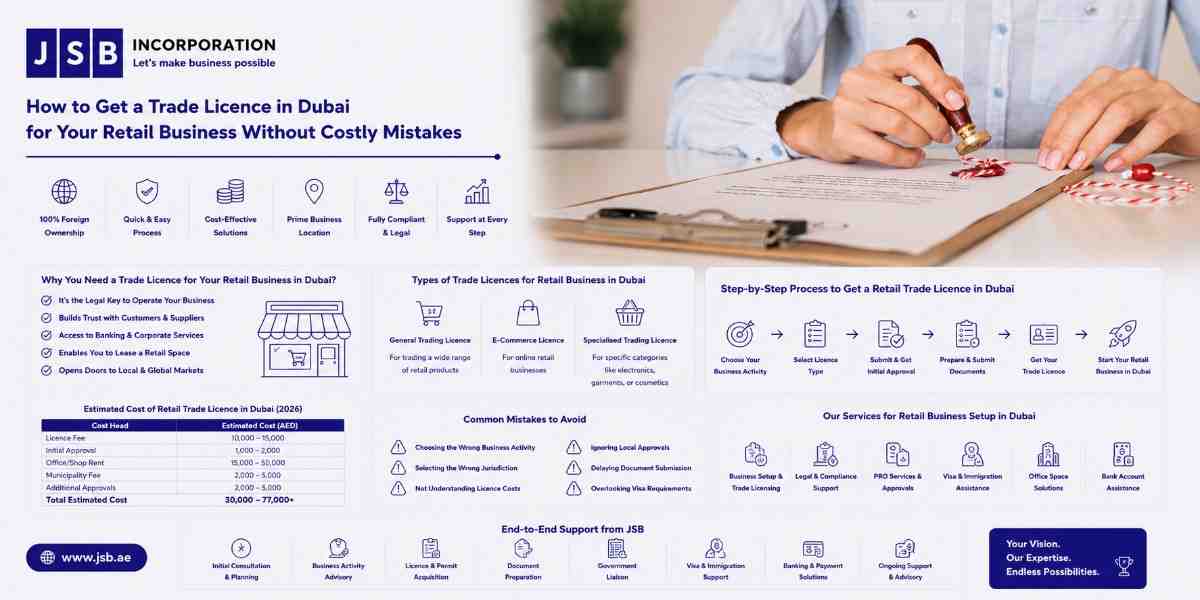
Most retail entrepreneurs discover the trade licence mistake at the worst possible moment: after the licence is issued, when the bank declines to open the corporate account.
Over 60% of UAE corporate bank account applications are rejected at first submission and the top reason cited is a mismatched or unclear business activity on the licence. The licence fee is paid. The paperwork is done. The mistake is already built in.
Keep reading this article to learn more about securing your retail business trade license in the UAE.
TL;DR: Retail businesses in Dubai require a commercial trade licence issued by DET or a free zone authority. A professional licence does not cover the sale of physical goods; using one for retail is a compliance violation that can result in trading penalties and bank account rejection.
DET issues four categories of trade licence for Dubai mainland businesses: commercial, professional, industrial, and tourism. Retail, the sale of physical goods to customers, falls exclusively under the commercial category.
A professional licence covers service-based activities only. Applying for a professional licence to run a retail operation is a direct violation of the licensing framework under DET regulations, and banks flag this mismatch during account due diligence.
Free zone authorities issue their own commercial licences, with scope limited to the zone’s permitted trading territory. Physical retail sales to UAE-based customers from a free zone entity require a separate mainland permit or DET licence.
Your activity codes do not just describe what your business does. They determine what you can legally invoice, what your visa quota is, and what UAE banks see when assessing your corporate account application.
A code that is too narrow blocks revenue streams you planned to use from day one. A code that is too broad triggers compliance scrutiny and processing delays at the authority level.
Getting your activity code wrong is not a paperwork inconvenience — it is the reason banks reject accounts.
A mismatch between your licensed activities and your actual business operations is one of the most cited triggers for corporate account rejection across UAE banks in 2026.
Selecting the right commercial activity codes, mapped accurately to your retail model, is a compliance decision that must happen before submission — not after.
TL;DR: A consultant who validates your activity codes and banking compatibility before submission prevents the restart cost most retail applicants only discover after a bank rejection. Activity code review and jurisdiction fit are not optional steps.
The right consultant maps your retail business model to DET’s approved activity list and confirms that your selected codes cover all current and planned revenue streams.
Consultants who process applications without reviewing banking compatibility transfer the compliance risk entirely to the applicant. You end up with a correctly issued licence that the bank cannot work with.
Ask specifically: does the consultant confirm activity code alignment with UAE bank due diligence requirements before submitting your application to DET?
If that step is not part of the process, the risk stays with you.
Understanding the mainland vs. free zone Dubai distinction is the first structural decision your retail business faces, and it directly affects your licence type, invoice scope, and banking options.
A mainland commercial licence issued by DET is required if you are selling physical goods to UAE-based customers, operating a retail shop, or trading directly with local businesses.
Under Federal Decree-Law No. 26 of 2020, as confirmed by the Ministry of Economy (MOEC) and effective from June 2021, 100% foreign ownership is permitted for the majority of commercial and industrial activities on a mainland licence including most retail categories. A local sponsor is no longer required for these activities.
A free zone licence is suited for import and re-export operations. Selling directly to UAE consumers from a free zone entity requires a separate permit issued by DET. Choosing the wrong structure here affects not just your trading scope but your corporate banking eligibility from the start.
Confirm that your consultant covers VAT registration obligations, annual licence renewal timelines, and Ministry of Human Resources and Emiratisation (MOHRE) employment requirements, not just initial licence issuance. A retail business that triggers VAT registration thresholds needs that process coordinated alongside the licence.
“Gaurav Keswani has been a tremendous help throughout the entire process. His support enabled us to complete everything seamlessly, even accommodating last-minute changes. It was a wonderful experience working with JSB Incorporation. We look forward to a long-term engagement.”
— Veena Talegaonkar, Google Reviews (Company formation, JSB Incorporation)
TL;DR: JSB Incorporation reviews activity codes, jurisdiction fit, and banking compatibility before any application is submitted to DET. This pre-submission review is the step that directly supports JSB’s 97.5% business setup approval rate.
JSB Incorporation reviews each client’s retail business model against DET’s approved activity list before any application is submitted.
The team confirms that the selected activity codes cover all planned revenue streams, match the correct commercial licence category, and align with what UAE banks check during account opening due diligence.
For mainland applicants, JSB also confirms 100% foreign ownership eligibility under the current DET and MOEC framework.
Reviewed by: Gaurav Keswani, Founder JSB Incorporation
Gaurav Keswani is the Founder of JSB Incorporation, a Dubai-based business setup and immigration consultancy. He appeared on Talk 100.3 FM answering live listener questions on UAE Golden Visa eligibility, citing GDRFA and ICP guidelines directly on air. JSB Incorporation handles documentation preparation and application coordination; all visa and license decisions rest with the relevant UAE government authorities—GDRFA, ICP, DET, and DLD.
1. What type of trade licence do I need to sell physical goods in Dubai?
A retail business selling physical goods in Dubai requires a commercial trade licence, not a professional licence. DET issues commercial licences for trading and retail activities on the mainland.
Free zone authorities issue their own commercial licences, but these do not automatically permit direct retail sales to UAE-based consumers—a separate mainland permit is required for that.
2. Can a foreigner own 100% of a retail business in Dubai without a local sponsor?
Yes, for most retail and commercial activities. Federal Decree-Law No. 26 of 2020, effective from June 2021, permits 100% foreign ownership of mainland companies for the majority of commercial and industrial activities, including most retail categories.
The Ministry of Economy (MOEC) and DET administer the updated ownership framework. Certain strategic sectors retain restrictions, but general retail is not among them. Verify your specific activity eligibility with a consultant before application.
3. How long does it take to get a retail trade licence in Dubai?
Most mainland commercial trade licences issued by DET are processed within 5–7 working days, subject to authority processing times. Free zone commercial licences vary by authority.
Timelines depend on trade name approval, document completeness, and activity-specific approvals. JSB Incorporation manages the full submission process to DET to avoid delays from incomplete filings.
4. What happens if I choose the wrong business activity code on my trade licence?
A mismatched activity code creates compliance issues across multiple systems simultaneously. UAE banks check that your licensed activities match your actual business operations during corporate account due diligence — a mismatch is a primary reason accounts are declined at first submission.
Operating outside your licensed activity codes also exposes your business to trading penalties under DET regulations. Amending activity codes after licence issuance incurs additional fees and extends your timeline. Selecting the right codes before submission, not after, is the correct approach.
5. Do I need to register for VAT after getting my retail trade licence in Dubai?
VAT registration becomes mandatory once your annual taxable turnover reaches AED 375,000, per Federal Tax Authority (FTA) rules under the current VAT framework. Voluntary registration is available from AED 187,500.
Retail businesses selling physical goods in the UAE are subject to the standard 5% VAT rate. Understanding VAT registration UAE requirements at the point of setting up your retail licence helps you plan your compliance obligations from day one.
Your retail trade licence is the legal foundation your entire business operation rests on. The activity codes you select determine what you can invoice, which customers you can serve, and whether your corporate bank account application clears.
Getting that right before submission, not after a rejection, is what separates a functioning retail business from an expensive restart.

Office 2505, 25th Floor, Regal Tower, Business Bay, Dubai, UAE P.O Box 27614.
+971 4 824 4842
info@jsbincorporation.com