
 Gaurav Keswani
Key highlights
Have you been running a small trading company in Dubai for three years? And you have noticed a market shifted, your main client moved overseas, and you have decided it is time to close up?
You think you can just stop renewing the license and walk away. Then your accountant tells you that is not how it works and that skipping the proper liquidation process could leave you personally exposed to unresolved debts and tax obligations for years.
That is the reality for a lot of mainland business owners. Once your company has actually traded, a licensed liquidator, not you, has to submit the closure application to Dubai’s Department of Economy and Tourism, the authority formerly known as DED.
The process includes a mandatory 45-day creditor notice period that you cannot skip or shorten, no matter how badly you want a clean exit.
This guide walks you through the real steps, the cost components you should expect, the realistic timeline, and the separate tax deregistration process that catches most owners off guard right when they think they are finished.
Voluntary liquidation is the formal process, supervised by Dubai’s Department of Economy and Tourism, that you go through when your company has traded, settling debts and de-registering the entity from the commercial register.
It is different from simple license cancellation, which applies if your company sat dormant and never actually operated. In that case, you can usually submit the cancellation yourself, without appointing a liquidator.
This distinction shapes your entire cost and paperwork picture. If you ever invoiced a client, opened a business bank account, or hired staff, you are almost certainly looking at full liquidation with a liquidator’s report. If your company never did any of that, you are in much simpler territory.
Here is something that changed your options recently. Federal Decree-Law No. 20 of 2025, which amended the Commercial Companies Law, introduced Article 15 bis, letting you re-domicile your company between authorities instead of dissolving it entirely, for example, shifting registration from the mainland to a free zone.
If your real goal is restructuring rather than a full exit, you now have an alternative worth exploring before committing to liquidation.
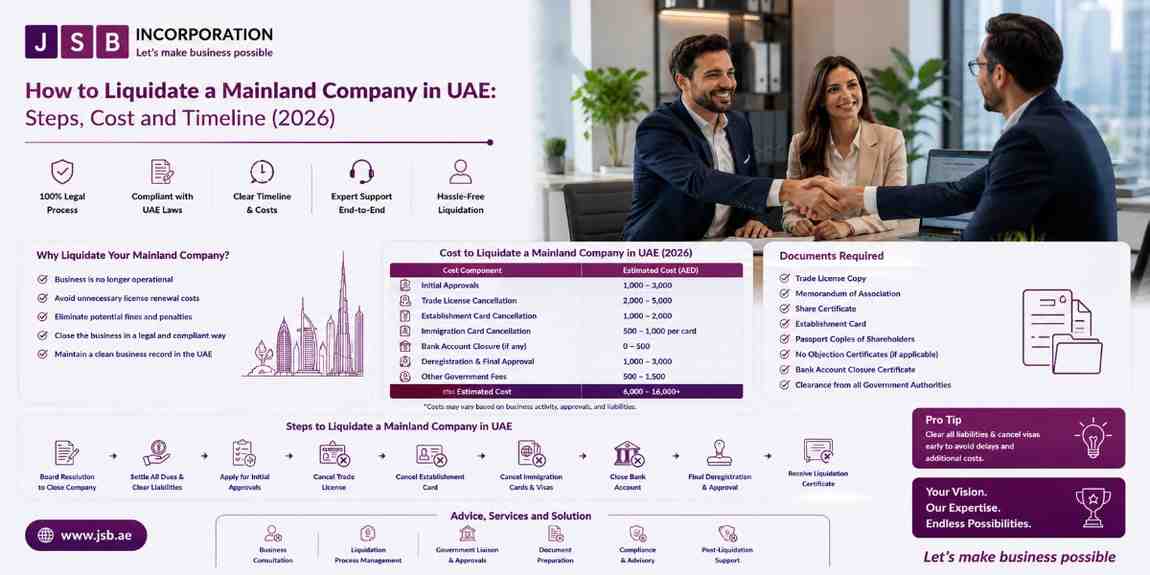
The Dubai process, which most other emirates broadly mirror, runs through Dubai’s Department of Economy and Tourism in a defined sequence.
Here is what you will actually do:
You will also have practical wind-down work running alongside these steps. Closing your company bank account and getting a formal closure letter, settling utility accounts, and clearing dues with your landlord all typically feed into your liquidator’s final report.
Your core paperwork stays fairly consistent, though your emirate and legal structure can add extra items on top.
At minimum, you will need the notarized shareholder resolution, your liquidator’s signed acceptance letter, a trade license copy, an auditor registration certificate, and a notarized signature specimen.
Requirements shift slightly by legal structure too. LLCs, sole establishments, and civil companies each face somewhat different checklists, so confirm your exact list with your local licensing authority before you start.
Every emirate runs its own version of this process, and the differences genuinely affect your timeline and workload.
Emirate | Key requirement | Notice period |
Abu Dhabi | Court decision required; initial service agent contract must be terminated | Varies by court process |
Dubai | Two-phase process through Dubai’s Department of Economy and Tourism; AED 520 dissolution certificate fee | 45 days for creditor claims |
Sharjah | Single establishment card cancellation letter from MOHRE submitted to the local licensing authority | Not separately specified |
Ajman | Partnership termination letter for LLCs; auditor no-objection letter after advertisement | 15 days for sole proprietorships vs. 45 days for LLCs |
If you are closing entities in more than one emirate, do not assume Dubai’s process applies elsewhere. Abu Dhabi’s court requirement in particular can add real weeks to your timeline.
The confirmed government fee for your dissolution certificate in Dubai is AED 520. That is only one line item, though; it does not cover auditor fees, liquidator service charges, or newspaper announcement costs, which private providers set independently rather than on a fixed government schedule.
Think about two different owners closing their companies this year as a simple illustration. One runs a consultancy with no employees, no inventory, and a single dormant bank account; she likely will not need a full liquidator’s report at all.
The other runs a trading company with staff, supplier contracts, and years of invoices; he will need audited financials and a formal liquidator’s report before the authority will even accept his final submission. The difference in their total bills comes down almost entirely to whether the company was operationally active.
Since audit and liquidator pricing is not standardized, get two or three itemized quotes before you commit to anyone. Ask each provider to separate government fees, service fees, and audit costs into distinct line items so you are comparing offers on equal footing.
Disclaimer: The AED 520 dissolution certificate fee is confirmed via official UAE government sources. All other cost components are set by private providers and are not published on a fixed government schedule. Confirm your total costs directly with a licensed liquidator or auditor before budgeting.
The 45-day creditor notice period is a statutory floor in Dubai. You cannot shorten it, no matter how simple your closure looks on paper. This window exists to give creditors a fair chance to file claims before your de-registration is finalized.
Your total timeline stretches beyond that 45-day floor if creditors raise objections, if your audited financials are not ready when you file, or if you are closing entities across multiple emirates with different procedural requirements.
Build in a realistic buffer rather than assuming best-case speed, especially if your bank closure or visa cancellations are tied to your liquidation timeline.
Canceling your trade license does not automatically deregister you from the Federal Tax Authority. That is a separate application you file directly with the FTA.
Two new decree laws add real urgency here. Federal Decree-Law No. 17 of 2025 on Tax Procedures and Federal Decree-Law No. 16 of 2025 on VAT, both effective January 1, 2026, set a five-year limitation period from the end of the relevant tax period for submitting refund or credit balance claims.
If your five-year window expired before January 1, 2026, or expires within a year of that date, you get a one-year transitional window from January 1, 2026, to file. You can also submit related voluntary disclosures within two years of filing, as long as the FTA has not issued a decision yet.
These same amendments give the FTA expanded authority to open audits or deny input tax deductions after the ordinary limitation period, specifically for refund requests filed close to the deadline.
That matters during your wind-down, since final VAT reconciliations often surface credit balances right when you are trying to close your books for good.
Q: Who submits the liquidation application, you or the liquidator?
A: If your company has a trading history, your appointed liquidator submits the application to the relevant licensing authority, not you.
Q: How much does liquidating a mainland company cost?
A: The confirmed government fee is AED 520 for the dissolution certificate in Dubai; your total cost depends on auditor and liquidator fees, which you should confirm with a licensed provider.
Q: How long does liquidation take?
A: The statutory minimum is a 45-day creditor notice period, and your total timeline extends if objections arise or documentation is incomplete.
Q: Do requirements differ by emirate?
A: Yes. Abu Dhabi requires a court decision, Sharjah uses a simplified MOHRE-based process, and Ajman applies different notice periods for sole proprietorships versus LLCs.
Q: Does liquidation automatically cancel my Corporate Tax and VAT registration?
A: No. You must file a separate deregistration application directly with the FTA.
Q: Can you re-domicile your company instead of liquidating it?
A: Yes. Since Federal Decree-Law No. 20 of 2025 amended the Commercial Companies Law, Article 15 (bis) lets you re-domicile between authorities, including between mainland and free zone jurisdictions, as an alternative to full liquidation.Reviewed by:
This article is reviewed by Gaurav Keswani, Founder and Managing Director of JSB Incorporation, a Dubai-based advisory firm specializing in UAE business structuring and cross-border company formation.
Closing a mainland company involves more moving parts than most owners expect, and getting even one step wrong, like filing before your creditor window closes or forgetting your FTA deregistration, can cost you months of delay and unexpected liability.
JSB Incorporation has supported company formation and closures across 24-plus UAE jurisdictions, and our process is built around clear, itemized quotes so you always know what a government fee covers versus what a service fee covers.
Our team coordinates your liquidator, prepares your paperwork, and handles your FTA deregistration filing directly, so you are not managing three separate providers on your own.
Whether you are closing a dormant entity or unwinding an active trading company, we build a realistic timeline around your specific documentation and creditor situation instead of a generic template.
Book your free consultation call today with the experts of JSB Incorporation to learn more.

Office 2505, 25th Floor, Regal Tower, Business Bay, Dubai, UAE P.O Box 27614.
+971 4 824 4842
info@jsbincorporation.com