
 Gaurav Keswani
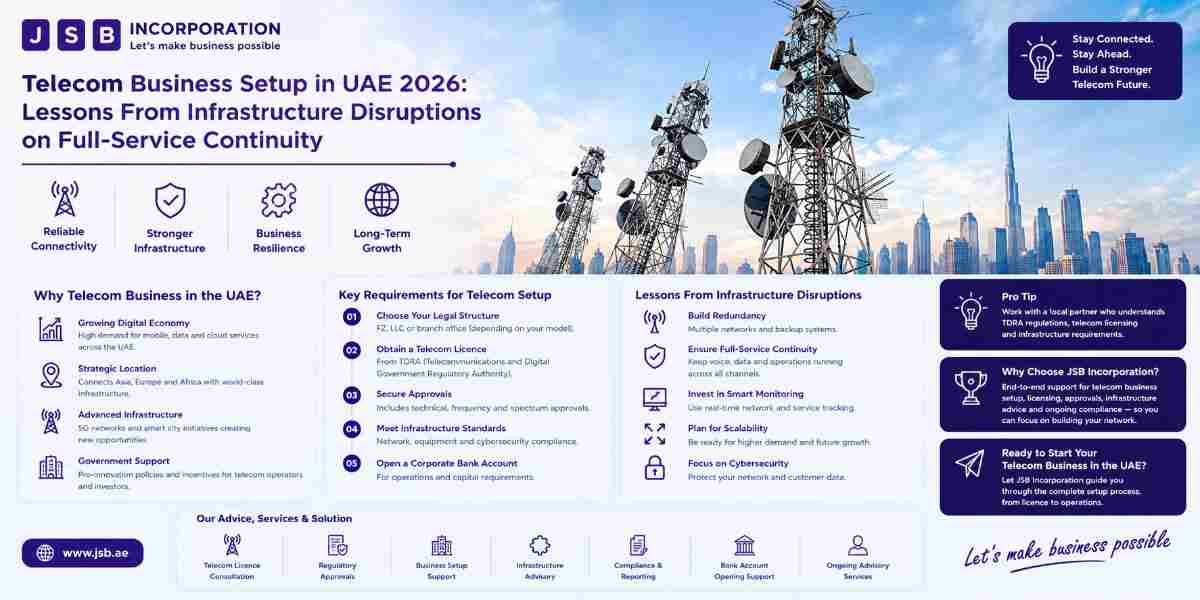
At a Glance
A telecom business in the UAE falls into one of two categories, and the difference determines your licensing path.
Operating a public telecommunications network, the infrastructure carrying voice and data traffic nationwide, requires a licence from the Telecommunications and Digital Government Regulatory Authority (TDRA).
Most entrepreneurs, though, aren’t building network infrastructure. They’re building services that ride on top of existing networks.
These activities typically sit under an ICT free zone trade licence rather than a TDRA network operator licence.
The line between an “ICT service” and a “regulated telecom activity” isn’t always obvious from a free zone’s activity list alone.
Keep reading the article to learn more.
Yes, if you’re operating a free zone ICT business rather than a national network. Free zones registered with the Ministry of Economy and Tourism (MOET) permit up to 100% foreign ownership of companies, with no requirement for a UAE national shareholder.
A full public telecommunications network licence works differently. TDRA issues it to specific approved operators under the Telecommunications Law, and it isn’t a general-application route for a new market entrant.
Mainland activities sit in the middle. Since Federal Decree-Law No. 26 of 2020 reformed the UAE’s Commercial Companies Law, 100% foreign ownership now applies to most mainland commercial activities under Federal Decree-Law No. 26 of 2020.
A short list of strategic-impact activities remains excluded, and national telecom network operation falls into that category.
License Type | Ownership Rule | Applicable Activities | Regulator |
|---|---|---|---|
Full public telecommunications network licence | Issued to TDRA-approved operators; not a general application route | National voice, mobile, and fixed-line network services | TDRA |
Free zone ICT or telecom-adjacent licence | Up to 100% foreign ownership | VoIP, cloud/SaaS, IoT, telecom equipment trading, resale | Free zone authority, MOET-registered |
Mainland ICT or trading licence | 100% foreign ownership for most non-strategic activities | Equipment trading, IT consulting, systems integration | DET |
Costs and regulations are subject to change. Confirm current figures with the relevant UAE government authority or with JSB before making decisions.
If your plan involves a genuine network operator model rather than an ICT service, JSB’s free zone and mainland licensing team can walk you through which route actually applies.
There’s no single best free zone for telecom or ICT activity. Your choice depends on the specific activity you’re licensing, your budget, and how much office space you need.
IFZA business setup (International Free Zone Authority) suits VoIP resale, SaaS, and consulting-style ICT activities since it bundles up to three activities into one licence package.
DMCC company formation (Dubai Multi Commodities Centre) fits telecom equipment trading and businesses wanting a Dubai mainland-adjacent address.
JAFZA company setup (Jebel Ali Free Zone) suits telecom hardware distribution because of its direct port access.
Free Zone | Best Fit for Telecom/ICT | Ownership | Notable Feature |
IFZA | VoIP, SaaS, consulting, resale activities | 100% foreign ownership | Up to 3 activities on one licence |
DMCC | Equipment trading, commodities-linked ICT | 100% foreign ownership | Established commercial ecosystem |
JAFZA | Hardware distribution, logistics-heavy ICT | 100% foreign ownership | Direct port and airport access |
The wrong free zone for your activity can mean re-registering later, which costs time and money, so confirm your activity code before you reserve a trade name.
Registering an ICT or telecom-adjacent business follows a fixed sequence, and skipping a step usually means delays rather than savings. Here’s the order JSB follows for telecom and ICT clients:
Most free zone trade licences are issued within a few working days of document submission, subject to the authority’s processing times.
JSB manages this sequence end-to-end, coordinating with the free zone authority, TDRA, where relevant, and the bank.
One client’s experience captures why that coordination matters. Veena Talegaonkar, reviewing JSB on Google Reviews after incorporating her company, wrote:
“We have recently incorporated our company through JSB Incorporation. Gaurav Keswani has been a tremendous help throughout the entire process. His support enabled us to complete everything seamlessly, even accommodating last-minute changes. It was a wonderful experience working with JSB Incorporation. We look forward to a long-term engagement.“
A free zone trade licence alone may not automatically cover a telecom-adjacent activity. This needs case-by-case confirmation rather than an assumption either way.
TDRA regulates the telecommunications sector under the Telecommunications Law, and activities that look like standard ICT services on a free zone list can still trigger additional scrutiny.
Before you assume your licence covers everything you plan to do, check these points:
If any of these apply to you, consult a licensing specialist before you launch rather than after a regulator flags it, since activity classification and any extra registration are best confirmed in advance.
Setting up an ICT or telecom-adjacent business involves several cost layers: the free zone licence fee, any regulatory application fee, office or flexi-desk costs, and residence visa fees.
Using IFZA’s published 2026 fee schedule as a working example, a zero-visa licence starts at AED 11,900 per year, and a one-visa package starts at AED 14,900 per year.
These figures apply to standard ICT activities and can shift for regulated telecom-adjacent activities requiring extra approval.
Component | Approximate AED Range | One-Time or Recurring |
Free zone trade licence (zero-visa) | AED 11,900 | Recurring, annual |
Free zone trade licence (1-visa) | AED 14,900 | Recurring, annual |
Establishment card | AED 2,000 | One-time, plus renewal |
UAE residence visa fee (2-year validity) | AED 3,750 per visa | Recurring, every 2 years |
Flexi-desk or office space | Varies by free zone | Recurring, annual |
Costs and regulations are subject to change. Confirm current figures with the relevant UAE government authority before making decisions.
Two verified 2026 events are worth building into your setup planning. In early March 2026, Iranian drone strikes hit two AWS data centers in the UAE and damaged a third in Bahrain, knocking availability zones offline.
Amazon confirmed full recovery would take several months, with billing suspended during repairs.
Separately, in July 2026, du confirmed a temporary disruption to calling services in Dubai and Abu Dhabi.
The operator attributed it to a planned system update, and voice calling was restored within about two hours, a materially smaller event than the March strikes.
Together, these incidents point to a practical resilience checklist:
A documented continuity plan isn’t just an internal exercise. It’s something you can point to if a regulator or client asks how your business handles disruption.
TDRA continues to regulate the sector under the Telecommunications Law, with e& and du remaining the UAE’s two licensed public telecommunications operators.
This continuity doesn’t change your licensing route, but it confirms the network layer you’ll build on isn’t in flux, which is a reasonable basis for long-term structuring decisions.
1. Can a free zone company operate a VoIP service in the UAE?
In many cases, yes, under an ICT free zone license, depending on your exact activity. Confirm your specific activity code with the free zone authority before assuming VoIP is covered.
2. What’s the difference between a full network operator licence and a free zone ICT license?
A full network operator licence from TDRA covers building and running a public network, issued only to approved operators. A free zone ICT licence covers services using existing networks, such as SaaS or VoIP, and allows up to 100% foreign ownership.
3. How long does telecom business registration take in the UAE?
Standard free zone trade licences are typically issued within a few working days of document submission, subject to processing times. Regulatory clearance for telecom-adjacent activities can extend this timeline, since it depends on case-by-case review.
4. Can I sell telecom equipment in the UAE without additional regulatory approval?
This depends on the specific equipment and whether it requires type approval before sale or use in the UAE. Don’t assume a standard trading licence covers it without confirming with a licensing specialist.
5. What happens to my telecom business if there’s another regional infrastructure disruption?
The March 2026 AWS strikes and the July 2026 du disruption both showed that even large operators can face extended recovery or short unplanned outages. Multi-region redundancy and a documented continuity plan reduce your exposure.
6. Do telecom free zone companies pay UAE corporate tax?
Free zone companies, including ICT ones, can qualify for a 0% corporate tax rate on qualifying income if they meet the Federal Tax Authority’s Qualifying Free Zone Person conditions. Other income is taxed at 9% above the AED 375,000 threshold.
7. Which free zone has the lowest telecom licence cost?
Cost comparisons shift frequently and depend on your visa allocation and activity count. IFZA’s published 2026 pricing starts at AED 11,900 for a zero-visa ICT license, but the right jurisdiction depends on more than price.
8. Can I upgrade from a free zone ICT licence to a mainland telecom licence later?
Recent amendments to the UAE’s Commercial Companies Law introduced a re-domiciliation mechanism for transferring registration between free zones and the mainland without losing legal continuity. Implementing rules are still being finalized, so confirm the current procedure with JSB first.
Gaurav Keswani is the Founder of JSB Incorporation, a Dubai-based business setup and immigration consultancy. He appeared on Talk 100.3 FM answering live listener questions on UAE Golden Visa eligibility, citing GDRFA and ICP guidelines directly on air. JSB Incorporation handles documentation preparation and application coordination; all visa and license decisions rest with the relevant UAE government authorities—GDRFA, ICP, DET, and DLD.
If you’re weighing a free zone ICT licence against a mainland or TDRA-regulated route, don’t guess your way through it.
Book a consultation with JSB Incorporation for a jurisdiction match based on your actual activity, ownership needs, and continuity requirements.
JSB’s team confirms your activity classification, handles your trade licence application end-to-end, and files any additional regulatory registration your business needs.
That means one point of contact for both the licence and the compliance layer.
Whether you’re reselling network capacity, building a SaaS platform, or trading telecom equipment, JSB can tell you which of its 24-plus jurisdictions fits your business before you commit.
Reach out to JSB Incorporation today to schedule your consultation.

Office 2505, 25th Floor, Regal Tower, Business Bay, Dubai, UAE P.O Box 27614.
+971 4 824 4842
info@jsbincorporation.com