
 Gaurav Keswani
Quick Answer
An offshore company is a non-resident holding or investment vehicle with no UAE trade licence and no office requirement.
A free zone company is a licensed trading entity that can sponsor residence visas under the relevant free zone authority’s own labor and immigration framework and can operate inside its zone or internationally.
You pick one based on whether you need to trade locally or simply hold assets.
Feature | Offshore company | Free zone company |
Ownership | 100% foreign | 100% foreign |
UAE trade licence | No | Yes |
Office requirement | Not required | Usually required |
Visa sponsorship | Not available | Available |
Ability to trade in the UAE | No | Yes, within permitted activities |
Typical use case | Holding assets, wealth structuring | Operating a business with UAE presence |
If you’re building an operating business with staff in Dubai, a free zone company fits better. If you’re structuring international holdings, an offshore vehicle is usually the right tool.
Continue reading to learn more.
RAK ICC is the fastest and most cost-efficient of the three registries. JAFZA Offshore is the only one that lets your entity hold Dubai property in designated developments.
ADGM offers the strongest reputation through its common-law framework. Your choice comes down to speed, property rights, or institutional credibility.
Jurisdiction | Reputation and use case | Property ownership rights | Typical processing time |
RAK ICC | Cost-efficient, high-volume registry | Can register property in Dubai’s designated areas | Same-day to a few working days |
JAFZA Offshore | Established Dubai government free zone registry | Can directly hold property in designated developments | A few working days |
ADGM | Common-law financial centre for holding structures | Generally used for holding structures, not direct Dubai property | A few working days |
The Dubai Land Department’s own investor guidance confirms that the DLD does not allow foreign companies to own real estate directly, but they may register property through subsidiary companies established in Dubai free zones, including JAFZA.
That property-ownership detail matters more to your jurisdiction choice than most comparisons let on.
Government registration fees start at roughly AED 3,250 and vary by registry before you add registered agent and banking assistance charges.
RAK ICC and ADGM both publish their fee schedules directly on their own registry websites; JAFZA does not publish retail pricing, so you’ll need to request a written quote before committing.
Cost component | RAK ICC | ADGM SPV |
Government registration fee | AED 3,250 for a one-year incorporation | USD 1,900 total: name reservation, registration, and commercial licence |
Annual renewal fee | AED 3,950 for a one-year renewal | Approximately USD 1,100, covering licence renewal and a confirmation statement |
Registered agent fee | Charged separately, varies by provider | Required for most non-exempt SPVs, varies by provider |
Bank account assistance | Charged separately | Charged separately |
Costs and regulations are subject to change. Confirm current figures with the relevant UAE government authority or with JSB before making decisions.
You’ll need passport copies, proof of address, and a bank reference letter, and you must appoint a registered agent before the registry accepts your application.
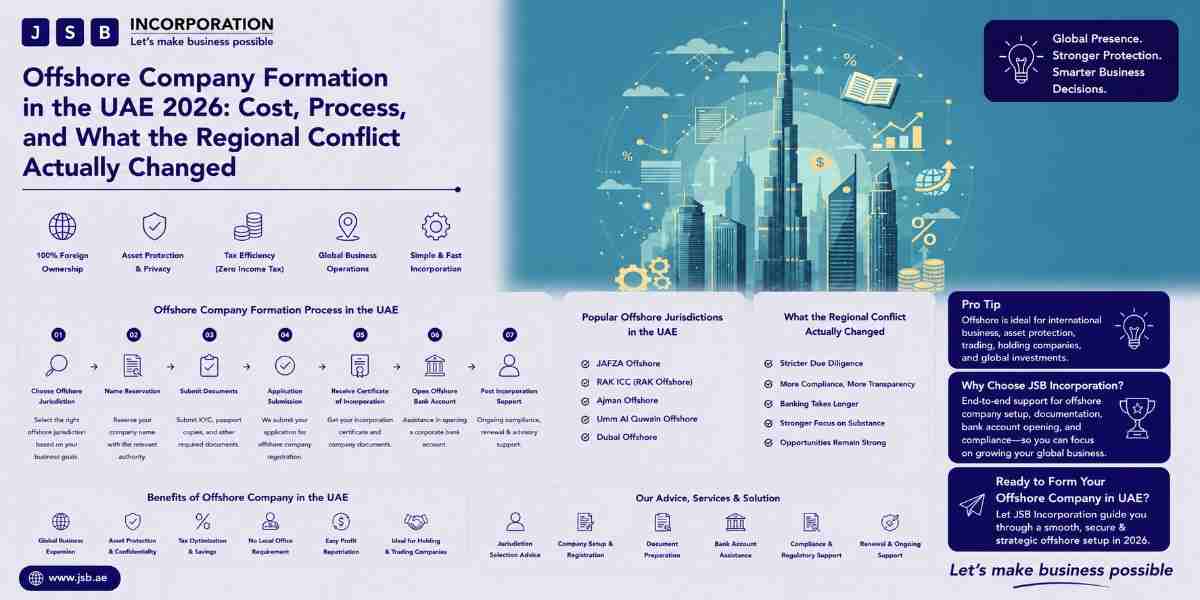
The process runs through six stages, from jurisdiction selection to your first bank account application.
Document checklist:
Before you pay any deposit, verify your formation agent is properly licensed by the relevant registry. Genuine agents appear on the registry’s own public list; if an intermediary can’t confirm this, treat it as a warning sign.
“What a fabulous service by Gaurav. He literally solved our problems for opening a company in UAE. Has a professional team to assist. Amazing customer service. High recommended for company formation. He also assisted us with banking services. Thank you once again.” – Dhaval Shah, Google Reviews
Offshore companies incorporated in the UAE fall within Corporate Tax scope like any other UAE-registered entity.
A Qualifying Free Zone Person can access 0% on Qualifying Income and 9% on non-qualifying income, but that status is separate from simple offshore registration, per the Federal Tax Authority’s Corporate Tax Guide on Free Zone Persons.
To qualify as a Qualifying Free Zone Person, an entity must meet all of these conditions, per the FTA’s guide:
Registering an offshore company doesn’t automatically give you Qualifying Free Zone Person status.
These are separate classifications, so confirm your entity’s status against current FTA guidance before assuming any tax treatment applies. Costs and regulations are subject to change.
Yes to both, with conditions attached to each. Banks apply enhanced know-your-customer checks to offshore entities before opening a business account.
And property ownership is generally limited to JAFZA Offshore and RAK ICC entities registering land in Dubai’s designated developments rather than every registry.
Banking requirements:
Property-ownership conditions:
The picture is genuinely mixed, and it’s worth separating verified data from commentary.
Official 2025 data shows the UAE as the Middle East’s top destination for foreign direct investment, while press and analyst reporting on the February-March 2026 Iran-UAE conflict described real, if uneven, shifts in investor sentiment during the acute phase of the fighting.
Official and government-linked data points:
Third-party market commentary, attributed by outlet:
Treat the press commentary above as attributed opinion and analysis, not as verified fact, when you’re making a structuring decision.
The safe-haven story didn’t disappear, but it got more complicated for a few weeks, and that nuance matters more to your jurisdiction choice than a single headline number.
Also Read:
How to Open an Offshore Bank Account in Dubai: A Complete Guide
Mainland vs. Free Zone vs. Offshore: Best Business Setup Options for Europeans in UAE
Timelines vary by registry. RAK ICC often completes incorporation within a few working days once documents are complete, and JAFZA and ADGM take a similar timeframe.
2. Can a UAE offshore company sponsor employee or investor visas?
No. Offshore companies can’t sponsor residence visas because they hold no UAE trade licence and no physical office presence.
If you need visa sponsorship, you’ll need a mainland or free zone trading entity instead, which JSB can help you structure alongside your offshore holding company.
3. What is the minimum share capital for a UAE offshore company?
Minimum share capital varies by registry and company type, and no single blanket figure applies across all structures.
Confirm the exact requirement for your intended structure directly with your chosen registry or with JSB before drafting your Memorandum of Association.
4. Is an offshore company allowed to invoice UAE mainland clients?
No. Offshore companies are non-resident vehicles and can’t trade with or invoice UAE mainland clients under their offshore licence.
If your model involves local UAE trading, you need a mainland or free zone trade licence alongside or instead of your offshore structure.
5. Do offshore companies need to file audited financial statements?
It depends on your entity’s tax classification, not simply its offshore status. If you seek Qualifying Free Zone Person treatment, the FTA’s guide requires audited financial statements regardless of revenue level. Confirm your specific filing obligations with JSB or a licensed auditor.
6. Can a foreign national be the sole shareholder and director of a UAE offshore company?
Yes, in most cases. UAE offshore registries generally permit 100% foreign ownership with a single shareholder who also serves as director, subject to the registry’s rules and any enhanced due diligence for higher-risk structures. Confirm requirements with your registered agent before submitting documents.
7. Is UAE offshore company formation still worthwhile given the 2026 regional conflict?
The core benefits, full foreign ownership, asset protection, and tax efficiency, remain intact. Official 2025 data shows the UAE as the Middle East’s top FDI destination, even as press reporting described short-term caution during the conflict’s acute phase.
8. What is the difference between an offshore company and an ADGM SPV?
An ADGM SPV is a specific offshore-style vehicle under ADGM’s common-law framework, typically used for holding shares or other assets rather than direct Dubai property registration.
RAK ICC and JAFZA Offshore are separate registries with their own rules, costs, and property rights.
9. How can I verify that an offshore formation agent is licensed before paying a deposit?
Ask the agent for their registered agent licence number and confirm it against the relevant registry’s own published agent list, which RAK ICC, JAFZA, and ADGM each maintain. If an intermediary can’t provide a verifiable licence number, pause before paying any deposit.
Reviewed by: Gaurav Keswani
Gaurav Keswani is the Founder of JSB Incorporation, a Dubai-based business setup and immigration consultancy. He appeared on Talk 100.3 FM answering live listener questions on UAE Golden Visa eligibility, citing GDRFA and ICP guidelines directly on air. JSB Incorporation handles documentation preparation and application coordination; all visa and license decisions rest with the relevant UAE government authorities—GDRFA, ICP, DET, and DLD.
Considering an offshore company in the UAE in 2026? JSB Incorporation’s advisory team can help you choose the right jurisdiction, RAK ICC, JAFZA Offshore, or ADGM, based on your actual goals rather than a generic template.
The team verifies that your formation agent is properly licensed before you pay a deposit, prepares compliant documentation for your registry of choice, and structures your entity with your tax position in mind from day one.
Whether you’re protecting personal assets, holding shares in other companies, or planning a cross-border wealth structure, JSB coordinates the registry paperwork, banking introductions, and compliance checks so you don’t have to chase separate providers for each step of the process.
Book your free consultation call today with the experts of JSB Incorporation to learn more.

Office 2505, 25th Floor, Regal Tower, Business Bay, Dubai, UAE P.O Box 27614.
+971 4 824 4842
info@jsbincorporation.com