
Quick Answer
Do You Actually Need a Trade Licence Before You Can Import From China?
Yes. UAE rules require a valid trade licence covering a trading activity for any commercial import or export business, whether obtained through the mainland formation process or an equivalent free zone route.
Without one, customs clearance, bank trade finance, and bulk resale aren’t legally possible.
A trade licence is what turns a sourcing plan into a legal business. Here is what it unlocks and what stays out of reach without it:
The mainland route follows the “steps to start a business” sequence published by the UAE government, while free zones run a parallel but similarly structured application.
Some product categories, such as food items, pharmaceuticals, or telecommunications equipment, need additional approvals from a specialized authority before the trade licence is issued.
So, it’s worth checking whether a specific China-sourced product category falls into a regulated list before applying.
It depends on where the buyers are. Free zones offer full foreign ownership and are built for re-export and regional trading hubs, while a mainland licence allows direct sales into the local UAE market without needing a distributor in between.
Both routes now allow up to 100% foreign ownership for most trading activities, so ownership alone isn’t the deciding factor anymore. What actually separates them is market access and physical footprint.
Factor | Mainland | Free zone |
Foreign ownership | Up to 100% for most trading activities, per current mainland ownership rules | Up to 100% as the default across licensed activities |
Local UAE market access | Direct, no distributor needed | Requires a distributor or a dual-license arrangement for onshore sales |
Office requirement | Registered tenancy (Ejari or emirate equivalent) mandatory | Flexi-desk or warehouse options available depending on the free zone |
Typical fit | Local distribution, retail supply, government contracts | Re-export, regional trading hub, holding stock for onward shipment |
If most China-sourced goods are heading straight to UAE retailers or end buyers, the mainland is usually the better fit. If Dubai is being used as a re-export base to Africa, the GCC, or South Asia, a free zone setup tends to make more sense.
Banking is one practical difference worth factoring in early. Mainland companies with a local trading history sometimes find it easier to open accounts with UAE banks that prioritize local market activity.
Free zone companies with a clear re-export model need to show banks a well-documented supply chain and buyer list from the outset.
“What a fabulous service by Gaurav. He literally solved our problems for opening a company in UAE. Has a professional team to assist. Amazing customer service. High recommended for company formation. He also assisted us with banking services. Thank you once again.”
Dhaval Shah, Google Reviews
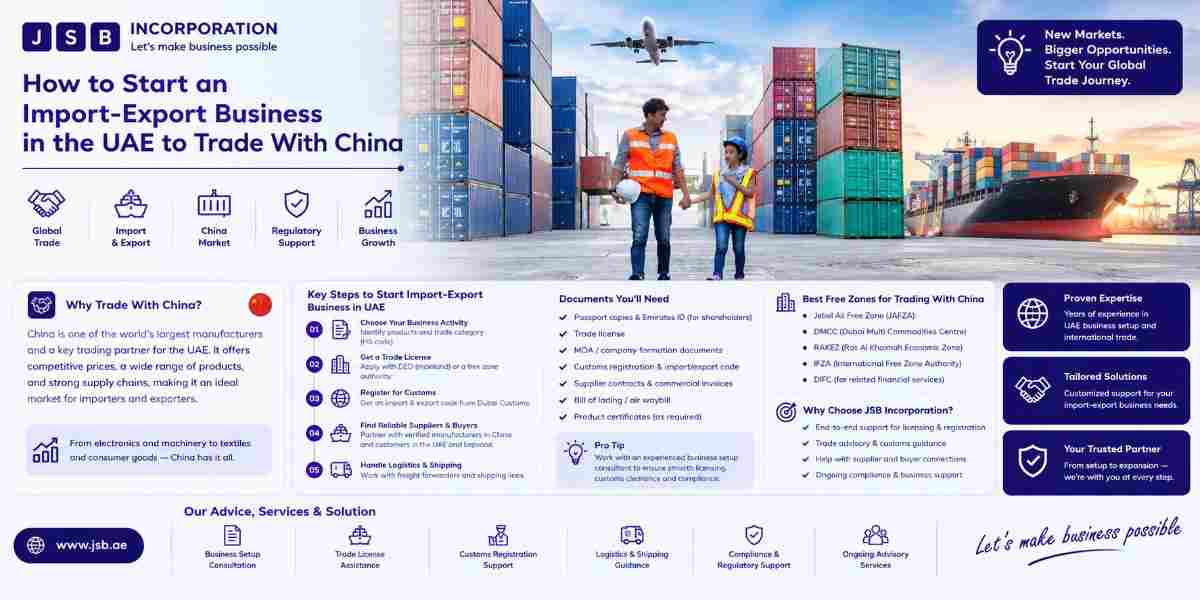
The mainland process follows nine official steps, and most free zones mirror this sequence with jurisdiction-specific paperwork. Following it in order avoids the rejection loops that come from applying before approvals are in place.
This sequence mirrors the UAE government’s published mainland steps, and the activity classification in step one is where most first-time traders lose time, since the wrong activity code can trigger a rejected application.
The mainland baseline covers identity documents, trade name approval, an initial approval certificate, a Memorandum of Association where applicable, and proof of a registered business location.
Free zones may ask for a few jurisdiction-specific extras, so it’s worth confirming with the relevant free zone authority before submission.
Before you apply:
At submission:
Document requirements can shift slightly between free zones, so this checklist reflects the mainland baseline as the reference point.
Total cost depends heavily on whether the structure is mainland or a free zone, how many business activities are registered, and how many visas are needed.
There is no single all-in AED figure that applies across the board, and any number quoted without those variables attached should be treated as a rough estimate at best.
Cost item | Approximate driver | Notes |
|---|---|---|
Trade licence fee | Jurisdiction, activity count | Mainland and free zone fee schedules differ by emirate and free zone authority |
Visa allocation | Office size, employee headcount | More visas typically require larger office space |
Office or facility cost | Flexi-desk vs. warehouse vs. mainland tenancy | Trading and warehousing activities usually need more physical space than services |
Bank account setup | Business profile, transaction volume | Banks assess trade volume and country-of-origin risk before approval |
Compliance and renewal | Annual, based on licence type | Includes trade licence renewal and any mandatory audits |
Yes, for most trading activities. Mainland rules no longer require a majority Emirati shareholder for the great majority of commercial activities, and free zones have offered full foreign ownership by default for years.
A foreign national can typically set up and fully own a general trading or specific commodity trading company on either the mainland or a free zone without a local partner holding equity.
A small number of strategic or regulated sectors still carry additional ownership conditions, so confirming the specific activity against the current mainland ownership list before finalizing a structure is worth doing.
Also Read: How to Start an Import Export Business in JAFZA Free Zone (2026 Step-by-Step Guide)
In principle, yes. The UAE’s Federal Decree-Law No. 20 of 2025 amended the Commercial Companies Law to add a formal mechanism for transferring a company’s registration between free zones and the mainland, or between emirates, without requiring liquidation or re-incorporation.
The Ministry of Economy and Tourism confirmed this directly in a January 2026 briefing on the amendments, describing a new article “regulating and legitimizing the transfer of a company’s registration in the commercial register with the relevant authorities.”
The Ministry also stated the transfer process depends on the compatibility of registration systems between the two locations, the absence of legal impediments, and approval from the relevant authorities.
For import-export businesses, this matters if a company starts in a free zone to take advantage of re-export flexibility and then later needs direct access to the local UAE market.
The exact steps and timelines vary by emirate and free zone, so confirming current requirements with the relevant free zone authority before initiating a transfer is the safest approach.
Costs and regulations are subject to change. Confirm current figures with the relevant UAE government authority or with JSB before making decisions.
1. Do I need to be physically present in the UAE to get an import-export trade license?
Not for every step. Many trade name and initial approval applications can start remotely, but an authorized signatory typically needs to be present for document notarization, bank account opening, and Emirates ID biometrics once the licence is issued.
2. Is a free zone licence enough if I only plan to re-export goods, not sell locally?
Yes, in most cases. Free zones are built for re-export and regional trading, and a free zone trading licence generally covers import, storage, and re-export activity without requiring a mainland presence.
3. Can I start with a free zone company and move to mainland later if I need local distribution?
In principle, yes, since the 2025 Commercial Companies Law amendment introduced a transfer-of-registration mechanism. Current requirements should be confirmed with the relevant authority before relying on this route, since exact steps vary by emirate and free zone.
4. Do I need a local UAE partner to own an import-export company?
No, not for most trading activities. Mainland companies can now be up to 100% foreign-owned for the majority of commercial activities, and free zones already offer full foreign ownership by default.
5. What’s the realistic timeline from application to having a usable trade license?
Timelines vary by jurisdiction and activity, and the mainland’s nine-step sequence has been streamlined considerably compared to a few years ago.
Complex or regulated activities that need extra government approvals will typically take longer than a straightforward general trading licence.
6. Does JSB handle both the company formation and ongoing compliance, or only the initial setup?
JSB handles the full lifecycle, from activity selection and trade licence application through bank account opening, PRO services, and annual compliance and renewal support.
Reviewed by Gaurav Keswani, Founder, JSB Incorporation.
Gaurav Keswani is the Founder of JSB Incorporation, a Dubai-based business setup and immigration consultancy. He appeared on Talk 100.3 FM answering live listener questions on UAE Golden Visa eligibility, citing GDRFA and ICP guidelines directly on air. JSB Incorporation handles documentation preparation and application coordination; all visa and license decisions rest with the relevant UAE government authorities—GDRFA, ICP, DET, and DLD.
Getting the jurisdiction, ownership structure, and documentation right from day one makes the sourcing and shipping side far easier to manage down the line.
JSB Incorporation handles the licensing, banking, and compliance work involved in setting up an import-export company in the UAE.

Office 2505, 25th Floor, Regal Tower, Business Bay, Dubai, UAE P.O Box 27614.
+971 4 824 4842
info@jsbincorporation.com
