
 Gaurav Keswani
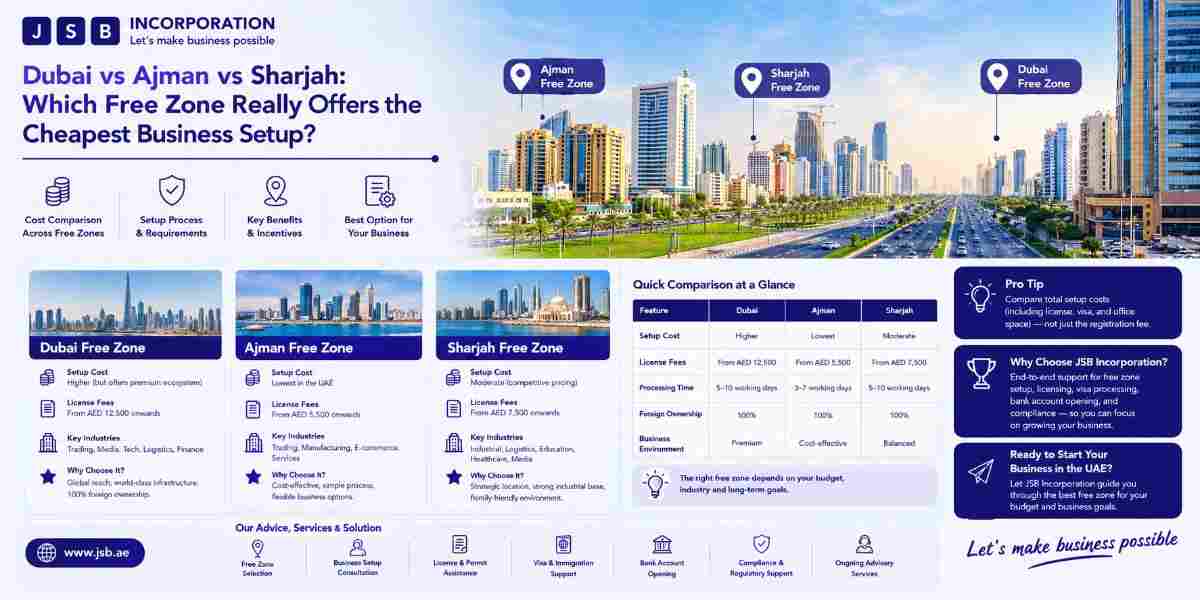
Key Highlights
You cannot rank Dubai, Ajman, and Sharjah on price using a single number you find online because free zone pricing changes throughout the year and none of the three authorities guarantee a fixed rate for future applicants.
Dubai’s IFZA publishes package tiers on its own fee schedule, but the authority reserves the right to amend pricing without prior notice.
Ajman Free Zone and Sharjah’s SHAMS both generate pricing only after you submit your activity and visa needs through their own calculators.
That gap matters more than most comparison content admits. A number quoted without a live link back to the free zone’s own current schedule or calculator output isn’t something you can confirm as accurate today, even if it was accurate when it was first published.
Here is how each jurisdiction actually structures its pricing as of today.
Emirate | Zone authority | Publishes package tiers? | How you get a current figure | Last verified |
Dubai | IFZA | Yes, tiered by visa count and term length | Authority’s own fee schedule, subject to change without notice | 29 August 2026 |
Ajman | Ajman Free Zone | No | Cost calculator on the authority’s own site | 29 August 2026 |
Sharjah | SHAMS | No | Package selection plus a direct enquiry on the authority’s own site | 29 August 2026 |
Requesting quotes from all three jurisdictions in one consultation puts every number on the same footing and protects you from comparing a current Dubai figure against an outdated Ajman or Sharjah number, or the reverse.
Your total first-year cost depends on visa count, the establishment card, and office type, not the headline license fee alone.
Every free zone in the UAE breaks its pricing into the same broad categories, even though the exact amount in each category varies by authority and changes over time.
Cost category | What it typically covers | Applies in |
Base license fee | The core trading, professional, or commercial license for your chosen activity | Dubai, Ajman, Sharjah |
Establishment or registration card | A mandatory immigration file that allows you to sponsor visas | Dubai, Ajman, Sharjah |
Visa allocation | Government-set residence visa components plus the free zone’s own processing charge | Dubai, Ajman, Sharjah |
Medical test and Emirates ID | Mandatory before any residence visa is stamped | Dubai, Ajman, Sharjah |
Office or desk space | Ranges from a shared flexi-desk to a dedicated office, depending on package tier | Dubai, Ajman, Sharjah |
Renewal | Charged annually or per license term, often at a different rate than first-year setup | Dubai, Ajman, Sharjah |
For Ajman and Sharjah, neither authority displays fixed, checkable amounts against these categories on its own official site.
Both confirm the license types they issue, including commercial, industrial, media, e-commerce, and professional licenses, but the exact amount only appears once you run their calculator with your specific activity and visa count.
Dubai’s IFZA publishes tiered package pricing against these same categories, but the authority states plainly that it can revise this pricing without prior notice, so any figure older than your quote date should be reconfirmed.
This is a genuine gap in public, permanently reliable comparison data, not an oversight on our part.
Treat any third-party number for any of the three jurisdictions cautiously unless it links back to that authority’s own current schedule or calculator output, dated the same day you’re reading it.
Dubai jurisdictions generally carry a higher headline price because they bundle banking convenience, business infrastructure, and mainland proximity that lower-cost zones price separately or don’t offer at all.
This isn’t a marketing claim. It reflects what each package actually includes.
Several structural factors drive the difference:
None of this means a Dubai free zone is automatically the right or the wrong choice for you. It means the price gap usually buys something specific, and you should confirm what that is before comparing numbers side by side.
Entry-level free zone prices are usually quoted as zero-visa packages, and a residence visa is a separate, paid add-on with a government-set component.
This holds true across Dubai, Ajman, and Sharjah, even though the bundling differs by jurisdiction.
Here’s how a zero-visa quote typically becomes a real one-visa total:
Some Dubai free zone promotions bundle the visa fee into a one-visa package price for a limited period, so ask whether your quote already includes it or whether it’s a separate line item.
Always ask for the current all-in total, dated the day you receive it, before you compare it against an Ajman or Sharjah quote.
A free zone license generally permits activity within that zone and internationally, while direct mainland trading in a different emirate typically requires a mainland presence, a distributor arrangement, or a separate permit. This applies whether your license is issued in Ajman, Sharjah, or Dubai itself.
Dubai has introduced a framework that lets eligible free zone companies conduct approved mainland activities without a full separate mainland license under an Executive Council resolution covering free zone establishments’ activities.
A permit fee applies and it varies by route, so ask JSB or the Department of Economy and Tourism to confirm the current rate for your specific activity before you apply.
What’s typically included versus excluded when trading across emirates:
Always verify current mainland trading and dual-licensing rules directly against official business services pages before you commit to a jurisdiction based on where your customers are.
Your all-in first-year total, once you add the establishment card, one visa, medical testing, Emirates ID, and desk space, runs meaningfully higher than the headline license price advertised.
This holds true across Dubai, Ajman, and Sharjah alike, regardless of which jurisdiction quotes the lowest starting number.
A representative first-year cost stack looks like this, regardless of jurisdiction:
You’ll only get a checkable, current total once you run each authority’s own calculator or request a dated quote.
That’s exactly why a side-by-side cheapest jurisdiction ranking, built from advertised numbers alone, can mislead you into comparing a month-old figure for one zone against a fresh quote for another.
Ajman Free Zone doesn’t publish a fixed public price, so this claim can’t be confirmed against an official source.
The authority generates pricing only through its own calculator once you submit your business activity and visa requirement.
2. Is a Dubai free zone ever cheaper than Ajman or Sharjah?
It’s possible for a specific activity or visa combination, but you can’t verify this without comparing dated, itemized quotes from all three jurisdictions.
Dubai’s IFZA publishes package tiers that it can revise without notice, while Ajman and Sharjah generate quotes individually per application.
3. What’s excluded from a starting-from-free zone price?
Starting-from prices are almost always zero-visa, license-only figures. They typically exclude the establishment card, visa fees, medical testing, Emirates ID, and desk or office costs, all of which add materially to your first-year total.
4. Does a cheaper free zone restrict the number of business activities allowed?
This varies by jurisdiction and package tier. Check the specific free zone’s own activity policy before assuming a lower-cost package covers the same activity scope as a premium one.
5. Is banking easier with a Dubai free zone license?
This can be true in practice, since several major UAE banks maintain established relationships with certain Dubai free zones. Final account approval always follows the bank’s own published requirements, not the free zone’s location alone.
6. How much does adding one visa cost across these zones?
Per ICP’s official service fee pages, the government-set components of a residence visa are charged as separate application, issuance, and smart-service fees.
Free zones then add their own processing, medical, and Emirates ID charges on top, and these vary by jurisdiction and provider.
7. Do renewal costs differ from first-year setup costs?
Yes. Establishment card renewals, visa renewals, and license renewals are typically priced separately from first-year setup, and some jurisdictions apply late-renewal penalties. Check each authority’s own renewal fee schedule before your first renewal date.
Reviewed by Gaurav Keswani, Founder, JSB Incorporation
Gaurav Keswani is the Founder of JSB Incorporation, a Dubai-based business setup and immigration consultancy. He appeared on Talk 100.3 FM answering live listener questions on UAE Golden Visa eligibility, citing GDRFA and ICP guidelines directly on air. JSB Incorporation handles documentation preparation and application coordination; all visa and license decisions rest with the relevant UAE government authorities—GDRFA, ICP, DET, and DLD.
Choosing between Dubai, Ajman, and Sharjah shouldn’t come down to guessing which advertised price is still current.
JSB Incorporation can request dated, itemized quotes from all three jurisdictions on your behalf, matched to your activity, visa count, and office needs, so you compare real totals instead of headline figures that may have changed.
We’ll flag which costs are one-time versus recurring, so your year-two renewal doesn’t surprise you.
If your plan involves trading into the Dubai mainland from an Ajman or Sharjah base, we’ll walk you through the current permit and dual-licensing options first.
Also Read:
How to Set up a Business in the Ajman Free Zone: Process & Benefits
How to Choose the Right Free Zone in the UAE: 2026 Step-by-Step Guide
UAE Financial Free Zones vs. Standard Free Zones: Where Can You License a Financial Services Company
Free Zone or Mainland: Which UAE Company Structure Fits Your Business?
Tax Benefits for IT Companies in UAE Free Zones: 0% Corporate Tax, R&D Credits and Substance Rules

Office 2505, 25th Floor, Regal Tower, Business Bay, Dubai, UAE P.O Box 27614.
+971 4 824 4842
info@jsbincorporation.com