
 Gaurav Keswani
Key highlights
If you’re running a SaaS company or software consultancy from a UAE free zone, you’ve probably heard someone say you don’t owe any corporate tax at all. That advice is incomplete.
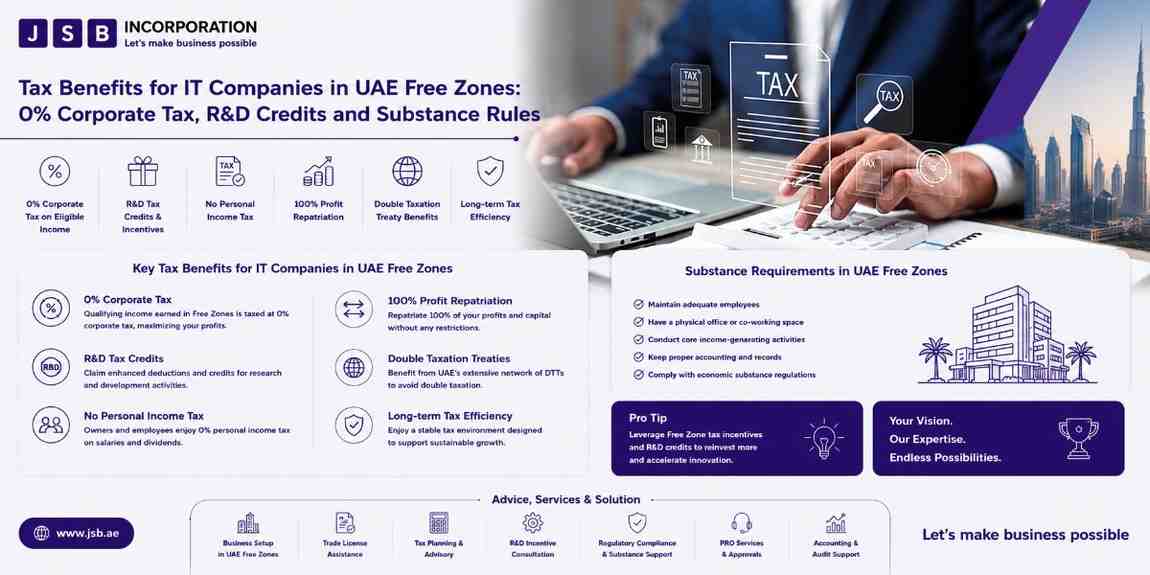
Free zone IT companies can access a 0 percent Corporate Tax rate on Qualifying Income, but only if they meet specific Qualifying Free Zone Person, or QFZP, conditions set by the Federal Tax Authority.
This guide covers those conditions, which activities actually qualify, the new R&D tax credit you can stack on top, and where the old Economic Substance filing rules stand today.
Picture this. You set up a software company in a Dubai free zone two years ago, assuming “free zone” meant “tax-free,” full stop. That assumption is a myth that keeps getting corrected in founder communities discussing UAE corporate tax rules.
You register your company on EmaraTax and move on, then your accountant flags that revenue from individual app subscribers doesn’t count as Qualifying Income and gets taxed at 9 percent.
This is one of the most common misunderstandings among IT founders who assume free zone status alone is a tax shield, and it usually only surfaces once a full income mix review is done.
No, not automatically. Corporate Tax in the UAE applies at 0 percent on taxable income up to AED 375,000 and at 9 percent above that threshold, and the regime continues honoring incentives for free zone businesses that meet regulatory conditions and don’t conduct mainland business.
The Federal Tax Authority has confirmed that all Free Zone Persons must still register for Corporate Tax, regardless of whether they ultimately qualify for the 0 percent rate. That single requirement trips up founders who assume registration only applies once tax is actually owed.
Registering does not mean you owe tax. It means the Federal Tax Authority can assess whether your income mix and structure meet the 0 percent conditions in the first place.
You must meet several conditions together, not just one or two, and the 0 percent rate applies only to Qualifying Income as defined in the Federal Tax Authority’s dedicated Free Zone Persons Corporate Tax Guide.
There is also a permanent establishment rule worth flagging. If your QFZP entity operates through a permanent establishment inside or outside the UAE, whether that is a branch, a fixed place of business, or a dependent agent arrangement, the profits attributable to that permanent establishment are taxed at the standard 9 percent rate even if the rest of your income qualifies for 0 percent.
This matters for IT companies that open a satellite office on the mainland while keeping their free zone entity as the primary vehicle.
Qualifying Activities include holding shares and securities, fund and wealth management, headquarters and treasury services, and trading of qualifying commodities from a designated zone, while most transactions with individual consumers and certain IP income fall outside the regime and get taxed at 9 percent.
Category | IT business model | Likely tax treatment |
|---|---|---|
SaaS | B2B SaaS sold to other free zone or mainland companies | May qualify for 0% if it fits recognized Qualifying Activities and substance conditions are met |
Intellectual Property | IP licensing income outside the qualifying IP regime | Generally excluded, taxed at 9% |
Services | Services sold directly to mainland clients or through a mainland branch | Generally taxed at 9% on that portion |
B2C | Consumer-facing app or SaaS sold to individual end users | Generally excluded as income from natural persons, taxed at 9% |
Freelance | Freelance or solo IT consulting to individuals | Falls outside Qualifying Income in most cases |
Confirm your specific classification against the Federal Tax Authority’s official Free Zone Persons Corporate Tax Guide before you file, since activity level nuances can shift the outcome.
Both free zone and mainland companies must register for Corporate Tax regardless of whether they expect to owe anything, but the rate treatment and available reliefs differ.
Factor | Free zone (QFZP) | Mainland |
Corporate Tax registration | Mandatory | Mandatory |
Rate on qualifying activity income | 0% | Not applicable in the same way |
Rate on non-qualifying or excluded income | 9% | 9% above AED 375,000 |
Small Business Relief | Not available under QFZP regime | Available under standard regime if turnover conditions are met |
Common entity types | FZ Co., FZE, branch | LLC, PJSC, branch |
If your free zone company does not meet QFZP conditions in a given period, it falls back to standard 9 percent treatment rather than automatically picking up Small Business Relief.
The Ministry of Finance launched Phase 1 of the R&D Tax Incentives Program, letting businesses claim a non-refundable R&D tax credit of up to 50 percent on qualifying expenditure, effective for tax periods or fiscal years commencing on or after 1 January 2026.
The framework runs through Cabinet Decision No. 215 of 2025 and Ministerial Decision No. 24 of 2026, whose operational text was published on 18 March 2026.
Per the official decision text, the credit rate depends on both spending level and R&D staff headcount, and both thresholds must be met together for a given tier to apply:
This credit applies across UAE entities, Free Zone Persons, and permanent establishments alike, so your free zone software company is not excluded just because it already benefits from the 0 percent Corporate Tax rate.
Qualifying Staff Costs get a 30 percent uplift for attributable overheads, there is a minimum spend threshold of AED 500,000 per R&D project per tax period, and pre-approval from the Emirates Research and Development Council is mandatory before claiming anything.
Documentation must be retained for 7 years, and the credit is non-refundable but can offset both Corporate Tax and Top-up Tax liability under Pillar Two.
One boundary worth knowing is that Qualifying R&D Activities exclude work in the social sciences, humanities, or arts, so the credit is aimed squarely at technical and scientific research.
If your company claims the R&D Tax Credit and then, within five years of the last claim, becomes a Qualifying Free Zone Person, applies Small Business Relief, enters liquidation, or redomiciles outside the UAE, any utilized credit gets clawed back and treated as payable tax.
This means the sequence of your tax planning decisions matters. If you are weighing whether to pursue R&D credits now versus locking in QFZP status later, get advice on sequencing before filing either claim.
Not automatically. Qualifying R&D Activities must be novel, aiming to produce new findings, and meet criteria aligned with internationally recognized R&D principles, including the OECD Frascati Manual: creative, uncertain in outcome, systematic, and reproducible or transferable.
Building genuinely new algorithms or solving technical problems with an uncertain outcome tends to fit this bar far more than routine work does.
Routine feature updates, standard bug fixes, or customizing off-the-shelf software for a client generally will not qualify.
Pre-approval from the Emirates R&D Council is the practical gatekeeper, so map your engineering roadmap against these criteria before assuming a project qualifies.
No. The Ministry of Finance cancelled the Economic Substance Notification and Report filing requirement for financial years ending after 31 December 2022, under Cabinet Decision No. 98 of 2024, and penalties tied to those years were cancelled or refunded.
Substance requirements did not disappear, they moved. What used to sit in a standalone Economic Substance Regulations filing now lives inside the Corporate Tax Law itself and is assessed as part of ongoing QFZP eligibility rather than a separate annual report.
Economic Substance Regulations obligations for financial years between 1 January 2019 and 31 December 2022 remain in force, and the Federal Tax Authority retains a six-year audit window to review compliance for those years.
If a free zone entity fails the adequate substance test in any tax period, it loses the 0 percent rate not just for that period but for the following four years as well, five years total at the standard 9 percent rate.
This is a heavier consequence than many founders realize, and it is one more reason substance cannot be treated as a paperwork formality.
Registration happens through the EmaraTax platform, available around the clock.
You create a Taxable Person Profile and submit your trade license, Memorandum or Articles of Association, and Emirates ID or passport details for owners holding more than 25 percent ownership.
Solo or freelance IT consultants operating as natural persons only need to register once business revenue exceeds AED 1 million annually.
No. Only Qualifying Free Zone Persons earning Qualifying Income get the 0 percent rate, and every free zone company still has to register for Corporate Tax.
2. What counts as Qualifying Income for a free zone software company?
Income from recognized qualifying activities such as transactions with other free zone persons, fund or treasury services, and qualifying commodity trading. Sales to individual consumers and certain IP income are generally excluded.
3. Can a free zone IT company claim the R&D tax credit and keep its 0% rate?
Yes. The credit is available to UAE entities, Free Zone Persons, and permanent establishments alike, offsetting Corporate Tax and Top-up Tax liability rather than replacing QFZP status. Watch the five-year claw-back rule if your status changes later.
4. Do free zone tech companies still need to file an Economic Substance Report in 2026?
No, Economic Substance Regulations notification and report filing were cancelled for financial years ending after 31 December 2022, though adequate substance continues to be assessed under Corporate Tax and QFZP rules.
5. What is the minimum spend to qualify for the R&D Tax Credit?
AED 500,000 per R&D project per tax period, with staffing minimums rising at each tier: 2 staff at 15 percent, 6 staff at 35 percent, and 14 staff at 50 percent.
6. How do I register my UAE free zone IT company for Corporate Tax?
Through the EmaraTax portal, by creating a Taxable Person Profile and submitting your trade license, Memorandum or Articles of Association, and owner identification documents.
Navigating QFZP conditions, R&D credit pre-approval, and Corporate Tax registration on your own can eat up hours better spent building your product.
JSB Incorporation helps IT founders and CFOs set up and structure UAE free zone entities with transparent pricing and end-to-end support across 24-plus jurisdictions, including DMCC, IFZA, and JAFZA, with a track record of getting entities operational in weeks rather than months.
Whether you are figuring out if your income mix qualifies for 0 percent, planning your R&D documentation, or just need clarity on registration steps, our team can walk through your specific situation with you.
Book your free consultation call today with the experts of JSB Incorporation to learn more.

Office 2505, 25th Floor, Regal Tower, Business Bay, Dubai, UAE P.O Box 27614.
+971 4 824 4842
info@jsbincorporation.com