
 Gaurav Keswani
Quick Answer
Dubai’s catering sector keeps growing alongside the emirate’s tourism calendar.
If you’re weighing a catering business in Dubai, resolve four decisions before you file anything. This includes the following:
This guide walks you through each decision in the order you’ll face it. Keep reading to learn more.
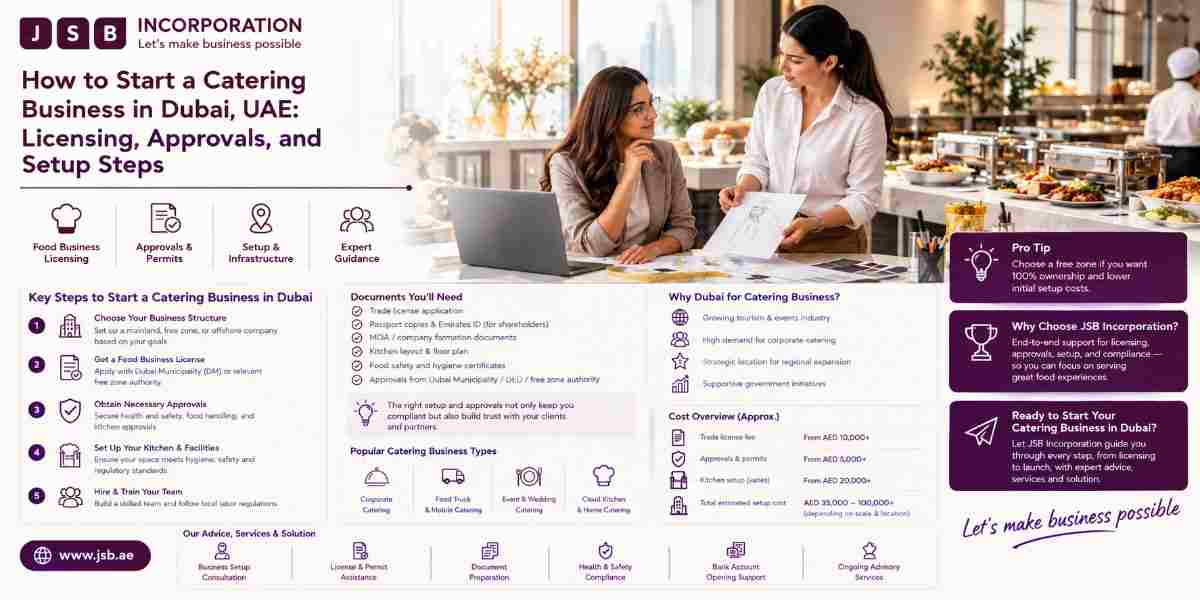
Catering in Dubai requires two separate approvals, not one. You need a commercial trade licence covering the catering activity, issued through DET, plus a food-safety establishment approval from Dubai Municipality before your kitchen can operate.
Treating these as one step is the most common mistake new caterers make. The trade licence confirms you can legally run the business; the food-safety approval confirms your kitchen meets Dubai’s food-handling standards. You need both before your first booking.
JSB coordinates both approvals in parallel, which shortens the runway to your first day of trading.
Your jurisdiction choice depends on where your clients are. Mainland structuring suits caterers serving events and corporate clients across Dubai, while free zone structuring can work for corporate-only catering or businesses that don’t need to trade freely outside their zone.
The UAE’s official free zone framework confirms that free zone companies can take the form of an LLC, a free zone company, a free zone establishment, or a branch structure, with the exact entity types available varying by individual free zone authority.
JSB’s free zone company setup guide covers the entity choice in more depth. That flexibility matters for catering founders because your entity type can affect visa allocation and ownership structure later.
Feature | Mainland | Free Zone |
|---|---|---|
Market access | Can serve clients and events anywhere in Dubai without an intermediary | Typically scoped to the free zone framework; confirm current activity-scope rules with the relevant free zone authority before assuming mainland access |
Visa allocation | Tied to office or kitchen space quota approved by the licensing authority | Tied to the free zone’s own space and package allocation rules |
General use case | Founders catering weddings, corporate events, and venues across the city | Founders running back-office, export-only, or corporate-only catering operations |
Setup cost structure | Varies by activity scope, office size, and local service agent requirements where applicable | Varies by free zone package, kitchen facility access, and visa allotment |
Confirm any mainland-access restriction directly with the relevant free zone authority and DET before you commit to a jurisdiction, since scope rules vary by free zone and can change.
Gaurav Keswani has noted the broader shift in UAE business licensing speed: “Before COVID, opening a business license in Dubai required a minimum of one week of personal time investment. Today, the process has been streamlined to just a few steps, sometimes completed on the same day.”
That speed applies to the trade licence stage; food-safety timelines run separately.
The general sequence for a catering licence runs from name reservation through to final inspection.
Treat this as a framework, not a checklist, since the Dubai Municipality and DET set the exact document list and it can change.
JSB’s PRO team handles the DET and Dubai Municipality submissions on your behalf at each stage, which cuts down the number of authority visits you need to make yourself.
“We have recently incorporated our company through JSB Incorporation. Gaurav Keswani has been a tremendous help throughout the entire process. His support enabled us to complete everything seamlessly, even accommodating last-minute changes. It was a wonderful experience working with JSB Incorporation. We look forward to a long-term engagement.” (Veena Talegaonkar, Google Reviews)
Yes. Dubai Municipality’s food-safety approval is generally mandatory for any catering operation with a physical kitchen, and it applies on top of your trade license, not instead of it. The framework governs kitchen layout, hygiene protocols, and staff training before you can legally prepare food for sale.
Dubai Municipality’s published Food Code confirms that food establishments must hold a valid trade licence before starting operations and must maintain a documented, Dubai Municipality-approved food-safety program that identifies and controls hazards.
That program is typically where HACCP (Hazard Analysis and Critical Control Points) principles come into play, since Dubai Municipality’s review checks how you identify and manage risk points in your kitchen process.
Confirm the current legal basis and HACCP requirement directly with Dubai Municipality’s official publication before you rely on any secondhand summary.
Costs and regulations are subject to change. Confirm current figures with the relevant UAE government authority or with JSB before making decisions.
Total setup cost for a catering business depends on your jurisdiction, kitchen fit-out scale, and the permit fees DET and Dubai Municipality apply to your activity.
There isn’t one universal number, and any article giving you a single flat figure is estimating, not quoting current fees.
Cost component | What determines it |
|---|---|
Trade licence fee | Activity classification and jurisdiction (mainland vs. free zone) |
Food-safety establishment approval | Kitchen size, layout complexity, and inspection scope |
HACCP-aligned food-safety programme | Whether you build it in-house or engage a compliance consultant |
Kitchen fit-out | Equipment scale, commercial-grade fixtures, and facility location |
Staff visas | Number of employees and their role categories |
One figure you can plan around with certainty is tax: the Federal Tax Authority applies UAE corporate tax at 9% on taxable income above AED 375,000, with no tax below that threshold.
Beyond tax, get a tailored cost estimate for your specific catering model rather than relying on a generic figure.
Yes, a catering business can support a residence visa, and the visa quota generally ties to your licence type and the physical space you’ve leased.
Larger catering ventures with significant capital investment or tax contribution may also open the door to Golden Visa eligibility.
The UAE’s official Golden Visa framework sets the investor route at a minimum capital of AED 2 million, whether through public investments, real estate, or contribution to an establishment or, alternatively, through ownership of a business paying at least AED 250,000 annually in federal taxes.
Entrepreneurs can also qualify through a five-year route by documenting an innovative or technical project with support from an approved business incubator or the competent local authority.
JSB’s Golden Visa guide breaks down every eligibility route in detail.
1. What’s the difference between a catering licence and a restaurant licence in Dubai?
A catering licence generally covers off-site food preparation and delivery for events, while a restaurant licence covers on-premises dining service.
The activity classifications differ under DET, and each carries its own food-safety review scope from Dubai Municipality. Confirm the exact classification boundaries with DET before you apply.
2. Can a free zone catering company serve clients outside its free zone?
This depends on the specific free zone’s activity-scope rules, which vary and can change.
Verify current scope rules directly with your chosen free zone authority and DET before assuming mainland access.
3. Do I need a liquor licence if I cater events serving alcohol?
Serving alcohol at catered events in Dubai typically requires separate alcohol-handling permissions beyond your standard catering licence.
Requirements vary by venue and event type, so confirm the current framework with the relevant licensing authority before planning an event involving alcohol service.
4. How long does food-safety approval for a catering kitchen typically take?
Timelines depend on Dubai Municipality’s inspection scheduling and how quickly your kitchen layout meets their standards on first review. There’s no fixed universal timeframe, so confirm current processing expectations directly with Dubai Municipality when you submit your application.
5. Can I run a home-based catering business in Dubai?
Home-based catering setups face additional scrutiny under Dubai Municipality’s food-safety standards, since kitchen approval generally assumes a commercial-grade facility.
6. Is VAT registration mandatory for a new catering business?
VAT registration becomes mandatory once your taxable supplies and imports exceed AED 375,000 over the previous 12 months or you expect to cross that threshold within the next 30 days, per Federal Tax Authority rules. Voluntary registration is available from AED 187,500.
7. What happens if I operate without HACCP certification?
Operating a catering kitchen without Dubai Municipality’s required food-safety program, including HACCP-aligned hazard controls, generally risks enforcement action and can jeopardize your trade licence standing.
8. Can I convert a free zone catering licence to a mainland one later?
Converting a free zone catering licence to a mainland one is generally possible but involves a fresh mainland application rather than a simple transfer.
Reviewed by Gaurav Keswani
Gaurav Keswani is the Founder of JSB Incorporation, a Dubai-based business setup and immigration consultancy. He appeared on Talk 100.3 FM answering live listener questions on UAE Golden Visa eligibility, citing GDRFA and ICP guidelines directly on air. JSB Incorporation handles documentation preparation and application coordination; all visa and license decisions rest with the relevant UAE government authorities, GDRFA, ICP, DET, and DLD.
Choosing a mainland or free zone for a catering business isn’t a decision you want to reverse after you’ve fitted out a kitchen.
We’ll walk you through the trade licence and food-safety sequence, coordinate the DET and Dubai Municipality submissions in parallel, and flag whether your investment level opens a Golden Visa route worth planning around.

Office 2505, 25th Floor, Regal Tower, Business Bay, Dubai, UAE P.O Box 27614.
+971 4 824 4842
info@jsbincorporation.com