
 Gaurav Keswani
Key Highlights
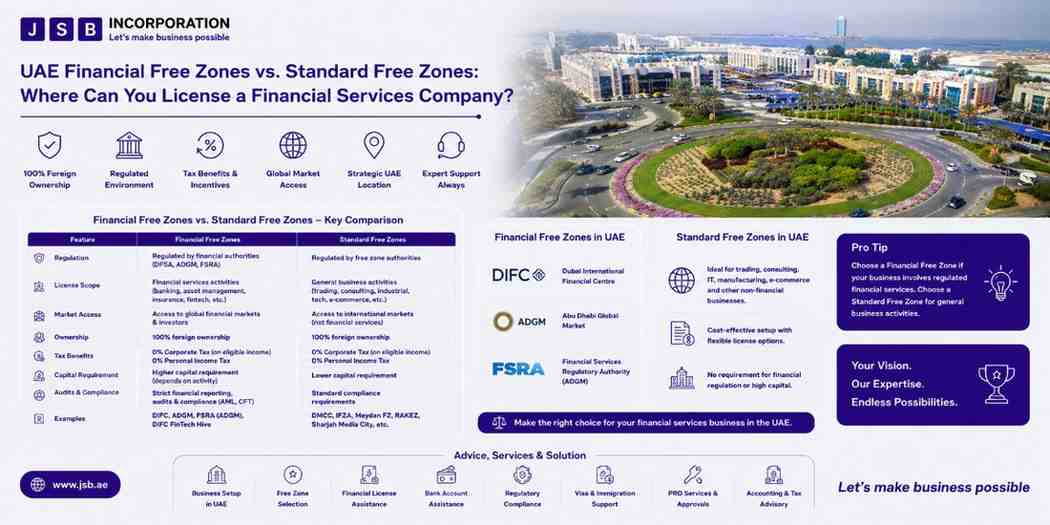
Only DIFC and ADGM can legally host CBUAE, DFSA, or FSRA-regulated financial services in the UAE. Standard commercial free zones like DMCC and IFZA can license finance-adjacent activities but not regulated ones, and Golden Visa eligibility follows its own separate rules.
Minimum paid-up capital ranges from AED 2 million for a basic exchange business licence to AED 150 million for a finance company. UAE Golden Visa eligibility runs through ICP’s own investment or business criteria and applies independent of which free zone hosts your company. Costs and regulations are subject to change.
If you’re weighing a financial services setup in the UAE, the first decision isn’t which emirate to pick. It’s whether your activity even qualifies for a standard free zone licence or needs a true Financial Free Zone. This distinction shapes your capital requirements, your regulator, and your long-term compliance load, so it’s worth getting right before you register anywhere.
Keep reading this article to learn more about setting up your financial service business in the UAE.
Only zones designated as Financial Free Zones under UAE federal law can host CBUAE, DFSA, or FSRA-regulated financial activities, and today that means exactly two zones: the Dubai International Financial Centre (DIFC) and Abu Dhabi Global Market (ADGM).
The CBUAE Rulebook’s own AML and licensing definitions separate Financial Free Zones of the UAE, such as DIFC and ADGM, from the general category of standard free zones when applying federal licensing provisions.
Here’s how the two recognized Financial Free Zones differ in regulation and location:
Financial Free Zones follow a separate regulator rulebook and legal system from standard commercial free zones, which fall under normal UAE federal company law instead.
Under the CBUAE Rulebook, entities in DIFC and ADGM are treated distinctly from entities registered in standard free zones for AML compliance and licensing purposes, since the Financial Free Zone category is carved out on its own.
A DMCC or IFZA company setup, by contrast, follows UAE federal commercial law and its own free zone authority’s licensing framework rather than a dedicated financial regulator’s rulebook.
This means the two paths lead to very different compliance calendars, reporting obligations, and even court systems in the case of disputes. DIFC and ADGM both run independent common law court systems, separate from Dubai and Abu Dhabi’s onshore courts.
Getting this distinction wrong at the licensing stage can mean re-registering later if your activity turns out to require CBUAE, DFSA, or FSRA oversight. That’s a costly and time-consuming correction to make after you’ve already signed a lease and hired staff.
Minimum paid-up capital under the CBUAE Rulebook scales sharply by activity type and legal form. The requirement runs highest for finance companies and lowest for basic exchange business categories.
Activity | Minimum paid-up capital |
Finance company | AED 150 million |
Exchange business, Category I | AED 10 million |
Exchange business, Category II | AED 5 million |
Exchange business, Category III | AED 2 million |
Exchange business, limited liability company form | AED 25 million |
Insurance broker established in the UAE | AED 3 million |
Finance companies must also keep aggregate capital funds from falling below AED 150 million on an ongoing basis. If a shortfall occurs, the company must submit a rectification plan to the Central Bank within 30 working days.
Insurance brokers established in the UAE must keep UAE national ownership at no less than 51% of total paid-up capital. Costs and regulations are subject to change.
These thresholds explain why most entrepreneurs testing a fintech idea don’t jump straight into a full finance company licence. Many start with a narrower, less capital-intensive activity and expand once the business model proves out.
Standard commercial free zones can license finance-adjacent activities such as investment holding or management consulting, but they can’t host CBUAE-regulated financial services, which remain restricted to Financial Free Zones.
The CBUAE Rulebook’s own definitions treat DIFC and ADGM separately from the general free zone category used for federal licensing and AML rules, meaning a licence from DMCC, IFZA, or any similar zone doesn’t carry the same regulatory permission.
Here’s the practical breakdown:
Many entrepreneurs assume “fintech” automatically means DIFC or ADGM, but software-only or advisory-only models often qualify for a standard free zone licence instead, at a fraction of the capital commitment.
Golden Visa eligibility depends on meeting ICP’s investment, business, or talent criteria, and it applies independent of which free zone your company is registered in.
The real estate investor route requires a property value of at least AED 2 million, confirmed through a letter from the Real Estate Registration Department, regardless of whether your income or company sits in DIFC, ADGM, or elsewhere.
Here’s how the main routes break down:
As JSB’s founder Gaurav Keswani explained during his Talk 100.3 FM appearance, “Right now, the government has been very actively offering golden visa services to the right mindset. So if anyone happens to know they would be able to qualify across, please reach out to the immigration office.”
“JSB Incorporation was recommended to me by a friend and they helped me throughout the process of my Golden Visa application. I had a fabulous experience working with Gaurav and Beena for my Dubai Golden Visa application. The entire process was managed with impeccable professionalism, sound knowledge, transparency and sharp communication. A special shout-out to Gaurav, who went above and beyond at particularly the week I was in Dubai, extremely proactive, always responsive and alert with every single question I had. Overall, I would highly recommend JSB incorporation for any similar visa related advisory and support, or broadly on business setup assistance in the UAE.” Rajnish Pal, Google Reviews
Costs and regulations are subject to change. Confirm current figures with the relevant UAE government authority or with JSB before making decisions.
Ultimate Beneficial Owner filing obligations apply across the UAE, but Financial Free Zone entities in DIFC and ADGM operate under their own regulator’s compliance framework alongside federal AML rules.
Because the CBUAE Rulebook treats Financial Free Zones as distinct from standard free zones for AML and licensing purposes, a DIFC or ADGM entity’s UBO filing pathway can differ procedurally from a DMCC or IFZA entity, even though the underlying obligation to disclose beneficial ownership applies broadly.
Don’t assume your UBO filing obligation disappears just because you’ve registered in a Financial Free Zone. Businesses should confirm the specific UBO filing route with their registered agent or the relevant authority before assuming any exemption applies.
The right choice comes down to your activity, not your budget alone. If your business model requires CBUAE, DFSA, or FSRA licensing, DIFC or ADGM is your only legal path, no matter how much capital you have available.
If your activity is finance-adjacent but not directly regulated, a standard free zone can save significant time and capital while you validate the business.
Consider these factors before you decide:
JSB’s activity-classification consultation walks through each of these factors with you before you commit to a jurisdiction, so your first registration is also your right one.
For activity that requires CBUAE, DFSA, or FSRA regulatory licensing, yes, only DIFC and ADGM qualify as Financial Free Zones.
Fintech companies conducting non-regulated activities, such as software development or consulting without handling client funds, can register in standard free zones like DMCC or IFZA instead, at a fraction of the capital and compliance burden.
2. Do Financial Free Zone companies need a physical office to hold a regulated license?
DIFC and ADGM both require a physical presence appropriate to the licensed activity as part of their regulatory frameworks.
Exact office requirements vary by licence category and regulated activity, so confirming the specific requirement with DFSA or FSRA directly before signing a lease is the safer approach rather than assuming a shared workspace will suffice.
3. Can a mainland company apply for a financial services licence instead of a free zone?
Mainland entities can apply for CBUAE licensing across several regulated financial activities, including exchange business and finance company licences.
The Central Bank’s rules apply to mainland financial institutions directly, while Financial Free Zones like DIFC and ADGM sit under their own separate regulatory carve-out with different oversight bodies.
4. Does registering in a Financial Free Zone automatically qualify you for the Golden Visa?
No, Golden Visa eligibility runs through ICP’s own investment, business, or talent criteria and applies independent of which free zone hosts your company.
Registering in DIFC or ADGM alone doesn’t satisfy the AED 2 million property threshold or the AED 500,000 entrepreneur project threshold on its own.
5. What activities are excluded from standard commercial free zones under CBUAE rules?
Exchange businesses, finance company activities, and insurance brokerage all require CBUAE licensing categories that standard commercial free zones can’t issue.
These activities remain restricted to Financial Free Zones or mainland CBUAE-licensed entities, regardless of how a standard free zone markets its activity list.
6. What is the minimum capital for a finance company in the UAE?
The CBUAE Finance Companies Regulation sets the minimum paid-up capital for a finance company at AED 150 million, and this level must be maintained on an ongoing basis, not just at licensing.
If aggregate capital funds fall below this threshold, the company must submit a rectification plan to the Central Bank within 30 working days.
7. How much capital does an exchange business need in the UAE?
Minimum paid-up capital for exchange businesses ranges from AED 2 million for a Category III licence up to AED 10 million for a Category I licence.
Limited liability company applicants face a higher floor of AED 25 million regardless of licence category, so entity structure matters as much as licence type.
8. Does a Financial Free Zone company still need to file UBO information?
Yes, the underlying obligation to disclose beneficial ownership applies broadly across the UAE, but the filing pathway for a DIFC or ADGM entity can differ procedurally from a standard free zone entity.
Reviewed by: Gaurav Keswani is the Founder of JSB Incorporation, a Dubai-based business setup and immigration consultancy. He appeared on Talk 100.3 FM answers live listener questions on UAE Golden Visa eligibility, citing GDRFA and ICP guidelines directly on air. JSB Incorporation handles documentation preparation and application coordination; all visa and licence decisions rest with relevant UAE government authorities, GDRFA, ICP, DET, and DLD.
For visa planning alongside your company structure, review the UAE Golden Visa Eligibility Guide, and for ongoing filing obligations after incorporation, see UAE Corporate Compliance Services.
The jurisdiction you choose shapes your licensing timeline, capital commitment, and long-term compliance workload.
JSB’s activity-classification consultation is a free session where our team reviews your business activity against current CBUAE, DFSA, and FSRA guidance to confirm whether you need a Financial Free Zone licence or a standard free zone activity instead.

Office 2505, 25th Floor, Regal Tower, Business Bay, Dubai, UAE P.O Box 27614.
+971 4 824 4842
info@jsbincorporation.com