
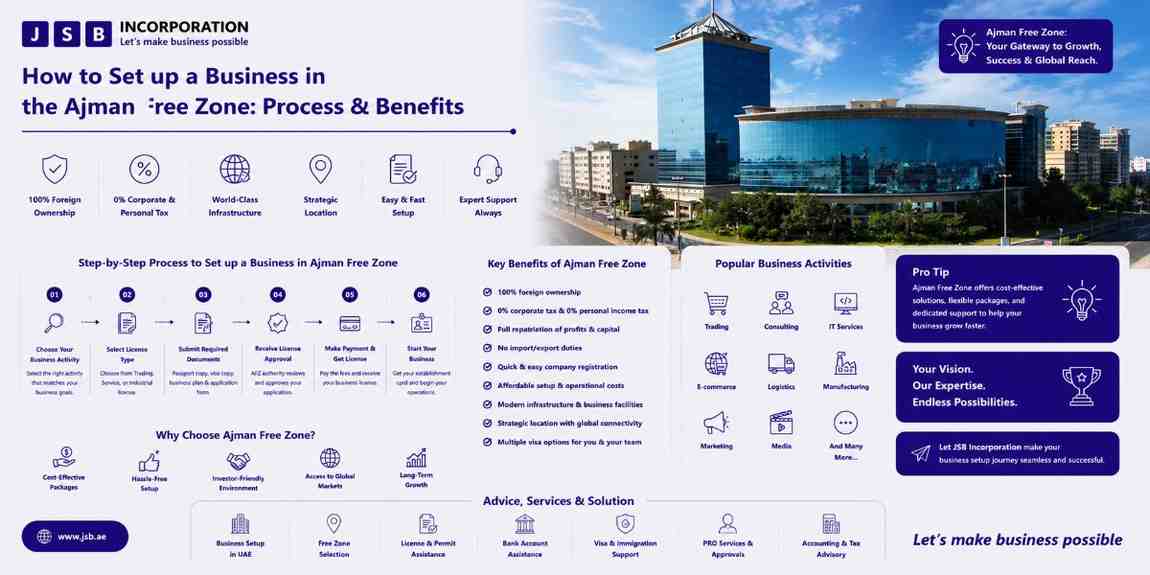
Key Highlights
Ajman Free Zone appears on the UAE’s official directory of recognized zones, alongside Ajman Media City, and it suits founders who want a lower-cost UAE entry point without giving up full foreign ownership.
It’s a practical starting point for anyone comparing jurisdictions before filing paperwork.
It tends to work well for specific business profiles:
A company registered here can trade internationally and within its own jurisdiction, but selling directly into the UAE mainland requires a distributor, branch, or mainland licence. That distinction matters if local UAE retail sales are central to your plan.
Keep reading the article to learn more about business setup in the Ajman Free Zone.
Companies set up this way in the UAE, including in Ajman, benefit from 100% foreign ownership and full repatriation of profits and capital, a framework the Ministry of Economy and Tourism confirms applies nationwide.
You don’t need a local UAE shareholder to hold equity, and you can move earnings out of the country without restriction on that front.
Other advantages matter to founders relocating from markets like the US or UK:
These benefits apply federally regardless of which jurisdiction you pick. What differs between options is cost structure, activity list, and facility availability, so matching your activity to the right one still matters.
“We have recently incorporated our company through JSB Incorporation. Gaurav Keswani has been a tremendous help throughout the entire process. His support enabled us to complete everything seamlessly, even accommodating last-minute changes. It was a wonderful experience working with JSB Incorporation. We look forward to a long-term engagement.” (Veena Talegaonkar, Google Reviews)
Registration follows the same core sequence the UAE’s official platform outlines generally, adapted to the local application portal.
You’ll move through activity selection, name reservation, document submission, and licence issuance before applying for visas and opening a bank account.
The step-by-step process:
Recognized entity types across these jurisdictions include LLCs, FZ Co.s, FZEs, PJSCs, and branch structures, though not every one registers every type.
Confirm directly with the Ajman Free Zone Authority (AFZA) which structures it currently accepts.
You’ll also need a defined document set, generally including:
Treat any Ajman-specific document checklist you find online as provisional until confirmed with AFZA directly.
An FZE (Free Zone Establishment) is a single-shareholder company, while an FZ Co. (Free Zone Company) allows multiple shareholders, and both are recognized entity types under UAE regulation.
The right choice depends on whether you’re setting up alone or with partners.
Structure | Shareholders | Best for | Liability |
|---|---|---|---|
FZE | One | Solo founders, single-owner ventures | Limited to share capital |
FZ Co. (FZCO) | Two or more | Partnerships, joint ventures, multi-founder startups | Limited to share capital |
Branch | N/A (parent company) | Foreign companies extending UAE operations | Tied to parent company |
Confirm which structures are currently offered before committing to a shareholding plan, since not every option is available in every jurisdiction.
Cost component | Status | Where to verify |
|---|---|---|
Trade licence fee | Varies by activity and package | Direct AFZA consultation |
Registration and establishment card | Varies | Direct AFZA consultation |
Visa processing per employee | Varies by visa quota tier | ICP-linked application |
Office or flexi-desk facility | Varies by facility type | AFZA facility options |
Health insurance (mandatory) | Applies to all visa holders | UAE Central Bank Rulebook, insurance provider |
Costs and regulations are subject to change. Confirm current figures with the relevant UAE government authority or with JSB before making decisions.
Beyond the initial license, plan for recurring costs: establishment card renewals, mandatory health insurance per visa holder, and visa stamping fees.
Confirm exact renewal cycles and amounts directly with AFZA, since these figures aren’t standardized everywhere.
UAE corporate tax applies at 9% on taxable income exceeding AED 375,000, per Federal Tax Authority regulations effective June 2023.
Eligible entities may qualify for a 0% rate on qualifying income as a Qualifying Free Zone Person (QFZP), though this isn’t automatic.
To hold QFZP status, a company generally needs to:
Income outside the qualifying list, or revenue exceeding the de minimis threshold, becomes taxable at 9%, and QFZP status can be affected for the current and following tax periods.
This is exactly where many founders get caught off guard, so review your income mix against these conditions before assuming a 0% outcome.
Visa allocation under this kind of licence is generally tied to your office or facility size and package tier, rather than a fixed number attached to every licence type.
The Federal Authority for Identity, Citizenship, Customs, and Port Security (ICP) governs residence visa issuance regardless of which authority issued your trade licence.
Packages tend to fall into indicative tiers, though you should confirm your specific quota with AFZA before planning your hiring:
Every residence visa application also requires an Emirates ID application, medical fitness test, and health insurance, set federally through ICP rather than by the licensing authority itself.
The right jurisdiction depends on whether your priority is cost efficiency, direct UAE market access, or a specific residency goal, not on which option is universally “best.”
Mainland companies can trade directly across the UAE without the distributor or branch workaround free zone companies need for local sales, per the UAE’s official guidance on mainland business.
Foreign investors can also now own up to 100% of most mainland companies, per the UAE’s official platform.
Feature | Ajman Free Zone | Dubai mainland | Other UAE free zones |
Foreign ownership | 100% | Up to 100% for most activities | 100% |
UAE market access | Requires distributor or mainland branch for local sales | Direct access across the UAE | Requires distributor or mainland branch for local sales |
Licensing authority | Ajman Free Zone Authority (AFZA) | Dubai Economy and Tourism (DET) | Zone-specific authority (for example DMCC, IFZA, JAFZA) |
Corporate tax treatment | 0% on qualifying income if QFZP; 9% otherwise | 9% above AED 375,000 taxable income | The same QFZP framework applies |
If your model depends on walk-in mainland customers or government contracts, that changes the calculation regardless of cost. A location-independent trading, consulting, or e-commerce business often fits this kind of jurisdiction better.
Also Read: Ajman Emerges as a Magnet for SMEs and High-Growth Industries in the UAE
Yes. This structure allows 100% foreign ownership with no requirement for a local UAE shareholder, a framework the Ministry of Economy and Tourism confirms nationwide. This applies regardless of your nationality before relocating.
2. How long does it typically take to get a UAE trade licence approved?
Timelines vary by jurisdiction and by how complete your application is at submission.
The UAE’s official platform describes this licensing route as streamlined once documents are in order, but confirm the current processing time directly with AFZA rather than assume a fixed timeframe.
3. Is there a minimum share capital requirement for an Ajman Free Zone company?
Minimum share capital requirements vary by entity type and activity and aren’t uniformly fixed across UAE free zones.
Confirm the specific requirement for your chosen activity directly with AFZA before finalizing your business plan.
4. Can an Ajman Free Zone licence be used to operate anywhere in the UAE or only within the zone?
A licence lets you trade internationally and within the zone itself, but direct sales into the UAE mainland generally require a mainland distributor, branch, or separate licence. This structural distinction applies to every UAE free zone.
5. Is Ajman Free Zone a viable option for freelancers who mainly want UAE residency?
It can be, depending on your activity and the residence visa quota tied to your chosen package. Freelancers should confirm eligibility and visa allocation with AFZA and cross-check residence visa procedures on the ICP’s official channels first.
6. What add-on costs come up after the initial licence fee?
Recurring costs typically include establishment card and immigration file renewals, mandatory health insurance per visa holder, and visa stamping fees. Exact amounts vary and should be confirmed directly with AFZA rather than estimated from third-party sources.
7. How does Ajman Free Zone compare to other UAE free zones for cost-conscious founders?
Cost positioning varies by jurisdiction, activity, and package tier, and no verified fee comparison exists across a government source. Request activity-specific quotes for the options you’re considering rather than relying on published third-party comparisons.
8. Do I need ICP approval separately from my free zone licence for a residence visa?
Yes. Your licence enables the visa application, but the residence visa itself is issued and governed by the ICP, a separate federal process from your establishment card.
9. What happens if my company doesn’t meet the 0% corporate tax (QFZP) conditions?
If you don’t meet QFZP conditions, your income can become subject to the standard 9% corporate tax rate above AED 375,000, per Federal Tax Authority rules. Falling out of QFZP status can also affect your tax treatment for subsequent tax periods.
10. Can an Ajman Free Zone company later convert to a Dubai mainland company?
Companies generally can’t simply convert in place. Expanding into the mainland typically requires a new mainland license, a branch, or a distributor arrangement. Confirm your specific expansion path with the relevant mainland authority.
Reviewed by Gaurav Keswani, Founder, JSB Incorporation.
Gaurav Keswani is the Founder of JSB Incorporation, a Dubai-based business setup and immigration consultancy. He appeared on Talk 100.3 FM answering live listener questions on UAE Golden Visa eligibility, citing GDRFA and ICP guidelines directly on air. JSB Incorporation handles documentation preparation and application coordination. All visa and license decisions rest with the relevant UAE government authorities: GDRFA, ICP, DET, and DLD.
JSB Incorporation’s team reviews your business plan, confirms activity eligibility with the relevant authority, and prepares an activity-specific 2026 cost estimate along with a QFZP tax qualification check before you commit to anything.
Whether you’re relocating from the US, UK, or elsewhere and dealing with unclear regulations, banking access questions, or unfamiliar residence visa rules, a single consultation can replace weeks of scattered research.
Book your free consultation call today with the experts of JSB Incorporation to learn more.

Office 2505, 25th Floor, Regal Tower, Business Bay, Dubai, UAE P.O Box 27614.
+971 4 824 4842
info@jsbincorporation.com
