
 Gaurav Keswani
Key Highlights
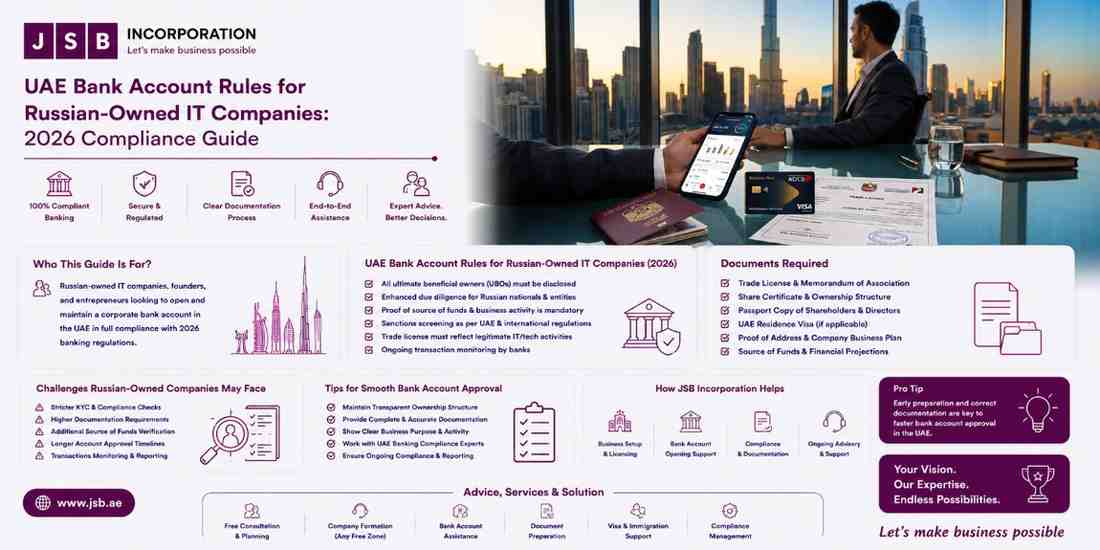
Russian nationals can still open UAE corporate bank accounts for their IT companies in 2026, but they will face enhanced due diligence under the Central Bank of the UAE’s risk-based framework, not automatic rejection.
If you’re a Russian founder trying to bank a Dubai-based IT venture right now, the friction comes from procedure, not prejudice. And it’s rooted in how the Central Bank requires banks to vet every legal person customer under its anti-money laundering rules.
The scrutiny you’re experiencing comes from risk-based customer due diligence, not nationality bias, and it applies to every legal-person customer regardless of where the owners are from.
Under the Central Bank’s rulebook, banks must identify and verify every individual who owns 25 percent or more of a legal-person customer, and if no single person meets that threshold, the bank must instead verify the identity of the customer’s senior managing official.
This isn’t a Russia-specific rule. It’s the same standard applied to any company structure with layered or offshore ownership, since complex ownership chains tend to trigger a stricter risk rating under the Central Bank’s framework.
The rule also means banks legally cannot open an account if they can’t verify who ultimately owns or controls the company.
The rulebook states that another legal person can never be classified as the beneficial owner, so if your IT company sits under multiple holding entities, banks must trace ownership up the chain until they identify the natural person or persons who hold 25 percent or more.
If that verification isn’t possible, banks must decline the account rather than proceed on incomplete information.
This due diligence doesn’t end once your account is opened. The Central Bank requires banks to review and update legal-person customer profiles on an ongoing basis, including at trade license renewal or when authorized signatories change. Your banking relationship stays subject to monitoring for the life of the account, not just at onboarding.
Banks must collect your company’s legal form, licensed address, trade license details, and senior official information and identify every beneficial owner holding 25 percent or more before they can open or maintain your account.
If your ownership structure runs through several jurisdictions, expect banks to request documentation proving ownership at each layer, since they cannot rely solely on verbal declarations from a company representative.
A complete application package typically includes your trade license, Memorandum and Articles of Association, beneficial ownership verification documents, proof of your IT company’s business activity, and a senior management authorization letter.
Q: What happens if a bank cannot verify a company’s beneficial owners?
A: The bank must not open the account, and if the relationship already exists, the bank is required to exit it once verification fails.
Your choice between mainland and free zone licensing shapes both your setup timeline and how banks perceive your application.
Factor | Mainland | Free Zone |
Licensing authority | Department of Economic Development in the relevant emirate | One of approximately 40 free zone authorities, such as DMCC, IFZA, or JAFZA |
Ownership rules | 100 percent foreign ownership permitted for most commercial activities | 100 percent foreign ownership standard across nearly all UAE free zones |
Physical presence requirement | Generally requires a physical office space registered with the relevant authority | Requirements vary by zone; several allow flexi-desk or shared-desk arrangements |
Typical approval friction | Banks are broadly familiar with mainland-licensed structures, which can smooth onboarding | Approval speed varies by zone reputation and how established the free zone authority is with the bank’s own risk team |
The standard Dubai setup sequence involves selecting your business activity, determining your legal form, applying for initial approval, and then securing your license, a sequence that applies whether you choose mainland or free zone.
Business setup licensing in Dubai has also become considerably faster in recent years, moving from a minimum of one week to a process completed in a few steps, sometimes on the same day.
Since banking approval odds can still vary by jurisdiction familiarity, review your specific IT activity against both a mainland structure and a relevant free zone before committing.
The UAE Golden Visa does not require you to invest exactly AED 2 million in a single property. The Dubai Land Department’s requirement is AED 2 million in total real estate investment value, which may be spread across one or more properties under the applicant’s name.
This is one of the most costly misconceptions for qualified applicants, since it stops people from applying when they actually qualify.
Beyond real estate, several no-salary entrepreneur pathways exist, though not all commonly cited figures match official government categories exactly:
On salary requirements, the AED 30,000 monthly threshold widely discussed online applies to the employment-based skilled professional route, not to investor or entrepreneur categories.
As of January 2026, immigration authorities reinstated a stricter calculation for this route. Only basic salary counts toward the AED 30,000 threshold, not total compensation.
This includes allowances, and applicants must show this basic salary sustained for at least two years under a Level 1 or Level 2 occupational classification. Investment-based and non-investment pathways carry no salary requirement at all.
Mandatory health insurance for the applicant and all family dependents applies across entrepreneur and investor routes.
Dependents over 25 can still qualify for Golden Visa sponsorship, provided they are single and fully financially dependent on the primary applicant, a distinction that matters for Russian IT founders relocating with adult children or extended family.
Given how frequently these criteria are refined, verify the exact current thresholds directly with immigration authorities before finalizing any application strategy.
Your IT company’s taxable income above AED 375,000 is taxed at 9 percent under UAE corporate tax. Free zone businesses may qualify for a 0 percent rate on qualifying income only if they meet all five conditions confirmed by the Federal Tax Authority:
Failing any single condition disqualifies the entity from qualifying for Free Zone Person status for that tax period and the following four tax periods, so IT companies billing a mix of free zone and mainland clients should review this threshold carefully rather than assuming the 0 percent rate applies automatically.
Two federal decree laws reshape VAT and tax procedures for cross border owned entities, both effective January 1, 2026:
Yes, most UAE free zones permit 100 percent foreign ownership regardless of nationality.
2. Do UAE banks reject accounts solely because of Russian citizenship, or is it risk-based due diligence?
It’s risk-based due diligence; the Central Bank requires the same beneficial ownership verification for every legal-person customer, and accounts are declined only when verification cannot be completed.
3. Does the Golden Visa really require AED 2 million in a single property?
No, the requirement is AED 2 million in total real estate investment value, which can be spread across multiple properties.
4. Is there a minimum salary requirement for entrepreneur-route Golden Visa applicants?
No, the AED 30,000 minimum applies only to the employment-based route, and as of January 2026, it must be a basic salary sustained for two years, not gross compensation. Entrepreneur routes are based on verified project value, not salary.
5. How do the 2026 VAT refund rules affect IT companies with existing credit balances?
Companies with credit balances nearing or past the old limitation period get a one-year transitional window from January 1, 2026, to submit refund requests before the new five-year rule fully applies.
Disclaimer: Banking approval decisions, tax rates, and Golden Visa thresholds are subject to change and depend on individual circumstances. Always confirm current figures directly with the Central Bank of the UAE, the Federal Tax Authority, and UAE immigration authorities before making financial or immigration decisions.
Setting up an IT company in the UAE as a Russian founder involves more moving pieces than banking alone, and getting the jurisdiction, documentation, and tax structure right the first time saves you months of rework.
JSB Incorporation has guided founders across 24 or more UAE jurisdictions through company formation, bank account introductions, Golden Visa applications, and VAT compliance, with transparent pricing and end-to-end support at every step.
Book your free consultation call today with the experts of JSB Incorporation to learn more.
Also Read:
18 Common Business Setup Mistakes in Dubai and How to Avoid Them
UAE Business Setup and Golden Visa in 2026: A Comprehensive Analysis
How Long Does Business Setup Take in UAE in 2026? (Per Jurisdiction) Breakdown)
The Ultimate Comparison: Business Setup in IFZA Free Zone vs. Mainland Dubai
Reviewed by: Gaurav Keswani
Gaurav Keswani is the founder of JSB Incorporation, a business setup consultancy based at Regal Tower, Business Bay, Dubai, UAE. He works directly with investors on company formation and Golden Visa applications and has publicly addressed common UAE business setup and Golden Visa misconceptions in regional media interviews.

Office 2505, 25th Floor, Regal Tower, Business Bay, Dubai, UAE P.O Box 27614.
+971 4 824 4842
info@jsbincorporation.com