
Key Highlights
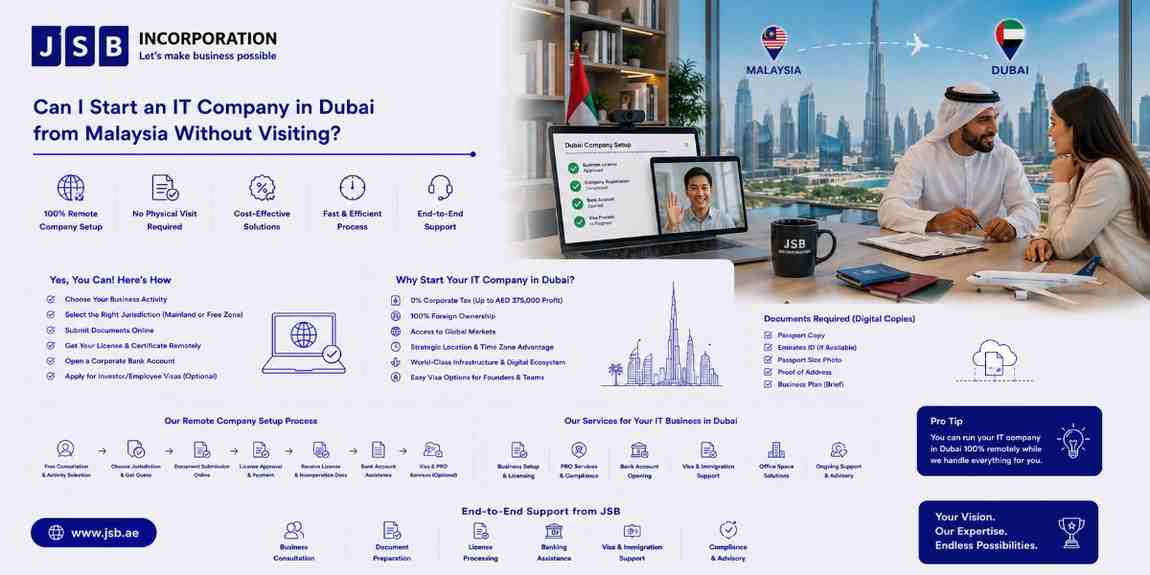
Yes, you can incorporate and fully own a Dubai IT company from Malaysia without flying over. No, you cannot finish your UAE residency the same way, because the medical test, biometrics, and visa stamping still require one physical trip.
This guide walks you through exactly what you can complete from your laptop in Kuala Lumpur, the three steps that force a short visit, the banking reality, and a realistic timeline built around a single trip.
Keep reading the article to learn more.
Incorporation is remote. Residency is not. That single split is the honest answer to the question, and everything else in this article expands on it.
You can reserve your trade name, apply for your license, and sign your documents online through your chosen free zone authority.
What you cannot do from Malaysia is complete the residence visa, because UAE rules tie residency to an in-person medical fitness test and biometric enrollment.
Here’s the clean breakdown so you can plan before you spend a dirham.
Step | Remote from Malaysia? | Why |
Trade name reservation | Yes | Handled through the free zone’s online portal |
License application and document upload | Yes | Free zones accept online applications and uploads |
Digital signing and license issuance | Yes | Portals like DMCC let you apply, pay, and sign online |
Medical fitness test | Yes | Must be done at a UAE medical center |
Emirates ID biometrics | Yes | Fingerprints are captured at an ICP service center |
Residence visa stamping | Yes | Completed inside the UAE after entry on your permit |
Disclaimer: Procedures and fees change. Always confirm the current process with your specific free zone authority and the official UAE government platform before you commit.
You can form the company, own it outright, and hold a valid trade license without setting foot in the UAE. The government’s own guidance describes an online setup path, and free zones are built to onboard foreign founders digitally.
Let’s break the remote portion into the three pieces that actually matter.
For a founder who wants a fully remote incorporation, a free zone is usually the cleaner starting point. Free zones allow full foreign ownership, and the UAE government lists technology as one of the sectors free zones actively cater to.
Mainland ownership also allows 100 percent foreign ownership for most activities today, after the Commercial Companies Law was amended to remove the old 51 percent local partner rule.
The practical difference is market access. A free zone company can trade internationally and within its zone freely, but selling directly into the UAE mainland market is regulated and usually needs a mainland distributor, branch, or extra approvals.
If your clients are global and you invoice from a UAE base, a technology focused free zone often fits. If you plan to sell software or services directly to UAE mainland customers, factor in those extra mainland steps early.
You start by picking your sector and free zone, then reserving a trade name that meets the naming rules. The name must not have been registered before, must suit your activity, and must be followed by the legal form of the company.
Next you determine your legal entity type. In a free zone you can set up a Free Zone Establishment, a Free Zone Company, a Private Limited Liability Company, a Public Limited Liability Company, or a branch.
The differences come down to the number of shareholders and whether shareholders are individuals or corporate entities.
You then apply for the business license online through the free zone authority’s website, submit your company details, and upload your documents. This whole application layer is designed for remote submission.
Once your documents are approved, issuance is fast. The UAE government states that after review and approval you’ll receive your license within 14 working days.
Some free zones let you apply, pay, and even sign documents online end to end. The government specifically points to DMCC as an example where you can complete these steps through the portal.
So by the time you close your laptop, you can realistically hold a licensed, fully owned Dubai IT company. What you won’t have yet is UAE residency.
Three steps require your physical presence in the UAE: the medical fitness test, Emirates ID biometrics, and residence visa completion. These are residency requirements, not company requirements, and no free zone can waive them for you.
If you want UAE residency, you’ll need a medical fitness test done inside the country. The UAE government is direct about this. Residence visa applicants who are 18 and above must undergo a medical test to prove they’re medically fit.
The test is carried out at approved public health centers and medical examination centers across the emirates, and results are sent to the applicant by email and SMS. You physically attend one of these centers. There’s no remote substitute.
Your Emirates ID requires biometric capture, and that happens in person. You can apply for a new Emirates ID card through the ICP website or an accredited typing center, but you may need to visit an ICP service center to provide your biometric details.
Individuals who’ve completed 15 years of age must complete fingerprint and signature procedures through ICP service centers. Fingerprints can’t be emailed, so this ties your residency to at least one trip.
The residence visa itself is completed after you enter the UAE. Once your entry permit is issued, you travel in, and within one month of entering, you complete the procedures to obtain your residency, which is valid for two years.
An entry permit stays valid for two months from its issue date, so you have a clear window to schedule your trip. The medical test, biometrics, and stamping are usually clustered into that same visit.
No, you don’t need a UAE residence visa simply to own shares in your company. Ownership and residency are two separate things, and this distinction is the whole point of setting up remotely.
Free zones allow companies to be fully owned by foreign investors. You can be a shareholder of a Dubai company while living in Malaysia.
The residence visa is what lets you live in the UAE and access resident services, and the government notes that a residency visa is essential for things like opening a bank account and obtaining a driver’s license.
So the honest picture is role-based. As a passive shareholder based abroad, you can own without a visa.
The moment you want to reside, run the company on the ground, or unlock resident banking and services, you move into visa territory, and that’s when the in-person steps kick in.
Banking, not incorporation, is usually the real bottleneck. Forming the company is the fast part. Getting a functioning bank account as a non-resident is where founders lose weeks.
Traditional UAE banks lean heavily on in-person verification and enhanced due diligence for non-residents.
Reporting based on advisory guidance indicates that only a limited number of banks offer non-resident accounts, approvals can take anywhere from three weeks to six months, and physical presence in the UAE is generally expected to complete account opening.
There’s a regulatory reason behind the friction. UAE banks apply strict know-your-customer and anti-money-laundering checks, so they ask for source-of-funds evidence, a reference letter, and a clear reason for opening the account.
No official UAE source confirms a full no-visit retail banking pathway, so treat any promise of instant remote banking with caution.
Disclaimer: Banking requirements are set by individual banks under the Central Bank of the UAE’s oversight and change frequently. Verify the current rules with the bank before you rely on them.
Malaysia and the UAE have a double taxation agreement in force, so your cross-border income isn’t automatically taxed twice. The treaty was signed on 28 November 1995 and has been effective since 1 January 1996.
The agreement allocates taxing rights between the two countries and provides relief mechanisms so the same income isn’t fully taxed in both places. To claim treaty benefits as a Malaysian resident, you generally need a Certificate of Residence from Malaysia’s Inland Revenue Board.
This is directional, not prescriptive. Your actual position depends on where you’re a tax resident, how your income is structured, and your permanent establishment status. Speak to a qualified tax advisor before making decisions, rather than treating a treaty summary as personalized advice.
The realistic path is remote incorporation first, then a single UAE trip to close out residency. Here’s the sequence structured around the official residence visa provisions.
That’s it. One trip, tightly scheduled, handles every step that can’t be done from Malaysia.
The costliest mistake is assuming banking is as easy and remote as incorporation. It usually isn’t, and that wrong assumption stalls more launches than any licensing issue.
Watch for these traps:
A quick note on tax rates so expectations are set: UAE corporate tax is 0 percent on taxable income up to AED 375,000 and 9 percent above that, per the Ministry of Finance. A qualifying free zone person can benefit from a 0 percent rate on qualifying income.
Disclaimer: Tax rates, thresholds, and deadlines are set by UAE authorities and can change. Confirm current figures with the Federal Tax Authority or a licensed advisor before filing.
1. Can I own 100 percent of a Dubai IT company from Malaysia without ever visiting?
You can own the company 100 percent without visiting, since free zones allow full foreign ownership. But if you also want UAE residency, you’ll need at least one trip for the medical test and biometrics. Ownership is remote. Residency is not.
2. Do I need a medical test to get an Emirates ID?
To get UAE residency, yes. Residence visa applicants aged 18 and above must pass a medical fitness test inside the UAE. Your Emirates ID also requires in-person biometrics at an ICP service center.
3. Is there a tax treaty between Malaysia and the UAE?
Yes. The Malaysia-UAE double taxation agreement has been in force since 1 January 1996. It allocates taxing rights and provides relief so income isn’t fully taxed twice, but your specific benefit depends on your tax residency, so consult a tax advisor.
4. Which Dubai free zones suit IT companies best?
The UAE government notes that free zones cater to diverse sectors, including technology, with some offering research and development labs and innovation hubs for tech businesses. Compare technology-focused zones on the activity list, visa allocations, and office options, then confirm details with each authority.
5. What happens if I skip the in-person visa steps?
You can still own the company as a non-resident shareholder, but you won’t hold UAE residency.
Without residency you generally can’t access resident services such as resident banking and a UAE driver’s license. If you want to live and operate in the UAE, the medical test, biometrics, and stamping aren’t optional.
You now know the honest split: you can incorporate and own remotely, but residency needs one focused trip. The founders who succeed are the ones who plan that trip around the medical test, biometrics, and banking all at once instead of discovering the hard stops halfway through.
That’s where experienced guidance pays for itself. The right setup partner helps you pick the correct free zone for IT activities, complete the remote incorporation cleanly, sequence your single UAE visit efficiently, and stay on top of corporate tax registration deadlines so you avoid penalties.
You get a clear roadmap, transparent expectations, and support across company formation, visas, banking coordination, and compliance, so your launch is fast and stress-free rather than a series of surprises.
Book your free consultation call today to learn more.
Also Read:
18 Common Business Setup Mistakes in Dubai and How to Avoid Them
UAE Business Setup and Golden Visa in 2026: A Comprehensive Analysis
How Long Does Business Setup Take in UAE in 2026? (Per Jurisdiction) Breakdown)
The Ultimate Comparison: Business Setup in IFZA Free Zone vs. Mainland Dubai

Office 2505, 25th Floor, Regal Tower, Business Bay, Dubai, UAE P.O Box 27614.
+971 4 824 4842
info@jsbincorporation.com
