
 Gaurav Keswani
Key highlights
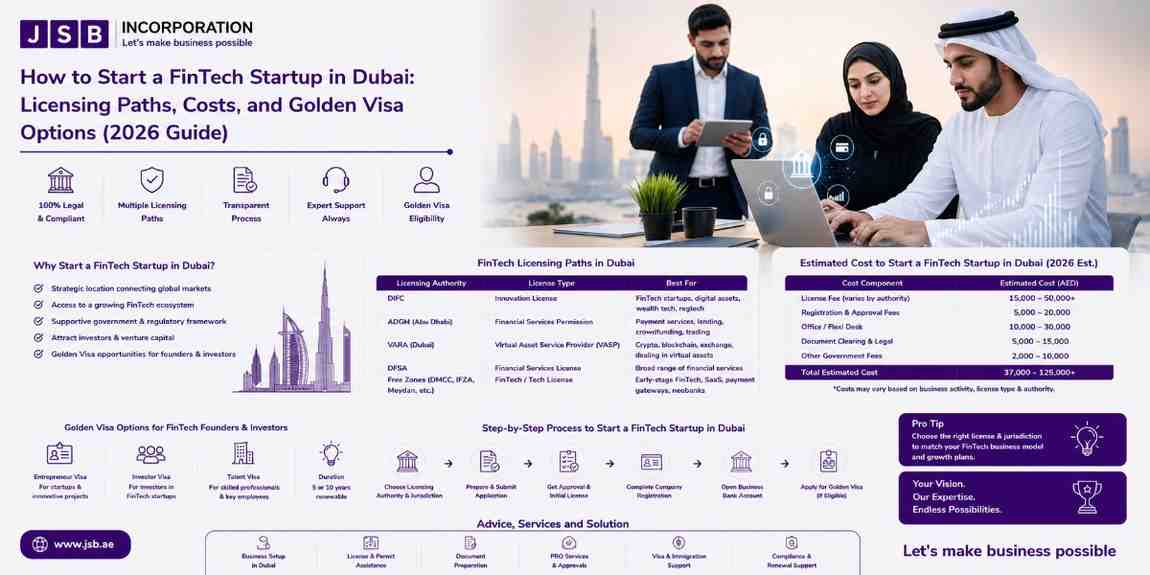
Starting a fintech company in Dubai requires choosing between a DFSA-regulated license through DIFC for payment, lending, or wallet products or a standard free zone license for non-regulated software tools and more.
This guide breaks down the licensing paths, real costs, compliance obligations, and Golden Visa options relevant to fintech founders setting up in 2026.
Non-regulated fintech includes software, analytics, and API tools that do not touch customer funds directly, while regulated fintech covers payment services, digital wallets, lending, and currency exchange under the Central Bank of the UAE’s Retail Payment Services and Card Schemes Regulation.
This regulation, in force since mid-2021 following a one-year transitional period, requires a license before providing services like account issuance, merchant acquiring, or cross-border fund transfers.
The Open Finance Regulation adds a further layer, governing data sharing and API access across licensed financial institutions if your product touches open banking.
Under Article 2 of the Retail Payment Services framework, no person may offer these services without a prior Central Bank license unless specifically exempted, such as already-licensed banks.
Misclassifying your activity risks either over-licensing a simple tool or operating an unauthorized payment business.
DIFC under DFSA regulation suits regulated fintech like payments and lending, while general free zones such as Dubai Silicon Oasis suit non-regulated software tools, and both offer 100 percent foreign ownership.
Route | Regulator | Best for | Ownership |
DIFC | DFSA | Regulated fintech: payments, lending, wallets | 100% foreign |
General free zone (e.g., Dubai Silicon Oasis) | Free zone authority | Non-regulated tech and software fintech tools | 100% foreign |
Mainland with free zone branch | DED plus relevant federal regulator | Scaling onshore post-CCL amendment | 100% foreign under CCL reforms |
DIFC’s regulator, the DFSA, runs an Innovation Testing Licence letting qualifying firms test products for six to twelve months before full authorization, with sandbox decisions typically taking 10 to 12 weeks from a complete submission.
Founders planning to scale onshore later should note that Federal Decree-Law No. 20 of 2025 now allows free zone companies to open mainland branches or re-domicile between free zone and mainland status without losing legal continuity effective October 2025.
Setting up a fintech company in Dubai involves eight steps, starting with activity classification and ending with residence visa issuance.
A one-year non-regulated fintech license through a Dubai Silicon Oasis-based free zone starts at AED 11,900 inclusive of VAT for zero visa allocation, rising to AED 14,900 with one free residence visa for life, though these figures reflect a promotional price list explicitly valid for licenses purchased and incorporated in April 2026, not a fixed year-round rate.
Multi-year packages carry built-in discounts: a two-year license with one visa costs AED 29,800 at a 15 percent discount, and a five-year license with one visa drops to AED 74,500, reflecting a 30 percent multi-year discount, again under the same April 2026 promotional terms.
Additional government fees include AED 2,000 for an initial establishment card and AED 3,750 per two-year UAE residence visa, plus AED 1,000 for each business activity beyond the three included in the base package, and AED 750 per additional corporate shareholder.
Since free zones reserve the right to amend pricing without prior notice, confirm current rates directly with your chosen free zone authority before budgeting.
For DIFC or DFSA-regulated fintech, costs vary by activity type and risk category, so confirm current figures directly with the regulator rather than relying on third-party estimates.
Also Read: Why Fintech Is the Most Profitable Business in UAE (2026 Complete Guide)
Licensed payment service providers must maintain documented AML and CFT policies, conduct risk-based due diligence, and report suspicious transactions to the UAE Financial Intelligence Unit under Article 12 of the Retail Payment Services and Card Schemes Regulation.
Card schemes carry similar reporting duties whenever there is reasonable suspicion that funds relate to criminal proceeds.
Founders who move fast on licensing but treat compliance as an afterthought frequently run into delays once these requirements surface mid-process. Building your AML policy and risk-assessment workflow before launch, rather than after a regulatory inquiry, avoids this rework.
Federal Decree-Laws No. 16 and 17 of 2025, effective January 1, 2026, introduced a five-year limitation period for VAT refund claims, removed the self-invoicing requirement under reverse charge, and gave the Federal Tax Authority explicit power to deny input tax tied to evasion arrangements.
A one-year transitional window applies to taxpayers whose refund periods were expiring around the effective date. Reverse charge transactions still require supporting documentation retention even without self-invoicing.
Because fintech platforms process high transaction volumes, the Federal Tax Authority’s new authority to deny input tax on evasion-linked supplies makes supplier due diligence workflows a day-one requirement rather than a later addition.
Fintech founders relocate to Dubai for access to enterprise-grade tools granted on license activation, proximity to global venture capital and sovereign wealth-backed funding, and Golden Visa residency that removes the six-month re-entry requirement tied to standard visas.
Family stability and schooling continuity are also cited as relocation drivers for founders with dependents, since Golden Visa status reduces sponsorship uncertainty in long-term family planning.
FinTech founders can qualify for a five-year entrepreneur Golden Visa by owning or partnering in an SME generating at least AED 1,000,000 in annual revenue in an accredited sector, securing approval from a business incubator or the Ministry of Economy and Tourism, or having previously founded and sold a project worth at least AED 7,000,000, alongside mandatory health insurance.
Separately, a ten-year investor Golden Visa is available through AED 2 million in qualifying property or a fund.
The Federal Authority for Identity, Citizenship, Customs, and Port Security requires entrepreneurs to submit an auditor’s letter confirming a project value of at least AED 500,000, a letter from a competent authority or business incubator confirming the project’s innovative nature, a valid passport, and proof of UAE residence.
For real estate-based investor applications in Dubai specifically, the Dubai Land Department confirms that a property valued at AED 2 million or more qualifies for a ten-year renewable permit, with total government fees of approximately AED 9,884.75 covering medical exams, Emirates ID, and administrative charges.
Mortgaged properties qualify with a bank no-objection letter confirming paid and outstanding amounts, rather than requiring the full amount already settled.
A few Golden Visa questions come up repeatedly among founders, and each is worth confirming directly with the relevant immigration authority before you rely on it for your own application, since eligibility details can vary by case.
The most common fintech setup mistakes in Dubai are using a non-regulated license for fund-handling activity, underestimating bank partnership timelines, and assuming promotional pricing stays fixed year to year.
1. Do I need a Central Bank or DFSA license to start a fintech company in Dubai?
Only if your activity falls under regulated categories like payment services, digital wallets, lending, or currency exchange. Pure software or analytics tools generally do not require this level of licensing.
2. Can I use a standard free zone license for a fintech SaaS or analytics tool?
Yes, a general free zone license such as those offered in Dubai Silicon Oasis is typically appropriate for non-regulated software and analytics products.
3. How did the 2025 Commercial Companies Law amendment affect free zone-to-mainland fintech expansion?
Federal Decree-Law No. 20 of 2025 allows companies to re-domicile between free zones and the mainland, or open onshore branches, without losing legal continuity, effective October 2025.
4. What are the entrepreneur Golden Visa requirements for fintech founders in 2026?
You need to own or partner in an SME generating at least AED 1,000,000 in accredited-sector revenue, secure incubator or Ministry of Economy approval, or have previously sold a project for AED 7,000,000 or more, plus mandatory health insurance.
5. What VAT compliance changes effective January 2026 affect fintech and payment platforms?
A five-year limitation period now applies to VAT refund claims, self-invoicing under reverse charge was removed with documentation retention still required, and the Federal Tax Authority gained authority to deny input tax tied to evasion arrangements.
6. What AML and CFT obligations apply to a licensed payment service provider in the UAE?
Licensed providers must maintain documented AML and CFT policies, conduct risk-based due diligence, and report suspicious activity to the UAE Financial Intelligence Unit under Article 12 of the Retail Payment Services and Card Schemes Regulation.
Disclaimer: Always verify current pricing, eligibility criteria, and policy nuances directly with the DFSA, DIFC, ICP, GDRFA, Dubai Land Department, or the Ministry of Economy and Tourism, or with a licensed immigration advisor, before making formation or visa decisions.
Setting up a regulated or non-regulated fintech in Dubai involves navigating DFSA sandbox timelines, AML documentation, and Golden Visa paperwork that can consume months of runway without the right guidance.
JSB Incorporation has helped founders complete formation across 24+ UAE jurisdictions with transparent pricing and setup timelines measured in weeks rather than months.
Book your free consultation call today with the experts of JSB Incorporation to learn more.

Office 2505, 25th Floor, Regal Tower, Business Bay, Dubai, UAE P.O Box 27614.
+971 4 824 4842
info@jsbincorporation.com