
 Gaurav Keswani
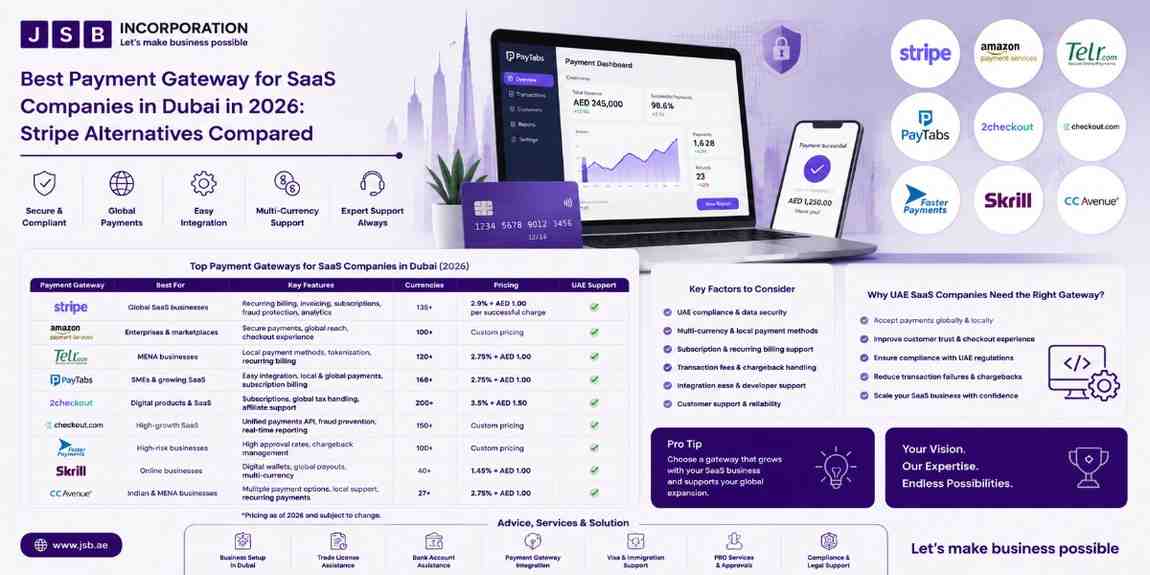
Key Highlights
Most payment gateways operating in the UAE, including Stripe, will not activate your account without a valid UAE trade license, and SaaS founders on subscription billing consistently report fund freezes and high-risk transaction blocks even after clearing onboarding.
If you’re running a SaaS business out of Dubai, you need to separate two distinct problems: what Stripe itself demands of you as a merchant, and what UAE law actually requires from any payment provider handling your money.
This guide walks through both, using Stripe’s own documentation and the Central Bank of the UAE’s regulatory framework directly, along with the gateways that are actually built for founders in your position.
The Central Bank of the UAE built its retail payments licensing regime specifically to prepare the country for digital and subscription-style commerce, positioning its payment services regulation as part of a broader shift toward regulated digital payments.
That regulatory intent matters practically: if your gateway isn’t properly licensed, or you misunderstand what Stripe requires from a UAE entity, a single frozen payout cycle can stall payroll or vendor payments for weeks.
Getting this right before you scale isn’t a background detail; it’s a direct operational risk.
No, you cannot. Stripe does not support individuals without a UAE trade license or freelancer permit, and this requirement applies to every business type it lists for the UAE market.
During onboarding, Stripe asks for your trade license or freelancer permit, your memorandum of association showing ownership structure, and a bank statement dated within the last six months.
If you or any co-founder owns 25 percent or more of the company, you’ll also need to submit a passport copy. If you live in the UAE, add your Emirates ID and a residence visa too, unless your Emirates ID was issued on or after April 11, 2022, in which case the visa becomes optional.
Miss any of these documents, and your account simply won’t go live, no matter how solid your product is.
One detail that trips up a lot of founders: if the person managing the Stripe account isn’t listed as a manager or beneficial owner on the actual trade license, Stripe requires a Power of Attorney dated within the last three months. It’s a small paperwork step, but it stalls a surprising number of onboarding attempts every month.
Stripe’s fund freezes usually stem from its own internal risk scoring, not from any UAE regulatory rule. Subscription billing carries structurally higher chargeback exposure than one-time purchases, and card networks now apply tighter dispute limits than they did even a year ago.
Visa’s Acquirer Monitoring Program, known as VAMP, dropped its merchant excessive threshold from 2.2 percent to 1.5 percent on April 1, 2026, a roughly 32 percent cut in the allowable dispute ceiling.
That threshold combines fraud reports and chargebacks into a single ratio measured against settled transactions, and once a merchant crosses it, Visa applies a per-transaction fee with no warning tier. Subscription-based SaaS businesses are especially exposed here, since forgotten renewals and disputed free trials both count toward the same ratio.
Confirm the current threshold directly with your acquirer or card network before adjusting your risk controls, since these figures are updated periodically.
You’ll find this freeze pattern across founder forums. One SaaS builder described hitting 700 customers and roughly 20,000 AED in monthly recurring revenue within a single month, only to have Stripe label the account high risk two weeks later and pull funds twice to cover potential refunds.
Another founder reported Stripe terminating a UAE business account entirely and holding 3,500 USD after a risk flag rooted in contractual terms rather than any specific violation. These are anecdotal accounts shared by founders online, not audited regulatory findings, but the volume and consistency of similar stories are worth planning around before you scale.
There’s also a slower-moving trap: continuous document verification. If your trade license expires, Stripe emails you the following month requesting the renewed copy and gives you until the end of that month to upload it.
Miss that window, and Stripe automatically pauses your payouts and charges until you comply. This isn’t a one-time check at signup; it runs indefinitely, and a lot of founders get caught out simply because they forgot the license renewal date sitting quietly on a UAE government portal.
Not through Stripe directly, since it requires a trade license or freelancer permit for every supported business type. A merchant of record model like Paddle is the workaround most founders lean on at this stage.
2. Is Ziina regulated by the UAE Central Bank?
Yes. Ziina holds a Stored Value Facility license from the CBUAE.
Providers must hold a license from the Central Bank of the UAE under either the Retail Payment Services and Card Schemes Regulation or the Stored Value Facility Regulation before they can legally offer payment services in the country.
The CBUAE introduced this regulation in July 2021, covering nine distinct categories, including payment account issuance, merchant acquiring, payment aggregation, and cross-border fund transfers. Existing providers were given a one-year transitional period, ending in mid-2022, to secure the correct license.
Licensed entities also carry ongoing anti-money laundering obligations, including transaction-level risk profiling and mandatory reporting of suspicious activity to the UAE’s Financial Intelligence Unit.
This regulatory layer sits underneath every gateway you’re choosing between, whether or not the provider markets itself that way. Since licensing status can shift over time, always verify a provider’s current standing directly through the CBUAE rather than relying on the provider’s own marketing page.
Provider | UAE Trade License Required | Licensing Basis | Recurring Billing Support | Settlement Currency / Payout Speed | Founder-Reported Issue |
Stripe | Yes | Operates via a DIFC entity, not directly CBUAE-supervised | Yes | Multi-currency, standard payout typically within days | High-risk flags and multi-month fund holds reported by founders |
Ziina | Yes | CBUAE Stored Value Facility license | Limited, built more for payments and transfers than full subscription billing | AED-focused, local payouts | Positioned as a regional Stripe alternative |
Mamo | Yes | Regulated by the DFSA under a Providing Money Services license, not CBUAE directly | Yes, via payment links and recurring invoicing | AED settlement, fast local payout | N/A |
PayTabs | Yes | States it holds a Retail Payment Services license from CBUAE; confirm current status directly with the provider | Yes | Multi-currency support | N/A |
Telr | Yes | Received in-principle approval for a Retail Payment Services license from CBUAE | Yes | AED and multi-currency, Sharia-compliant option available | N/A |
Network International | Yes, plus Emirates ID for owners with 25 percent or more equity | Holds a CBUAE Stored Value Facility license | Yes | AED and multi-currency, enterprise-grade settlement | N/A |
Paddle (Merchant of Record) | Not required to start selling | Acts as Merchant of Record, absorbing tax and compliance liability itself | Yes, purpose-built for SaaS subscriptions | Global multi-currency, standard MoR payout cycle | Acceptable-use policy restricts certain human-delivered services |
Mamo is frequently grouped alongside CBUAE-licensed gateways in casual comparisons, but its actual regulator is the DFSA operating out of the Dubai International Financial Centre, not the Central Bank of the UAE directly.
That distinction matters if your finance team needs to confirm regulatory jurisdiction for banking or audit purposes. Treat every provider’s licensing status as something to verify directly with CBUAE or the provider’s compliance team before onboarding.
A merchant of record, or MoR, is a provider that becomes the legal seller of your product, taking on the tax, compliance, and chargeback liability that would otherwise sit on your shoulders.
Paddle, one of the most established MoR platforms for SaaS companies, manages payment routing, tax compliance, subscription renewals, and fraud protection under one consolidated fee.
This model works well if you’re still validating your product with international customers before completing UAE incorporation, since the MoR absorbs the tax and compliance complexity you’d otherwise have to build yourself.
It isn’t free of tradeoffs, though. Paddle applies acceptable-use restrictions on what counts as an eligible product, and some human-delivered services or coaching-style offers may fall outside what it processes.
If your SaaS includes a services layer, check the MoR’s current policy directly before you build your entire billing flow around it.
No, Stripe requires a valid UAE trade license or freelancer permit for every business type it supports before activating your account.
2. Why does Stripe hold or freeze funds for UAE businesses?
It’s typically Stripe’s own risk scoring reacting to chargeback exposure common in subscription billing, and card network dispute thresholds have tightened industry-wide through 2026.
3. What is the best payment gateway for a SaaS startup with international clients in Dubai?
It depends on your stage. Stripe gives you the widest global reach once you hold a trade license, while a merchant of record like Paddle suits founders still validating their product internationally.
4. Is Ziina regulated by the UAE Central Bank?
Yes, through a Stored Value Facility license.
5. Do you need a UAE bank account to use a payment gateway as a free zone company?
Most licensed gateways, including Stripe and Network International, ask for proof of an active UAE bank account during onboarding.
6. What happens if your trade license expires while using Stripe?
Stripe pauses your ability to process payments and receive payouts if you don’t upload the renewed license within the grace period following expiry.
Getting your payment infrastructure right starts with getting your company structure right first, since your jurisdiction, license type, and bank account setup all directly affect which gateways you can even qualify for.
JSB Incorporation has helped entrepreneurs across 24-plus UAE jurisdictions, including DMCC, IFZA, and JAFZA, set up companies in weeks rather than months, with transparent pricing and no hidden fees along the way.

Office 2505, 25th Floor, Regal Tower, Business Bay, Dubai, UAE P.O Box 27614.
+971 4 824 4842
info@jsbincorporation.com