
 Gaurav Keswani
Key Highlights
The CBUAE Rulebook has long directed banks to complete account opening within 3 business days for applicants assessed as low risk with complete documentation. This benchmark is being reinforced under a new SME Customer Protection Regulation, Circular No. 2/2026, set to take full effect on September 13, 2026.
Most SaaS founders take longer than this benchmark because their file is incomplete on the first submission, not because their business is inherently high risk.
This guide breaks down why software businesses face more scrutiny than trading companies, what documents get your file marked low risk on day one, and how mainland versus free zone licensing changes your banking path.
Banks apply Customer Due Diligence (CDD) and Enhanced Due Diligence (EDD) to every legal person opening an account, verifying company identity, beneficial ownership, source of funds, and the stated purpose of the account before activation under the CBUAE Rulebook.
For a SaaS company, this due diligence takes longer because subscription revenue is harder to verify than trade-based income, which is intangible and processed through foreign payment platforms.
SaaS revenue lacks the physical paper trail a trading company can show, such as a bill of lading or customs declaration, since it’s billed through foreign payment processors with no shipment to reference.
The CBUAE’s Know Your Customer (KYC) standard requires banks to confirm that account inflows trace back to a declared, legitimate business activity, so when your clients pay from multiple countries through a processor like Stripe, the bank needs extra documentation to connect those inflows to your licensed activity.
The CBUAE Rulebook’s account opening standard for SMEs has set a 3-business-day target since 2018 for applicants assessed as low risk with complete, standard documentation submitted upfront.
This target is being formalized further under Circular No. 2/2026, the new SME Customer Protection Regulation issued February 17, 2026, which enters into force on September 13, 2026, and applies stricter operational requirements around SME account opening timelines.
Until that date, the 3-day benchmark functions as the Rulebook’s existing standing guidance rather than a fully enforced statutory deadline, and it never applies to profiles with missing documents or elevated risk indicators.
The due diligence rules apply equally to mainland and free zone companies, but your jurisdiction changes how straightforward your banking story is to a compliance officer.
Mainland companies generally have unrestricted domestic market access, and UAE government guidance lists opening a bank account as a required post-licensing step alongside payroll and health insurance setup.
Free zone companies can trade internationally with considerable flexibility but need a licensed distributor, a mainland branch, or a separate mainland entity to access the UAE mainland market directly, per official UAE free zone guidance.
Yes, a free zone company can already establish an onshore branch where its own free zone rules permit it under amended Articles 3 and 5 of the UAE Commercial Companies Law, which took effect on October 15, 2025, following Federal Decree Law No. 20 of 2025.
The same amendment added Article 15 bis, giving companies a legal right to re-domicile their registration between free zones and the mainland without losing legal continuity, and this right is now in force, with the amendments described as fully operational as of January 2026.
Certain operational procedures for executing specific re-domiciliation or branch transactions were still being finalized as of this writing, so confirm the current procedural status with a licensed advisor before initiating a transaction.
Free zones like Dubai Silicon Oasis are listed among the UAE’s technology and software licensing options on the Ministry of Economy and Tourism’s official free zones directory.
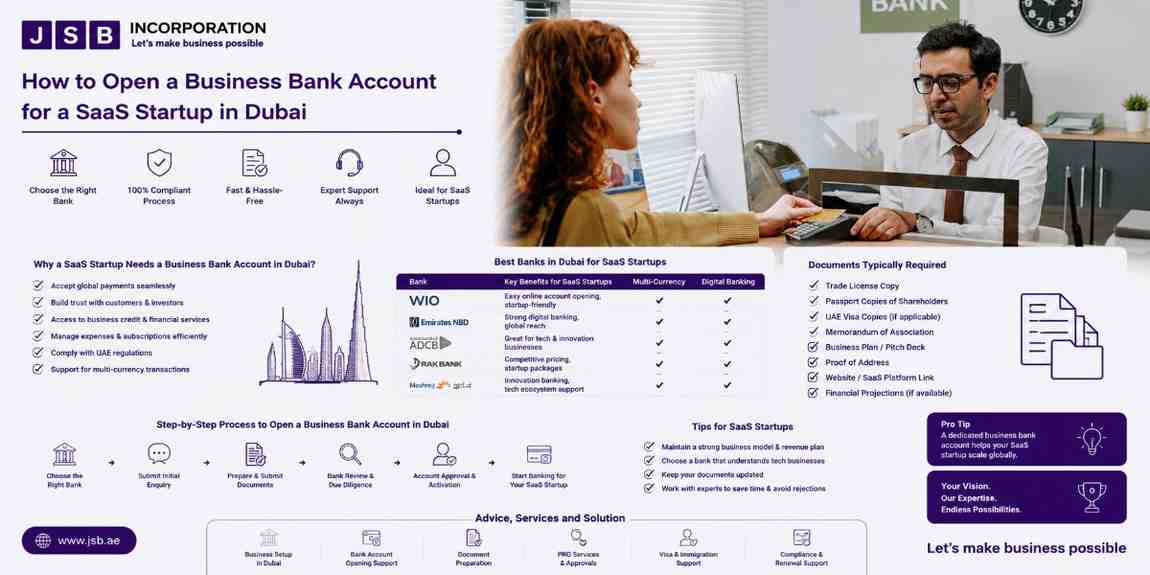
A SaaS startup needs its trade license, MOA/AOA, shareholder KYC documents, a written business plan, and source-of-funds evidence before applying, per CBUAE due diligence standards for legal persons.
Opening a business bank account for a SaaS company in the UAE involves five steps: finalize your legal structure, prepare a complete document pack, submit your application, respond quickly to compliance queries, and activate your account.
SaaS bank applications most often face delays due to virtual-office-only setups, vague business descriptions, foreign-only billing, incomplete shareholder KYC, and unclear sources of funds.
Many founders who set up with only a virtual office report facing more questions during the bank’s compliance review than those who lease a serviced or dedicated office space.
This pattern shows up repeatedly in founder discussions and community forums, where entrepreneurs describe longer waits and more document requests when their registered address is a flexi-desk or virtual arrangement rather than a physical workspace.
This is anecdotal founder experience rather than official banking policy, so it should not be treated as a guaranteed outcome.
Still, it lines up closely with the CBUAE’s underlying due diligence principle, which requires that your funds and business activity remain traceable and consistent with your declared business purpose.
When your office setup doesn’t clearly support the story your business plan tells, banks tend to ask more questions before approving your account.
Common Delay Cause | Basis | What Helps |
Virtual office only | Reported pattern in founder discussions | Consider a flexi-desk or serviced office if budget allows |
Vague business description | Fails the purpose of account requirement | Provide a one-page business plan detailing your subscription model |
Foreign-only billing | Banks must trace fund legitimacy | Provide client contracts or payment processor statements |
Incomplete shareholder KYC | CDD/EDD rules require full verification | Submit passport, Emirates ID, and proof of address for every shareholder upfront |
Unclear source of funds | Core CBUAE due diligence checkpoint | Prepare documentation tracing capital to a legitimate origin |
The CBUAE Rulebook has directed a 3-business-day target for low-risk, fully documented applicants since 2018, and this standard is being reinforced under a new SME Customer Protection Regulation taking full effect on September 13, 2026.
2. Can a free zone SaaS company open an onshore branch instead of a separate mainland entity?
Yes, amended Articles 3 and 5 of the Commercial Companies Law, in force since October 15, 2025, already permit free zone companies to establish branches onshore where their free zone’s own rules allow it, though some operational procedures were still being finalized as of this writing.
3. Is a virtual office enough, or does a bank expect a physical office?
No absolute rule requires a physical office, but founder discussions suggest virtual-office-only setups sometimes face more scrutiny during compliance review.
4. What documents does a bank need to verify the source of funds for a startup?
Banks typically require documentation tracing founder or investor capital to a legitimate origin, in line with CBUAE due diligence standards for legal persons.
5. Do the UAE’s 2026 tax and VAT procedure changes affect how banks assess a SaaS company’s documentation?
Federal Decree-Laws No. 16 and No. 17 of 2025, effective January 1, 2026, and administered by the Federal Tax Authority, tightened VAT refund limitation periods, reverse charge documentation, and anti-evasion input tax rules, reinforcing the same documentation discipline that supports faster bank account approval.
Opening a business bank account as a SaaS founder does not need to be the hardest part of building your company in the UAE.
JSB Incorporation prepares SaaS-specific, bank-ready documentation and coordinates directly with relationship managers across the UAE’s banking sector.
With coverage across 24-plus jurisdictions and transparent, upfront pricing, JSB works to get you licensed and banked without unnecessary delays.
Book your free consultation call today with the experts of JSB Incorporation to learn more.
Also Read:
Why Your UAE Business Bank Account Application Got Rejected & How to Fix It
UAE Business Bank Accounts for Startups & SMEs in 2026: Best Options by Use Case
Mainland vs Free Zone Business Bank Accounts in UAE 2026: What Really Makes Banking Easier for You
How to Open a Business Bank Account in UAE (Fast Approval Guide 2026)

Office 2505, 25th Floor, Regal Tower, Business Bay, Dubai, UAE P.O Box 27614.
+971 4 824 4842
info@jsbincorporation.com