
Key Highlights
You’ve landed a deal to assemble EV battery packs for a regional automaker. The client wants your production line running within the quarter. You’ve secured funding, found a warehouse in Dubai Industrial City, and are ready to sign the lease.
Then your lawyer mentions you’ll need sign-off from two entirely separate government bodies before you bolt down a single machine. If you’re building an EV or auto-component manufacturing operation in the UAE, this is closer to your reality than your exception.
Setting up a factory here isn’t like opening a trading office or a consultancy. You need a mainland or free zone industrial trade license from your local Department of Economic Development or Department of Economy and Tourism.
Separately, you also need a federal Industrial Production License and Industrial Registry entry from the Ministry of Industry and Advanced Technology before you can legally operate. Skip either one, and you either can’t open your doors or you leave real money on the table in unclaimed customs duty exemptions.
The UAE’s Ministry of Economy and Tourism recognizes six mainland trade license categories. These include industrial, commercial, professional, tourism, agricultural, and crafts licenses.
If your EV business involves assembly, fabrication, or physical production of vehicles or components, that activity falls under the industrial license category, not the commercial license most trading and service businesses use.
This distinction carries real weight because industrial licensing triggers a separate federal registration track. Beyond the standard mainland licensing steps, manufacturers must also register in MoIAT’s federal Industrial Registry to formally operate as a licensed industrial facility.
That registry runs under Federal Decree-Law No. 25 of 2022 and its executive regulations. It covers establishments engaged in manufacturing activity across the UAE’s industrial classification system, whether you’re on the mainland or inside a free zone, and it requires an annual update filing to stay active.
Investors are actively pursuing this dual-approval process for EV manufacturing. In 2022, M Glory Group laid the foundation stone for the UAE’s first dedicated EV manufacturing facility at Dubai Industrial City.
The AED 1.5 billion investment, roughly USD 408 million, covered a 1 million square foot site. The project was announced with a target capacity of 55,000 vehicles a year and more than 1,000 new jobs. It was designed to serve the GCC region along with export markets, including Egypt, Kenya, Tanzania, Mali, and Senegal.
That project didn’t happen by accident. It sits inside the UAE’s broader Operation 300bn strategy, a ten-year national plan launched in 2021 to raise the industrial sector’s GDP contribution from AED 133 billion to AED 300 billion by 2031.
The UAE is backing this with more than AED 40 billion in fresh manufacturing investment over five years, targeting an increase in the sector’s GDP share from roughly 9 percent in 2024 to 15 percent by 2031.
A project of M Glory’s scale isn’t the typical starting point for most first-time EV component manufacturers. Treat it as proof of sector momentum rather than a benchmark for your own capital requirements.
A lot of entrepreneurs assume that once they hold a trade license, they’re cleared to manufacture.
That assumption causes real delays later, especially when factories try to import machinery duty-free or bid on government supply contracts without the federal layer in place.
Here’s how the two approvals actually split:
Aspect | Mainland trade or industrial license, DED or DET | MoIAT Industrial Production License and Registry |
Governing authority | Emirate-level Department of Economic Development or Dubai Department of Economy and Tourism | Federal Ministry of Industry and Advanced Technology |
Purpose | Legal authorization to operate a business or trade activity in the emirate | Registers the factory in the national industrial register and unlocks customs duty exemptions on machinery, equipment, and raw materials |
Key benefit | Enables legal commercial operation, hiring, and contracts | Enables Certificate of Origin eligibility and value-added certificate requests through the Ministry of Economy |
Sequencing | Applied for first | Requires an existing local industrial license as a prerequisite before filing |
Minimum capital and staffing thresholds | Varies by activity and legal form | Not published on MoIAT’s official service page; confirm directly with MoIAT before budgeting |
You need the mainland license first. MoIAT lists holding an industrial license from a local licensing department as a precondition for issuing the federal Industrial Production License.
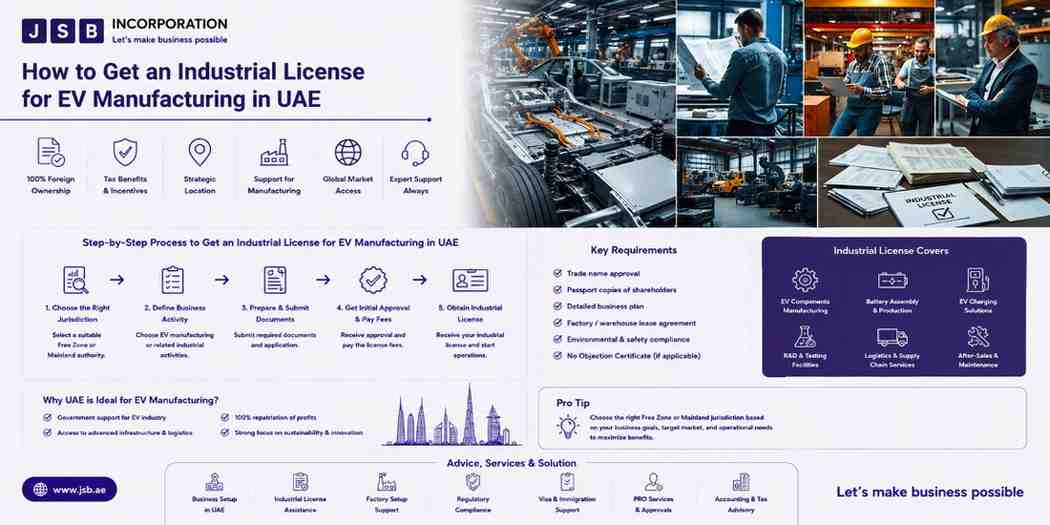
Here is the full sequence, built from official government process pages:
Timelines vary by case, factory readiness, and inspection scheduling. MoIAT does not publish a single fixed processing window on its official service page. Rather than estimate a specific number of days, plan for the broader journey to stretch into a multi-month build for a genuine factory.
This includes premises fit out, civil defense approvals, and utility connections. Confirm current processing expectations directly with MoIAT once your application is filed.
Clearing MoIAT’s inspection and receiving your license unlocks several concrete advantages that go well beyond compliance on paper.
Keep in mind the duty exemption isn’t automatic. You register each industrial input with MoIAT and file a specific exemption request. Those inputs need to tie directly to the product you’re licensed to manufacture.
Businesses change, and MoIAT accounts for that through dedicated digital services. If your ownership structure, activity, raw materials, capital, or workforce shifts, MoIAT lets you update your license data through its online platform.
Changes involving your activity or physical site trigger a follow-up inspection before approval. Renewal and reactivation run as separate official MoIAT services.
If your license lapses or you need to formally wind down operations, you’ll use the dedicated cancellation or reactivation service rather than starting the whole process over.
Staffing an EV factory takes more than posting job listings. Mainland recruitment in the UAE runs through a two-stage process. You first secure work permit pre-approval. Residency processing then moves through the General Directorate of Residency and Foreigners Affairs.
This applies directly to EV manufacturers scaling up factory floors and technical teams. Budget for both the timeline and per-employee visa costs as your production headcount grows.
Yes. The mainland license authorizes legal operation of your business. MoIAT’s Industrial Registry and Production License unlock customs exemptions and other industrial sector benefits.
2. What government body handles MoIAT applications, and how are they submitted?
Applications go through MoIAT’s digital services platform. You enter your factory and activity details and upload the required attachments before submission.
3. Can an existing industrial license be modified if ownership or activity changes?
Yes, through MoIAT’s license modification service. Changes involving your activity or physical site trigger a mandatory inspection before the change gets approved.
4. What customs benefits does the Industrial Production License provide?
It provides exemption from customs duties on imported machinery, equipment, and raw materials used directly in manufacturing. Each input needs separate registration and an exemption request.
5. Is EV manufacturing actually happening in the UAE right now?
Investor activity has been real and substantial. M Glory Group announced an AED 1.5 billion EV manufacturing facility at Dubai Industrial City in 2022, targeting 55,000 vehicles annually for GCC and export markets. Current operational output has not been independently verified as of this writing.
Getting your EV manufacturing license structured correctly the first time saves you months of rework and keeps your production timeline on track.
JSB Incorporation, based at Regal Tower, Business Bay, Dubai, UAE, supports mainland licensing and MoIAT federal registration steps and coordinates inspections and keeps paperwork moving so you can focus on building your factory instead of chasing approvals.
Book your free consultation call today with the experts of JSB Incorporation to learn more.

Office 2505, 25th Floor, Regal Tower, Business Bay, Dubai, UAE P.O Box 27614.
+971 4 824 4842
info@jsbincorporation.com
