
 Gaurav Keswani
Key Highlights
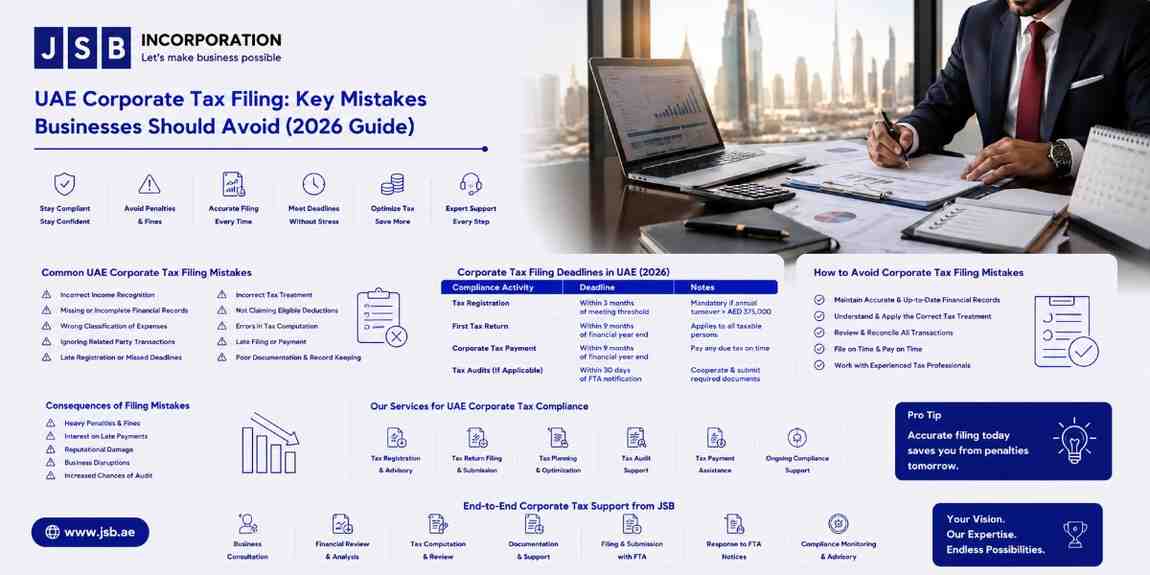
UAE Corporate Tax registration errors are costing businesses real money. The Federal Tax Authority confirms that more than 68,600 businesses had already benefited from its Late Registration Penalty Waiver by May 2026, a figure it expects to climb past 91,000 as more first-time filers approach their deadlines.
That scale points to a simple problem: a lot of business owners in the UAE are still getting their Corporate Tax filing wrong, not because they’re negligent, but because the registration timeline, exemption categories, and relief provisions are more nuanced than most people expect when they first set up shop here.
The good news is that every one of these mistakes has a clear and verified fix. This guide breaks down the five filing errors that trigger FTA penalties most often and shows you exactly how to correct or avoid each one using only verified UAE government sources.
You’ll pay 0 percent on taxable income up to AED 375,000, and 9 percent on taxable income above that threshold under Corporate Tax.
If you operate as a juridical person conducting business in the UAE, you must register with the FTA and get a Corporate Tax Registration Number, regardless of whether you end up owing tax.
If you’re a natural person, like a freelancer or sole proprietor, you only need to register for Corporate Tax when your business turnover exceeds AED 1,000,000 per year. Your salary, personal investment income, and real estate investment income don’t count toward that threshold.
This distinction trips up a lot of consultants and freelancers who assume any income they earn counts when, really, only revenue tied to an actual business activity matters.
If you came from a country where personal and business income get taxed together, this separation feels unfamiliar at first.
You might hold a salaried role, own a rental property, and run a side consultancy all at once, and only one of those three income streams actually factors into your AED 1,000,000 threshold check.
Get this wrong, and you either register when you didn’t need to, wasting time, or skip Corporate Tax registration when you should have filed, risking a penalty.
If you register late, you’ll face an administrative penalty of AED 10,000 for Corporate Tax. That’s a flat fine, and it applies whether you’re a one-person consultancy or a large group.
There’s real relief available, though. Under the FTA’s Late Registration Penalty Waiver Initiative, you can have this AED 10,000 penalty waived if you submit your first Corporate Tax Return, or Annual Declaration if you’re an exempt person, within seven months from the end of your first Tax Period, instead of the standard nine months.
You don’t need to file a separate reconsideration or waiver request; it’s applied automatically once you meet the condition through EmaraTax.
If you already paid the penalty, the amount gets credited back to your EmaraTax account once you meet the seven-month filing condition. This exception applies only to your first tax period, no matter when that period ends.
Here’s how the violation, penalty, and waiver condition break down:
Violation | Penalty | Waiver Condition |
Late Corporate Tax registration | AED 10,000 | File your first Tax Return or Annual Declaration within 7 months of your first Tax Period end, via EmaraTax |
Registration application not yet submitted | AED 10,000 once assessed | Submit registration and file your return or declaration within 7 months of your first Tax Period end |
Missed the 7-month window | Penalty stands | Standard 9-month filing deadline still applies, but you lose the waiver benefit |
Take a common situation: an entrepreneur registers a free zone consultancy, spends the first year building a client base, and only realizes in month eight of their first tax period that their Corporate Tax Registration Number was never fully processed because the application sat incomplete.
By the time they notice, they’ve already missed the seven-month waiver window, and that AED 10,000 penalty becomes very real.
This is exactly the kind of gap that catches busy founders off guard, not because they’re ignoring the rules, but because Corporate Tax compliance competes with a dozen other priorities in a new market.
If your first Tax Period ended in the past year, don’t wait until the nine-month mark just because it’s technically allowed. That extra two months could cost you AED 10,000 you didn’t need to spend, and once that window closes, there’s no second chance to claim the waiver.
You can elect for Small Business Relief if your revenue is AED 3,000,000 or less in your current tax period and in every previous tax period. Under this relief, you’re treated as having no taxable income for that period, which sounds like a free pass from UAE Corporate Tax, but it isn’t quite that simple.
Keep in mind this relief only applies to tax periods ending on or before December 31, 2026, so if you’re relying on it, check whether your current tax period falls before that cutoff.
Here’s the mistake we see constantly: qualifying for this relief doesn’t remove your Corporate Tax registration or filing obligation. A lot of small business owners assume that if they owe zero tax, they don’t need to file anything, and that assumption is exactly what leads to registration and filing penalties.
You should also know that if you’re a Qualifying Free Zone Person, or part of a multinational group with consolidated group revenue exceeding AED 3.15 billion, you can’t elect for Small Business Relief at all.
And if you do elect for it, you’re giving up other exemptions, reliefs, and deductions for that tax period while still needing to comply with the arm’s length principle. Weigh this tradeoff carefully rather than electing for it automatically just because your revenue qualifies.
If you’ve set up in a free zone, you might assume your 0 percent Corporate Tax rate is a permanent perk that comes automatically with your license. It isn’t. Your free zone tax incentives continue only if you comply with all regulatory requirements and don’t conduct business on the mainland outside the scope permitted to you.
Step outside those conditions, even without meaning to, by taking on mainland clients or activities beyond your license scope, and you risk losing your Qualifying Free Zone Person status.
That means your preferential Corporate Tax rate is conditional, not automatic, so it’s worth confirming your eligibility each tax period rather than assuming it carries over from the last one.
You might assume any business with a charitable, government, or resource-related angle automatically qualifies as an Exempt Person under Corporate Tax.
It doesn’t work that way. Exempt Persons include government entities and government-controlled entities; extractive and non-extractive natural resource businesses upon notification to the Ministry of Finance; qualifying public benefit entities; and qualifying investment or pension funds.
Some of these categories, specifically government entities, government controlled entities, and extractive and non-extractive natural resource businesses, remain excused from registration and filing obligations, but only if they don’t conduct an activity that falls within the scope of Corporate Tax.
If you fall into one of these categories, don’t assume you’re off the hook entirely; check your specific activity against this condition first.
Corporate Tax applies from the start of your first financial year beginning on or after June 1, 2023. Because the law ties to your specific financial year rather than one universal calendar date, your Corporate Tax filing deadline could look completely different from another business’s, even if you’re in the same industry.
If you’re setting up a new entity now, your registration deadline is three months from your date of incorporation, establishment, or recognition, rather than a license month table.
That three-month rule replaced the earlier license-month-based deadlines, which applied only to resident juridical persons that already existed before March 1, 2024. If you’re managing multiple entities with staggered financial years, or entities set up under different rules at different points in time, this is exactly where deadlines slip through the cracks.
Rather than relying on memory, mark your financial year end date and your incorporation date the moment you receive your trade license, then count backward from your filing deadline and your seven-month waiver window separately.
Businesses running multiple entities under one holding structure often benefit from tracking each entity’s deadline on a single shared calendar rather than assuming they align.
If you run a UAE branch of a UAE-based juridical person, that branch is treated as an extension of your parent entity, not a separate legal entity. That means you’re not required to register or file separately for Corporate Tax for that branch.
We often see businesses with multiple branch locations overfile by registering each branch independently, creating admin work they didn’t need to take on.
On the flip side, don’t assume this exemption automatically applies if your branch structure involves a foreign parent; confirm whether your setup is domestic first, since foreign branch structures can carry different Corporate Tax obligations.
Here’s the process, step by step, through the EmaraTax platform:
Keep digital copies of every document you submit for your Corporate Tax registration, along with your submission confirmation, in case you need to reference your filing history later.
If you’re an Exempt Person still required to register, remember that annual declarations are due within nine months from the end of your financial year, so exemption from tax payment doesn’t always mean exemption from paperwork.
You’ll face an administrative penalty of AED 10,000 for late Corporate Tax registration. It’s waived if you file your first Tax Return or Annual Declaration within seven months of your first Tax Period’s end.
2. Do small businesses still need to file if they qualify for Small Business Relief?
Yes. Small Business Relief treats your taxable income as nil for the period, but it doesn’t remove your Corporate Tax registration or filing obligation, and it only applies to tax periods ending on or before December 31, 2026.
3. Is the Free Zone 0 percent corporate tax rate automatic?
No. You keep the 0 percent incentive only if you meet all regulatory requirements and don’t conduct mainland business outside your permitted scope.
4. Who is exempt from UAE corporate tax?
Exempt Persons include government entities, government-controlled entities, extractive and non-extractive natural resource businesses upon notification, qualifying public benefit entities, and qualifying investment or pension funds.
5. Do UAE branches need to register separately for corporate tax?
No. If your UAE branch belongs to a domestic juridical person, it’s treated as an extension of the parent entity, so you don’t need to register or file separately for Corporate Tax.
6. Does a natural person always need to register for corporate tax?
No. You only need to register if your business turnover exceeds AED 1,000,000 per year, excluding salary, personal investment income, and real estate investment income.
Disclaimer: Corporate Tax rates, thresholds, registration deadlines, and waiver conditions are set by the FTA and Ministry of Finance and are subject to change through new Cabinet or Ministerial Decisions. Always confirm your current filing obligations before making registration or filing decisions.
Reviewed by- Gaurav Keswani, Founder JSB Incorporation
Gaurav Keswani is the Founder and Managing Director of JSB Incorporation, where he has guided entrepreneurs through UAE company formation, Corporate Tax registration, and compliance across 24-plus jurisdictions since founding the firm. He has been featured as a business setup and immigration expert in Khaleej Times.

Office 2505, 25th Floor, Regal Tower, Business Bay, Dubai, UAE P.O Box 27614.
+971 4 824 4842
info@jsbincorporation.com