
 Gaurav Keswani
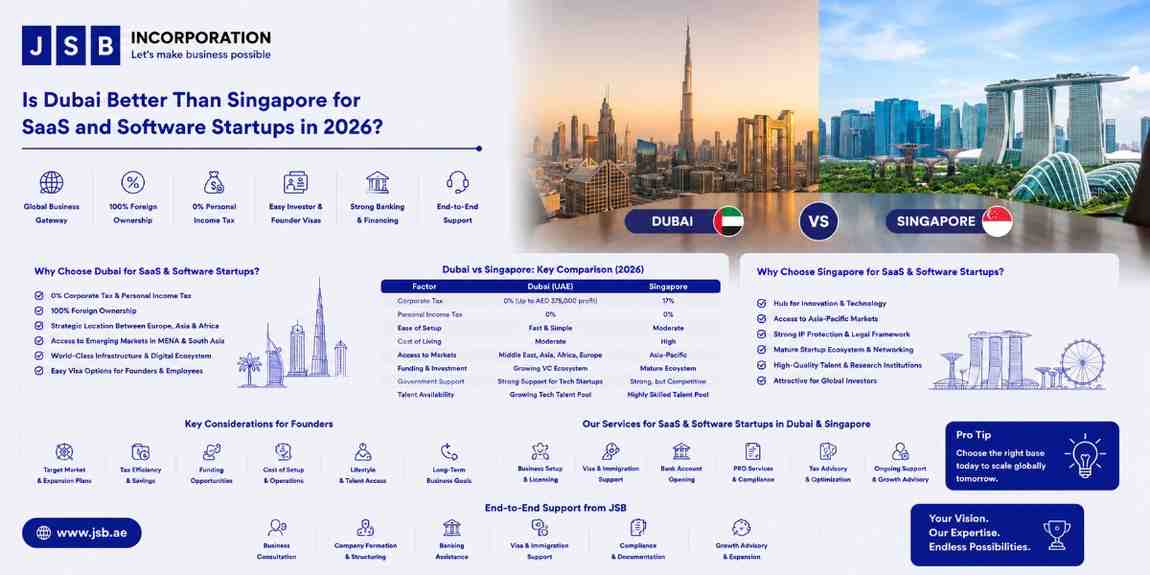
Key Highlights
Dubai is usually the better base if you want low personal tax and fast, low-cost setup, since a free zone license can start from AED 11,900 per year with 0% personal income tax and, for qualifying free zone companies, 0% corporate tax on qualifying income.
Singapore fits venture-backed SaaS teams better because of its common-law system and deep investor pool, but it charges a flat 17% corporate tax and requires at least one locally resident director.
Your best choice depends on where your customers are, how you plan to raise money, and whether you want residency for yourself.
Dubai free zone setup costs are fixed and published upfront, while Singapore’s government fees are lower but come with mandatory service costs like a resident director and company secretary.
Here is a side-by-side view of the official, verifiable numbers.
Cost item | Dubai (IFZA free zone) | Singapore (Pte. Ltd.) |
Base license / incorporation | Zero Visa License AED 11,900/year; 1-Visa License AED 14,900/year; 2-Visa License AED 16,900/year | Name application SGD 15 + incorporation SGD 300 = SGD 315 total |
Establishment / e-card | Establishment Card AED 2,000 (initial) | Not applicable |
Residence visa | UAE Residence Visa AED 3,750, valid 2 years | Not applicable at incorporation |
Minimum shareholders | Included in package | 1 shareholder minimum |
Minimum share capital | Not required for standard package | SGD 1 minimum |
Resident director | Not required in free zone | At least one locally resident director required |
Company secretary | Not required | Must appoint within 6 months |
Here is the part that trips up first-time founders. Singapore’s government fee of SGD 315 looks cheaper than Dubai’s AED 11,900, but that number does not include the recurring cost of a resident director and a licensed company secretary.
If you do not live in Singapore, you will likely pay a service provider for a nominee director and secretarial support every year, and those ongoing fees add up. So compare the total first-year cost, not just the government filing fee.
Disclaimer: All fees above are drawn from IFZA’s published 2026 documents and Singapore government portals. Pricing changes often. Always confirm current figures against the relevant UAE and Singapore government sources before you commit any capital.
Dubai charges 0% corporate tax on taxable income up to AED 375,000 and 9% above that, while qualifying free zone companies can keep 0% on qualifying income. Singapore charges a flat 17%, softened by startup exemptions in the early years. Here is how the two systems line up.
Tax feature | Dubai / UAE | Singapore |
Headline corporate tax | 0% up to AED 375,000; 9% above | Flat 17% on chargeable income |
Free zone benefit | 0% on qualifying income for a Qualifying Free Zone Person; 9% on non-qualifying income | No free zone regime |
Startup relief | Small business relief: revenue up to AED 3 million can elect to be treated as having no taxable income, available until 31 December 2026 | Start-Up Tax Exemption: 75% off first SGD 100,000 and 50% off next SGD 100,000 of chargeable income, first 3 years of assessment |
Personal income tax | 0% | Progressive, up to 24% for residents |
A Qualifying Free Zone Person is a free zone company that meets specific conditions and can therefore pay 0% corporate tax on its qualifying income.
According to the UAE Federal Tax Authority, to qualify you must maintain adequate substance in the UAE, derive qualifying income, not elect into the standard tax regime, and comply with transfer pricing rules.
There is a catch that many founders miss. You also have to pass the de minimis test. Your non-qualifying revenue must not exceed 5% of total revenue or AED 5 million, whichever is lower. Break that threshold and you can lose your 0% status, with all income taxed at 9% for that period and for a minimum of five years.
So a free zone license does not hand you 0% tax automatically. You earn it by meeting real substance and income conditions.
Disclaimer: Tax rules and thresholds are technical and change over time. Confirm your specific position with the UAE Federal Tax Authority, IRAS, and a licensed tax advisor before making decisions.
Dubai offers more than 40 free zones, and several are built around technology, media, and finance companies. For a software or SaaS founder, the commonly cited technology-focused options include:
A meaningful change arrived at the end of 2025. The UAE Commercial Companies Law was amended by Federal Decree-Law No. 20 of 2025, issued on 1 October 2025 and effective the day after publication in the Official Gazette on 14 October 2025. Two updates matter for founders.
First, the amended law confirms that companies incorporated in UAE free zones, including financial free zones, may establish branches and representative offices onshore where the relevant free zone rules permit.
Second, a new article 15 bis introduces a re-domiciliation provision, letting companies transfer their registration between authorities, for example, from a free zone to the mainland and back, while maintaining their original legal personality, contracts, and obligations.
In simple terms, you get more flexibility to grow. You can start in a free zone and later reach onshore customers without dismantling your company. Note that detailed implementing regulations are still being issued, so the practical process will depend on the rules in each free zone and emirate.
Yes. Every Singapore company must have at least one director who meets local residency rules, meaning a Singapore citizen, a permanent resident, or a holder of a valid pass such as an Employment Pass or EntrePass.
You also need to appoint a company secretary within six months of incorporation, and the role cannot stay vacant beyond that window. A private limited company needs at least one shareholder, and share capital can start at just SGD 1.
For an overseas founder, the resident-director rule is the practical hurdle. If nobody on your team lives in Singapore, you will usually engage a service provider for a nominee director until you or a co-founder qualifies. Dubai’s free zones do not impose this requirement, which is one reason solo and remote founders often lean toward the UAE.
Dubai lets a founder secure long-term residency through the entrepreneur Golden Visa, while Singapore ties your work pass to an operating, venture-backed, or innovative company through the EntrePass.
Here is the comparison.
Residency route | Country | Duration | Key requirements |
Entrepreneur Golden Visa | UAE | 5 years | Innovative or technical project; project value of no less than AED 500,000 confirmed by a certified auditor; approval letter from a competent authority or approved incubator |
Investor Golden Visa | UAE | 10 years (public investment); 5 years (real estate) | Minimum capital of AED 2 million, qualifying property, or an establishment paying at least AED 250,000 annually in taxes |
Virtual working programme | UAE | 1 year | Remote work option that lets you live in Dubai while working for an overseas employer |
EntrePass | Singapore | Tied to the business | Private limited company registered with ACRA; hold at least 30% of the company; be venture-backed or own innovative tech; meet at least one criterion such as raising SGD 100,000 in a single funding round, backing from a recognized incubator, or holding registered IP |
The difference is philosophical. Dubai’s Golden Visa can give you and your family five years of stability tied to a qualifying project, and it is not linked to hitting funding milestones. Singapore’s EntrePass expects your company to be venture-backed or genuinely innovative, and it leans toward founders who have already raised money or built recognized IP.
Disclaimer: Visa criteria and thresholds are set by government authorities and can change. Verify current requirements directly with ICP, u.ae, Invest in Dubai, and Singapore’s Ministry of Manpower before applying.
Use this decision table to match your situation to the jurisdiction that supports it, based on the facts established above.
Your situation | Better fit | Why |
Bootstrapped SaaS targeting MENA clients, wanting low personal tax | Dubai | 0% personal tax and 0% on qualifying income for a QFZP |
VC-backed SaaS or fintech needing common-law IP protection and institutional investors | Singapore | Common-law framework and a mature investor ecosystem, with the EntrePass built for venture-backed founders |
Founder wanting fast personal and family residency | Dubai | Entrepreneur Golden Visa offers 5 years tied to a qualifying project |
Founder needing flexibility to shift between free zone and mainland | Dubai | New article 15 bis allows re-domiciliation without losing legal continuity |
Avoid these three errors, because each one can cost you money or your tax status.
1. Is Dubai good for software startups in 2026?
Yes, Dubai is a strong base for software startups in 2026, especially bootstrapped and MENA-focused teams.
You get 0% personal income tax and published free zone license prices starting from AED 11,900 per year and the possibility of 0% corporate tax on qualifying income if your company meets QFZP conditions.
2. What is a Qualifying Free Zone Person (QFZP)?
A Qualifying Free Zone Person is a UAE free zone company that pays 0% corporate tax on qualifying income by meeting set conditions. Those conditions are adequate substance in the UAE, qualifying income, no election into the standard regime, and transfer pricing compliance.
3. How much does an IFZA business license cost in 2026?
IFZA’s 2026 standard prices are AED 11,900 per year for a zero-visa license, AED 14,900 for a 1-Visa License, and AED 16,900 for a 2-Visa License, inclusive of VAT.
Government-related fees, such as an Establishment Card at AED 2,000 and a UAE Residence Visa at AED 3,750, are charged separately.
4. Can I get UAE residency through my software startup?
Yes. If your project is innovative or technical, you can apply for the entrepreneur Golden Visa, which grants five years of residency. You need a certified auditor letter showing a project value of no less than AED 500,000 and an approval letter from a competent authority or an approved business incubator.
5. Do I need a local director to register a company in Singapore?
Yes. Every Singapore company must have at least one director who meets local residency rules, meaning a Singapore citizen, permanent resident, or valid pass holder such as an Employment Pass or EntrePass holder.
6. Can a founder register a company in both Dubai and Singapore?
Yes, and many founders do run parallel structures, for example, a Singapore entity for investor-facing IP and a Dubai free zone company for tax-efficient operations.
Each entity must independently meet its own jurisdiction’s rules, including Singapore’s resident-director requirement and Dubai’s QFZP substance conditions.
You now have the facts. The next step is turning them into a setup that actually fits your business, and that is where getting it right the first time saves you months.
JSB Incorporation helps global entrepreneurs form companies across 24+ UAE jurisdictions, including DMCC, IFZA, and JAFZA, with support for trade licenses, bank account opening, tax and VAT compliance, and PRO services.
If Dubai is your direction, JSB can guide you through free zone selection, UAE Golden Visa eligibility, and QFZP substance planning, with transparent pricing and end-to-end support so you are not guessing at costs or timelines.
You can reach JSB Incorporation at Regal Tower, Business Bay, Dubai, UAE, or start with a consultation to map your options.
Book a free consultation call today.
Also Read:
18 Common Business Setup Mistakes in Dubai and How to Avoid Them
UAE Business Setup and Golden Visa in 2026: A Comprehensive Analysis
How Long Does Business Setup Take in UAE in 2026? (Per Jurisdiction) Breakdown)
The Ultimate Comparison: Business Setup in IFZA Free Zone vs. Mainland Dubai

Office 2505, 25th Floor, Regal Tower, Business Bay, Dubai, UAE P.O Box 27614.
+971 4 824 4842
info@jsbincorporation.com