
 Gaurav Keswani
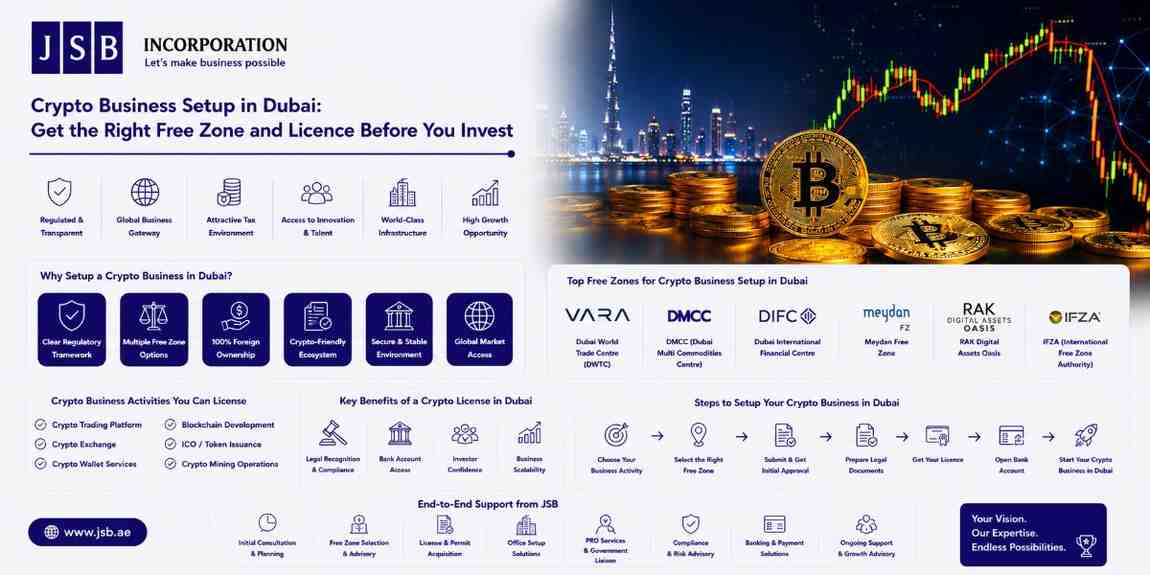
Key Highlights
As of mid-2026, every virtual asset business operating in Dubai is subject to Dubai Law No. 4 of 2022, which established the Dubai Virtual Assets Regulatory Authority (VARA) as the mandatory regulatory authority for this sector.
That single legal fact changes everything about how you structure your company. Yet most buyers discover it only after committing AED 30,000–50,000 to a free zone setup that doesn’t match their activity.
The most expensive mistake in crypto business setup Dubai isn’t choosing the wrong zone. It’s choosing the right zone with the wrong licence. Some crypto activities need only a standard free zone trade licence.
Others require a separate VARA Virtual Asset Service Provider (VASP) licence on top. Knowing which applies to your business before you register saves you from restarting the entire process.
This article covers which activity maps to which licence, which free zones are suitable, and what the setup sequence involves so you make the right decision.
TL;DR: A crypto business setup in Dubai requires two separate decisions: the right free zone entity and the correct trade licence activity. Getting one wrong without the other creates a compliance gap that banks and regulators will find before you do.
Dubai’s virtual asset regulatory framework operates on two separate layers and understanding both before you register is the only way to avoid a costly restart.
The first layer is the free zone trade licence. Every UAE business, including crypto and Web3 companies, needs a free zone or mainland trade licence issued by the relevant authority.
For free zone companies, this is issued by the zone itself, including DMCC (Dubai Multi Commodities Centre), IFZA (International Free Zone Authority), or another approved authority.
The second layer applies only to businesses that provide virtual asset services to external clients.
Under Dubai Law No. 4 of 2022, any company offering services as a virtual asset exchange, broker, custodian, transfer provider, or investment manager to clients must obtain a VARA VASP licence directly from VARA in addition to its free zone trade licence.
A free zone trade licence alone does not authorize you to serve clients in these categories.
This is the distinction that determines your entire setup path: whether your activity triggers the VARA layer is not about whether you’re involved in crypto. It’s about whether you’re serving others.
The table below maps activity types to their correct licence requirement:
Activity | Licence Required |
Proprietary crypto trading (own account only) | Free zone trade licence |
Web3 software development or blockchain consultancy | Free zone trade licence |
Crypto fund management (own capital only) | Free zone trade licence |
NFT creation, tokenisation projects, DeFi protocol development | Free zone trade licence |
Operating a crypto exchange for clients | Free zone trade licence + VARA VASP licence |
Providing brokerage, advisory, or custody services to clients | Free zone trade licence + VARA VASP licence |
Managing crypto assets on behalf of third parties | Free zone trade licence + VARA VASP licence |
Running a virtual asset transfer or settlement service | Free zone trade licence + VARA VASP licence |
In Dubai, whether you need a VARA VASP licence depends on who you’re transacting for. Trading, investing, or building with your own capital through a UAE free zone company requires a standard trade licence only.
The moment you provide virtual asset services like exchange, brokerage, custody, or transfer to external clients, VARA requires a VASP licence under Dubai Law No. 4 of 2022.
The free zone trade licence is the foundation; the VARA licence is the additional regulatory layer for client-facing operations.
TL;DR: Not every UAE free zone supports virtual asset activities. DMCC and IFZA are the two JSB-serviced free zones with confirmed crypto-compatible licence structures. The right choice between them depends on your activity type, budget, and office requirement.
DMCC operates a dedicated Crypto Centre within its free zone and supports over 600 business activities, the broadest activity list of any single Dubai free zone.
For crypto and Web3 businesses, DMCC is particularly suited to commodity-linked virtual assets, blockchain infrastructure companies, and Web3 ventures that benefit from proximity to Dubai’s trading and commodities ecosystem.
DMCC requires a physical presence, including a flexi-desk at minimum, which means your cost structure includes office setup alongside the trade licence.
That requirement also strengthens your corporate bank account application, as UAE banks assess physical presence as part of their due diligence on crypto-related entities.
IFZA (International Free Zone Authority) allows multiple activities under a single trade licence at a cost-accessible entry point, with remote setup possible for founders who don’t need to be physically present in Dubai during registration.
JSB Incorporation is itself registered under IFZA, which means the team works within the authority’s documentation requirements daily.
IFZA business setup is well-suited to crypto consultancy firms, Web3 service companies, blockchain technology developers, and digital asset businesses that operate primarily through service contracts rather than physical trading infrastructure.
For founders comparing cost and setup speed, IFZA is consistently the more accessible option.
Three factors determine which free zone fits your situation: your activity type and whether it requires physical infrastructure; your budget for office space alongside the trade licence, and your visa quota requirement relative to your team size.
The activity-matching step comes first. Selecting a free zone before confirming your activity category is the order of operations that creates the most costly restarts. A JSB consultation confirms which zone matches your activity before any documentation is prepared.
TL;DR: The process follows four stages: activity confirmation, free zone entity registration, trade licence issuance, and corporate tax registration with the Federal Tax Authority. Each stage has a defined sequence; skipping one creates a compliance gap you’ll face at banking or an audit.
Before any documentation is submitted, your activity must be confirmed against the correct licence category. This is not a form-filling step. It’s a regulatory assessment: does your business model require only a free zone trade licence, or does it trigger the VARA layer?
JSB reviews your activity structure and matches it to the appropriate free zone and licence category. That output determines everything that follows—the zone, the licence type, the office requirement, and the bank account documentation strategy.
Once the free zone and activity are confirmed, the entity registration process begins with the relevant authority — DMCC or IFZA. The free zone issues the trade licence under the confirmed activity.
JSB manages the full documentation process: Memorandum of Association preparation, shareholder documentation, authority submissions, and bank account documentation guidance.
JSB guides the bank selection process and prepares the corporate documentation package. UAE banks make independent decisions on account opening — JSB coordinates the preparation, not the bank’s approval decision.
“Before COVID, opening a business licence in Dubai required a minimum of one week of personal time investment. Today, the process has been streamlined to just a few steps, sometimes completed on the same day.” — Gaurav Keswani, Founder, JSB Incorporation, Talk 100.3 FM
Every UAE-registered company, including free zone entities, must register with the Federal Tax Authority (FTA). This is mandatory, not optional. UAE corporate tax applies at 9% on taxable income above AED 375,000.
Free zone companies may be eligible for a 0% rate on qualifying income, subject to meeting the FTA’s substance requirements.
JSB’s in-house Chartered Accountants handle FTA registration as part of the end-to-end setup sequence, ensuring your entity is registered correctly from the first financial period.
UAE tax regulations are subject to change. Verify current requirements directly with the Federal Tax Authority or consult a qualified tax advisor for your specific situation.
TL;DR: JSB Incorporation handles the full company formation sequence, including activity matching, free zone registration, trade licence acquisition, and FTA registration for crypto and Web3 businesses across DMCC and IFZA.
The JSB process for crypto business setup in Dubai starts with activity confirmation — not paperwork. Before recommending a free zone or preparing any documents, JSB’s team maps your business model against the correct licence category. That step alone eliminates the most common and most expensive mistake in this space.
From there, JSB manages the full formation sequence: free zone entity registration, trade licence acquisition, bank account documentation guidance, and visa quota confirmation. JSB Incorporation operates with a 97.5% business setup approval rate.
For businesses requiring FTA corporate tax registration, JSB’s in-house team handles registration and filing within the same engagement.
JSB’s confirmed scope covers free zone company formation and trade licence acquisition across DMCC, IFZA, JAFZA, and RAKEZ. The VARA VASP license is a separate regulatory process administered directly by VARA — JSB guides you to the point where your entity is correctly formed and your regulatory position is clear.
Knowing the right activity and licence match before setup is the difference between a clean registration and a restarting process that costs both time and capital.
“We were helped by the gentleman named Gaurav who was kind enough to drive down to the place where we lived and explained to us the process in detail. Gaurav is confident about his work and has extensive knowledge about the DED process. We consulted a few other service providers but Gaurav knew something that the other providers in the market did not. Thank you for hand holding us in the initial setup, including bank account opening. Will definitely come back in future!” — rajnishnair, Google Review
That process knowledge — knowing what the other providers didn’t — is what the activity-matching step delivers before a single dirham is committed.
Reviewed by: Gaurav Keswani, Founder, JSB Incorporation
Gaurav Keswani is the Founder of JSB Incorporation, a Dubai-based business setup and immigration consultancy. He appeared on Talk 100.3 FM answering live listener questions on UAE Golden Visa eligibility, citing GDRFA and ICP guidelines directly on air. JSB Incorporation handles documentation preparation and application coordination—all visa and license decisions rest with the relevant UAE government authorities (GDRFA, ICP, DET, and DLD).
It depends on what your business does. A UAE free zone company involved in proprietary crypto trading, Web3 development, or blockchain consultancy for its own account requires a standard trade licence only.
Under Dubai Law No. 4 of 2022, a VARA Virtual Asset Service Provider licence becomes mandatory when your business provides virtual asset services to external clients, including exchange operations, brokerage, custody, asset management for third parties, or transfer services. The trade licence is the foundation; VARA adds the client-services layer.
2. Which free zone is best for a crypto company setup in Dubai?
DMCC (Dubai Multi Commodities Centre) suits commodity-linked virtual assets, blockchain infrastructure, and Web3 ventures that benefit from a physical presence and DMCC’s 600-activity roster.
IFZA (International Free Zone Authority) suits crypto consultancy, Web3 services, and technology companies that prioritize cost efficiency and remote setup capability. The decision turns on your activity type, office requirement, and budget — not on a fixed ranking.
3. Can I set up a crypto company in Dubai without living there?
Remote setup is possible through IFZA. Certain documentation steps require notarized or attested originals, which JSB coordinates.
If you require a residency visa as part of your setup, you’ll need to complete the Emirates ID biometrics in person in the UAE. Visa requirements are confirmed by the Federal Authority for Identity, Citizenship, Customs, and Port Security (ICP).
4. Does UAE corporate tax apply to my crypto free zone company?
Yes. The Federal Tax Authority (FTA) requires all UAE-registered companies to register for corporate tax. The standard rate is 9% on taxable income above AED 375,000.
Free zone companies may qualify for a 0% rate on qualifying income, subject to meeting FTA substance requirements. UAE tax regulations are subject to change. Verify current requirements directly with the Federal Tax Authority.
5. How long does a free zone crypto company setup take in Dubai?
Processing times vary by free zone authority and are subject to authority processing times at the time of application.
Most free zone trade licences are issued within a defined working-day window after documentation is complete and approved. You’ll get a realistic timeline at the consultation stage, based on current authority processing conditions.
6. What does JSB handle for a crypto business setup in Dubai?
JSB Incorporation handles free zone entity registration, trade licence acquisition under the confirmed activity, bank account documentation guidance, visa quota confirmation, and FTA corporate tax registration.
JSB’s in-house Chartered Accountants manage the compliance layer from the first financial period. VARA VASP licensing is administered by VARA directly — JSB prepares the correctly formed entity and supports your regulatory position from the formation stage.
Committing to the wrong free zone or the wrong licence category is the most common and most avoidable mistake in crypto business setup in Dubai. Confirm your activity type, your licence requirement, and your free zone match before any documentation is prepared.
Check your business setup eligibility in 5 minutes — book a free consultation with JSB Incorporation today.

Office 2505, 25th Floor, Regal Tower, Business Bay, Dubai, UAE P.O Box 27614.
+971 4 824 4842
info@jsbincorporation.com