
 Gaurav Keswani
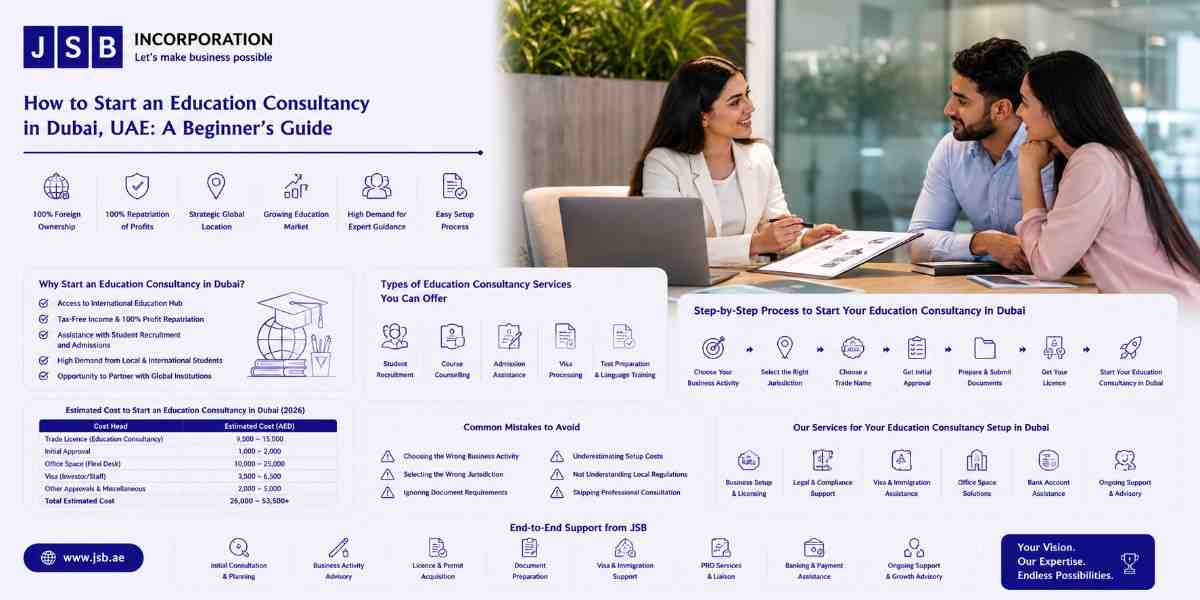
KEY HIGHLIGHTS
Many entrepreneurs register a consulting trade licence in Dubai expecting to start teaching or running courses immediately.
The Knowledge and Human Development Authority (KHDA) requires a separate Educational Services Permit for any activity involving training delivery, and the fee for this permit ranges from AED 15,000 to AED 25,000 depending on how many activities you register.
A commercial trade licence alone does not authorize you to teach, coach, or deliver structured courses in Dubai.
This guide walks you through what the licence actually covers, what the KHDA permit adds, and how the two processes fit together before you commit any budget.
A commercial licence lets you operate as a business, but it does not authorize teaching activities on its own. You need both an approved trade name and Initial Approval before KHDA will review any permit application.
Setting up an education consultancy starts the same way any Dubai company does. You reserve a trade name and secure Initial Approval from the relevant licensing authority and then apply for your commercial licence, whether through a free zone or the mainland route.
Trade Name Reservation confirms your business name is available and compliant with UAE naming conventions. Initial Approval signals that the licensing authority has no objection to your proposed activity before you invest in office space or further documentation.
This sequence establishes your legal entity but does not, by itself, cover activities like curriculum delivery, tutoring, or certified training.
Many entrepreneurs treat the trade licence stage as the finish line, then discover mid-launch that a second layer of approval sits between them and their first paying student. Understanding this upfront changes how you budget, how you plan your timeline, and which jurisdiction you choose from day one.
Not every consultancy activity crosses into KHDA’s jurisdiction. Pure advisory work, such as guiding students through university applications, career counseling, or study-abroad placement without delivering coursework, typically stays within standard commercial licensing.
This distinction matters because two businesses can carry near-identical names, “education consultancy,” yet fall under completely different regulatory tracks depending on their actual service scope.
The moment your business model includes structured lessons, coaching programs, test preparation with a fixed curriculum, or certification courses, KHDA’s Educational Services Permit becomes mandatory alongside your trade licence.
This applies whether you plan to teach in person, online, or through a hybrid format. The activity code you select at the trade licence stage should reflect this distinction precisely, since a mismatch between your registered activity and your actual operations can create compliance issues later.
This is where most first-time applicants get tripped up. They assume the commercial licence covers everything because it lists “education consultancy” as an approved activity.
In reality, the activity description on a trade licence and the regulatory permission to deliver training are two entirely different approvals, issued by two different authorities. A trade licence confirms your right to operate a business entity. A KHDA permit confirms your right to deliver educational content within that entity.
Skipping the KHDA step does not just risk a fine. It can mean operating illegally until the gap is corrected, which delays revenue and puts your entire setup timeline at risk.
Buyers researching this topic online frequently find guidance that stops at the trade licence stage, since general business setup content rarely accounts for activity-specific permits that apply only to certain sectors like education, healthcare, or media.
The right provider treats your trade licence and KHDA permit as one connected process, not two separate transactions.
A provider who understands KHDA-specific activities will flag early whether your business model requires the education permit at all. This single question, asked before you commit to a jurisdiction or activity code, can save weeks of rework later.
Ask any prospective provider directly whether they have handled KHDA-linked licensing before, and ask them to walk you through the sequence rather than just quoting a headline setup fee.
In-house compliance expertise matters just as much. A team with Chartered Accountants and PRO specialists on staff can move your Initial Approval, trade licence, and KHDA documentation in parallel rather than sequentially, which shortens your overall timeline.
Providers who outsource compliance work to third parties often introduce delays simply because documents pass through more hands before reaching the relevant authority.
Cost transparency is the next filter. Some providers quote only the trade licence fee and leave the KHDA permit as a surprise line item discovered mid-process.
Ask for a single combined estimate covering both stages before signing anything, including any facility compliance costs your KHDA application may require if you plan to operate a physical training space.
Finally, ask about realistic timelines, not just the official processing window. KHDA states an 8 working days benchmark once documents are submitted, but that clock only starts after Initial Approval and Trade Name Reservation are already complete.
A provider who quotes only the KHDA-specific processing window without accounting for the preceding steps is giving you an incomplete picture of your actual launch date.
JSB coordinates your trade licence, Initial Approval, and KHDA permit as one sequenced process, not three disconnected applications.
JSB Incorporation’s in-house Chartered Accountants and PRO team map out the full activity scope before filing anything, confirming upfront whether your consultancy model triggers the KHDA permit requirement.
Rather than leaving clients to discover the KHDA layer after their trade licence is already issued, JSB sequences Trade Name Reservation, Initial Approval, and the education permit application together, reducing the back-and-forth that typically stretches out education-related setups.
This coordinated approach means your trade licence activity description and your KHDA permit application are aligned from the outset, rather than requiring correction after the fact.
Clients working with JSB on company formation have noted this coordinated approach directly.
“We have recently incorporated our company through JSB Incorporation. Gaurav Keswani has been a tremendous help throughout the entire process. His support enabled us to complete everything seamlessly, even accommodating last-minute changes. It was a wonderful experience working with JSB Incorporation. We look forward to a long-term engagement.”
Yes, if your consultancy delivers training, coaching, or structured courses. A standard commercial trade licence alone does not authorize these activities; the Educational Services Permit from KHDA is a separate, mandatory requirement.
2. How much does the KHDA Educational Services Permit cost?
The fee ranges from AED 15,000 for one to two activities up to AED 25,000 for more than seven activities. This is separate from your trade licence cost and from any Initial Approval or Trade Name Reservation fees.
3. Can I get a mainland trade licence and a KHDA permit at the same time?
Both applications can be coordinated in parallel once Initial Approval and Trade Name Reservation are complete, but KHDA typically requires your commercial licence application to be underway before it reviews the education permit.
4. How long does the full setup take, licence plus permit?
KHDA states an 8 working days benchmark for permit processing once documents are submitted, but this excludes the time needed for Trade Name Reservation, Initial Approval, and trade licence issuance that must happen first.
5. Does a free zone licence still require KHDA approval for education activities?
Yes. KHDA jurisdiction over training and education activities applies regardless of whether your commercial licence is issued through a free zone or the mainland.
6. What happens if I operate without the KHDA permit?
Delivering training or courses without the required KHDA approval means operating outside your licensed scope, which can affect your ability to renew your licence or expand your activities later.
Reviewed by- Gaurav Keswani, Founder JSB
Gaurav Keswani is the Founder of JSB Incorporation, a Dubai-based business setup and immigration consultancy. He appeared on Talk 100.3 FM answering live listener questions on UAE Golden Visa eligibility, citing GDRFA and ICP guidelines directly on air. JSB Incorporation handles documentation preparation and application coordination; all visa and license decisions rest with the relevant UAE government authorities: GDRFA, ICP, DET, and DLD.
If you’re planning an education consultancy, understanding the full business setup cost in Dubai upfront, including licensing, permits, and PRO fees, helps you budget accurately before you commit.
The KHDA Educational Services Permit fee sits between AED 15,000 and AED 25,000 depending on your activity count, and this figure sits on top of your standard trade licence cost, not instead of it.
Buyers considering a free zone company setup in the UAE route should confirm whether their chosen free zone activity list already anticipates education-specific permitting or whether KHDA coordination happens as a separate step, since this can materially affect both cost and timeline.
Get a clear picture of your education consultancy setup requirements before you commit a budget.

Office 2505, 25th Floor, Regal Tower, Business Bay, Dubai, UAE P.O Box 27614.
+971 4 824 4842
info@jsbincorporation.com