
 Gaurav Keswani
Quick Answer
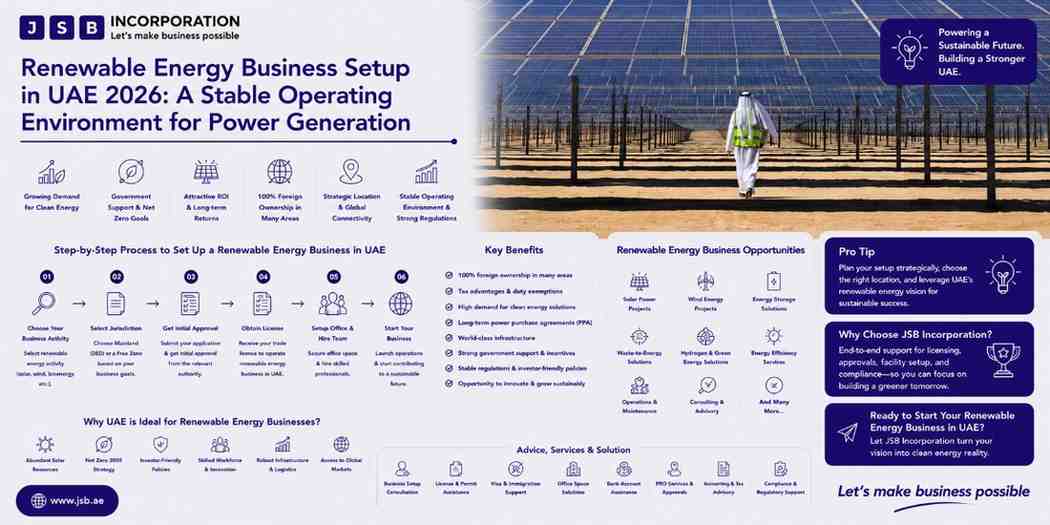
The UAE backs renewable energy with federal investment targets, not just favourable headlines, which makes 2026 a reasonably stable window to register a solar, wind, or clean energy venture.
This guide covers jurisdiction choice, licence types, the setup process, government approvals, indicative costs, and the Golden Visa route for qualifying investors.
If you’re comparing a free zone against mainland licensing or checking whether your investment clears the Golden Visa threshold, a short consultation with JSB Incorporation’s business setup advisory team can confirm what applies to your activity.
Keep reading the article to learn more.
Yes. The UAE Energy Strategy 2050 commits AED 150 billion to AED 200 billion in energy investment by 2030 and targets tripling renewable energy’s contribution to the national energy mix.
The strategy also aims to raise installed clean energy capacity from 14.2 GW to 19.8 GW by 2030. That target sits alongside emirate-level reinforcement.
Dubai’s Clean Energy Strategy now targets 36% of Dubai’s energy mix from clean sources by 2030 and 100% by 2050.
A few factors reinforce this stability for anyone considering a renewable energy business setup:
Costs and regulations are subject to change. Confirm current figures with the relevant UAE government authority or with JSB before making decisions.
If you’re weighing whether now is the right time to formalize a renewable energy venture, the policy backdrop supports moving forward. The next question is which jurisdiction and licence type fit your activity.
It depends on what you’ll actually do. Mainland licensing lets you bid on government tenders and install anywhere in the UAE.
Free zone licensing gives full foreign ownership with a faster, lower-cost setup for trading or consultancy. Physical installation from a free zone entity often needs a dual-license arrangement.
Mainland companies have allowed full foreign ownership for most activities since the UAE amended its Commercial Companies Law in 2020.
The restricted-activity list covers security, defense, telecommunications, and banking, not renewable energy trading or installation. Grid-connected generation still needs separate utility-regulator licensing regardless of ownership.
Jurisdiction | Ownership | Government tenders | Local partner needed | Typical use case |
Mainland | Up to 100% for most activities | Yes | No, for most non restricted activities | Installation, contracting, government facing work |
Free zone | 100% | Generally no, without a dual license. | Not for ownership, but installation work may need a local arrangement | Trading, consultancy, equipment distribution |
If your business will chase utility or government contracts and install equipment on-site, a mainland trade licence is the more direct route.
If you’re focused on equipment trading or engineering consultancy, a free zone company formation gives you full ownership with less overhead.
Your licence category depends on the activity. Equipment import and export falls under a trading license, engineering advisory falls under a consultancy license, and physical installation or grid-connection work falls under a contracting licence with regulator sign-off layered on top.
Activity codes are reviewed periodically by the licensing authority you choose. Confirm the current code list before finalizing your application. Costs and regulations are subject to change.
The process runs in a fixed sequence, from activity and jurisdiction choice through name reservation, approvals, and documentation to licence issuance and corporate bank account opening.
Gaurav Keswani, Founder of JSB Incorporation, put it this way on Talk 100.3 FM: “Before COVID, opening a business license in Dubai required a minimum of one week of personal time investment. Today, the process has been streamlined to just a few steps, sometimes completed on the same day.“
One client described the experience this way: “We have recently incorporated our company through JSB Incorporation. Gaurav Keswani has been a tremendous help throughout the entire process. His support enabled us to complete everything seamlessly, even accommodating last-minute changes. It was a wonderful experience working with JSB Incorporation. We look forward to a long-term engagement.” Veena Talegaonkar, Google Reviews.
Also Read: Why Is Renewable Energy Business Growing in the UAE? (2026 Complete Guide)
Grid-connected or generation-scale renewable work needs regulatory sign-off beyond your trade licence.
Dubai’s electricity and water regulator licenses new entrants to the generation market, alongside municipality or civil defense sign-off for the physical installation.
Fee tiers for generation licences vary by capacity and are revised periodically, so don’t rely on a fixed figure from a general search. Costs and regulations are subject to change.
Confirm current figures with the relevant UAE government authority or with JSB before making decisions.
Costs vary by activity and jurisdiction. Free zone licences for trading or consultancy typically start lower than mainland or installation licences. Treat every figure below as indicative, not fixed.
Cost component | Free zone estimate | Mainland estimate | Notes |
Trade license, one year | It starts around AED 12,000 inclusive of VAT for a basic package | Varies by activity and licensing authority | Free zone packages often bundle visa allocation |
Office or desk space | Often included in entry-level packages | Tenancy contract required, cost depends on the location. | Mainland installation activities typically need a physical office |
Establishment card | Roughly AED 2,000 for initial application | Set by the relevant licensing authority | Required before visa processing |
Residence visa, per person | Roughly AED 3,750 for a two-year visa | Set by the federal immigration authority | Excludes medical and Emirates ID costs |
Yes, if you meet the qualifying capital threshold through the public-investment or business-ownership route, separate from the real estate investor path.
The UAE’s official Golden Visa page lists a minimum capital of AED 2 million for the investor category, through either property ownership or contribution to an establishment, with an alternative route through paying at least AED 250,000 annually in taxes.
Entrepreneurs can qualify with a smaller threshold: the Federal Authority for Identity, Citizenship, Customs, and Port Security requires an auditor’s letter confirming a project value of at least AED 500,000.
Investor category | Minimum threshold | Alternative route | Residency duration |
Public investment or company capital | AED 2 million | Contribution to an establishment paying AED 250,000 or more annually in taxes | 10 years |
Real estate investor | AED 2 million property value | Not applicable | 5 years |
Entrepreneur | Project value verified by auditor: minimum AED 500,000 | Business incubator approval letter | 5 years |
There is no dedicated renewable energy fast-track category confirmed on the UAE’s official Golden Visa pages at the time of writing.
A clean energy venture qualifies through the standard investor or entrepreneur categories, not a sector-specific shortcut.
Gaurav Keswani addressed the timing question directly on Talk 100.3 FM: “Right now, the government has been very actively offering golden visa services to the right mindset. So if anyone happens to know they would be able to qualify across, please reach out to the immigration office. This is a very good time for you, where you would be able to obtain it either for yourself or for someone whom you know.”
One Golden Visa client shared this experience: “Gaurav and team supported me from the start to the end to complete my residency. It was a seamless and efficient process. Highly recommend working with JSB.” Nikhil M, Google Reviews.
Two confirmed 2026 developments reinforce sector stability: Abu Dhabi’s Solar Energy Self-Supply Policy and a multi-year energy investment commitment. Both point to continued backing rather than a one-off announcement.
Abu Dhabi’s energy regulator launched its Solar Photovoltaic Energy Self-Supply Policy in February 2026, letting eligible customers install rooftop solar and battery storage for self-consumption rather than relying solely on the grid.
The initial phase targets the agricultural sector. Confirm current eligibility with the regulator before project planning.
Abu Dhabi’s energy regulator has signaled planned energy investment reaching roughly AED 160 billion over the next five years, pointing to sustained capital commitment for contractors and suppliers entering the sector.
Confirm the current figure with the issuing authority before citing it in a business plan.
Together, these two developments support a stable operating environment for renewable energy business setup in 2026.
The UAE Energy Strategy 2050’s investment target through 2030, combined with Abu Dhabi’s 2026 solar self-supply policy, points to sustained backing for 2026 as a reasonable window to formalize a venture.
2. What’s the difference between a clean energy licence and a standard trading license?
There is no single clean energy licence. Trading covers equipment import and export, consultancy covers engineering advisory, and installation covers physical works, each with a different approval chain and, for generation work, added regulator sign-off.
3. Do I need a UAE partner to start a solar company as a foreigner?
Not for ownership. Mainland companies have allowed up to 100% foreign ownership for most activities since 2021, and free zones already offer full ownership. Installation work from a free zone entity may still need a local arrangement.
4. Can a free zone renewable energy company install directly on the Dubai mainland?
Generally no, not without a dual-license arrangement or a mainland branch. Free zone licences are typically scoped to trading and consultancy work, and on-the-ground installation usually needs a mainland-licensed entity.
5. How long does it take to get a renewable energy business licence in the UAE?
Trading and consultancy licences in free zones can often be processed within days once documents are complete. Mainland licences and activities needing external approvals, such as generation licensing, take longer.
6. Is renewable energy equipment imported into the UAE subject to customs duty?
Customs treatment varies by equipment classification and changes periodically. Confirm current duty treatment for your equipment category with UAE customs authorities before budgeting a shipment.
7. Do renewable energy companies pay UAE corporate tax?
Yes, under the same federal rules as other businesses. The Federal Tax Authority applies 0% corporate tax on taxable income up to AED 375,000 and 9% above that threshold, with qualifying free zone entities potentially eligible for 0% on qualifying income.
Costs and regulations are subject to change. Confirm current figures with the relevant UAE government authority or with JSB before making decisions.
8. What happens if I skip a required regulatory approval before launching?
Operating without a required approval, such as a generation licence for grid-connected work, exposes you to penalties and can halt your project until the sign-off is obtained.
Reviewed by: Gaurav Keswani
Gaurav Keswani is the Founder of JSB Incorporation, a Dubai-based business setup and immigration consultancy. He appeared on Talk 100.3 FM answering live listener questions on UAE Golden Visa eligibility, citing GDRFA and ICP guidelines directly on air. JSB Incorporation handles documentation preparation and application coordination; all visa and license decisions rest with the relevant UAE government authorities, GDRFA, ICP, DET, and DLD.
If you’re evaluating a renewable energy venture in trading, consultancy, or contracting, a consultation with JSB Incorporation covers activity classification, jurisdiction selection between mainland and free zone structures, and full licence application handling.
If you expect to meet the AED 2 million capital threshold, JSB’s Golden Visa advisory can run eligibility alongside your company formation, so residency and business setup move on parallel tracks.
Reach out to start with a jurisdiction and activity review tailored to your renewable energy plans.

Office 2505, 25th Floor, Regal Tower, Business Bay, Dubai, UAE P.O Box 27614.
+971 4 824 4842
info@jsbincorporation.com