
Key Highlights
A Dubai travel agency needs two separate approvals before it can legally operate: a commercial trade licence from Dubai Economy and Tourism (DET) and a tourism-specific regulatory approval tied to your exact activity. Holding only the trade licence is not enough.
This two-approval structure has been the governing framework for tourism licensing in Dubai for years, and it remains in force today.
Tourism activities generally fall into four categories, and each one carries a different scope of permitted work.
You’ll need to confirm which category matches your intended business model before DET can process your application, since the activity code determines your licence conditions.
Keep reading the article to learn more.
Yes. Since the Commercial Companies Law amendments, foreign investors, including Swiss nationals, can own 100% of a UAE mainland company across the great majority of commercial activities, according to the Ministry of Economy and Tourism (MOET).
There’s an important catch for this specific sector, though: free zones cannot issue the tourism regulatory approval a travel agency needs, so full agency operations must sit on the mainland.
This makes the mainland-versus-free-zone decision fairly clear-cut for a travel business, but the two structures still differ in scope and banking experience.
The table below breaks down the practical differences you’ll want to weigh before choosing your structure.
Factor | Mainland company | Free zone company |
Foreign ownership | Up to 100% for most activities, per Ministry of Economy and Tourism guidance | 100% by default |
Tourism approval eligibility | Can obtain the tourism approval for full agency operations | Cannot obtain the tourism approval; limited to non-regulated back-office or consulting work |
Activity scope for travel | Full inbound, outbound, and ticketing agent activity | Administrative or consulting support only |
Local UAE bank account | Generally more established relationships for mainland trading entities | Achievable but often requires more documentation for regulated activities |
If your business model depends on selling packages or issuing tickets under your own agency name, a mainland licence is the only route that lets you do that legally.
Costs and regulations are subject to change. Confirm current figures with the relevant UAE government authority or with JSB before making decisions.
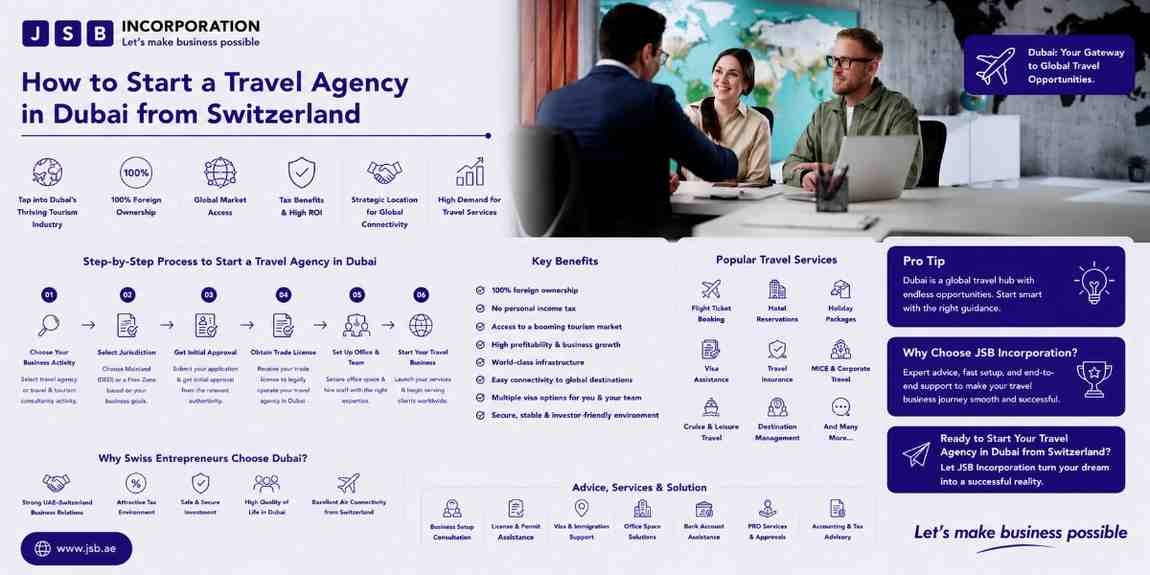
Registering a Dubai travel agency follows a defined sequence: activity selection, trade name reservation, initial approval, office lease, tourism approval, and licence issuance.
Each step builds on the last, and skipping the tourism approval step means you hold a licence that doesn’t actually authorize you to trade. JSB manages this entire sequence for clients so nothing gets missed along the way.
As Gaurav Keswani noted on Talk 100.3 FM, “Before COVID, opening a business license in Dubai required a minimum of one week of personal time investment. Today, the process has been streamlined to just a few steps, sometimes completed on the same day.”
That shift matters directly for a Swiss founder managing the process from abroad, since fewer manual touchpoints mean fewer reasons you’d need to be physically present.
The core sequence looks like this:
Processing times depend on document readiness and authority workload at the time of filing, so ask for a current timeline estimate once your activity and structure are confirmed.
Much of the registration sequence can be completed remotely through power of attorney and digital document submission, so you don’t necessarily need to fly to Dubai to start the process.
Some steps, particularly certain bank know-your-customer (KYC) requirements, may still call for your direct involvement depending on the bank’s internal policy. Plan for at least one possible in-person requirement even if you intend to manage most of the process from Switzerland.
Here’s a general breakdown of what’s typically remote-friendly versus what may need you in person.
Bank KYC policy varies from one UAE bank to another and can change without much notice, so reconfirm requirements close to your intended filing date.
Overseas founders managing this from Switzerland typically need a single local point of contact to keep the moving pieces coordinated.
Also Read:
Is Remote Company Formation Possible in Dubai, UAE? (2026 Guide)
Remote IFZA Dubai Company Formation: Start Your Business Without Visiting the UAE
IATA accreditation is optional, and it only becomes relevant if you want to issue airline tickets directly under your own agency’s name rather than through a third-party consolidator.
If your business model doesn’t involve direct ticket issuance, you can operate a fully licensed travel and tourism agency without pursuing it.
Agencies that do want direct ticketing rights typically need to coordinate an additional civil aviation clearance step before applying to IATA.
Confirm current civil aviation clearance requirements with the relevant UAE authority before assuming direct ticketing rights are included in your licence.
There’s no need to resolve this upfront if your initial launch plan focuses on packages, visa processing, or hotel bookings instead.
Switzerland and the UAE have a double taxation agreement in place, but that treaty doesn’t exempt your Dubai entity from UAE corporate tax.
The Federal Tax Authority (FTA) applies corporate tax at 0% on taxable income up to AED 375,000 and 9% on taxable income above that threshold, and this applies regardless of any treaty relief you might claim on the Swiss side of your structure.
The treaty’s main function is to prevent the same income from being taxed twice, not to eliminate local UAE tax obligations.
If your travel agency generates taxable profit above the AED 375,000 threshold, that portion is taxed locally at 9% under UAE corporate tax law.
Your Swiss tax position and your UAE tax position are assessed separately, even though the treaty coordinates how the two interact. A cross-border structure like this is worth reviewing with a qualified tax advisor before you file.
Starting a new travel agency alone does not automatically qualify you for the UAE Golden Visa. Eligibility depends on meeting specific thresholds set by the UAE government, and simply holding a trade licence isn’t one of them.
You’ll need to look at the entrepreneur and investor categories separately to see where your business might fit.
According to the UAE’s official government portal, the investor category requires a minimum capital of AED 2 million for a 10-year Golden Visa through public investments, property ownership, or contribution to an establishment paying at least AED 250,000 annually in taxes.
The entrepreneur category carries a 5-year Golden Visa term under a comparable set of conditions. Neither route is automatic. Approval rests entirely with the relevant federal identity and citizenship authority based on your documentation.
If your travel agency reaches a stage where you’re paying significant UAE tax or meeting the investment threshold, a Golden Visa eligibility review is a natural next step once your business is licensed and generating tax-paid revenue rather than a day-one consideration.
Not for most of the process. Trade name reservation, document submission, and constitutional document signing can typically be done through power of attorney. Some bank KYC steps may still require your involvement, so confirm this with your chosen bank before assuming a fully remote setup.
2. What’s the bank guarantee requirement for a Dubai travel agency license, and does it vary by activity?
Bank guarantee amounts vary by tourism activity category and are set by the licensing authority. Confirm the current figure for your specific activity before budgeting, since amounts can be adjusted.
3. Can a free zone company sell travel packages, or must it be mainland?
A free zone company cannot obtain the tourism approval needed to sell travel packages or operate as a licensed agency. Free zone travel-related licences are generally limited to back-office or consulting work, so full agency operations require a mainland licence.
4. How long does the whole licensing process typically take from Switzerland?
Processing time depends on document readiness, activity classification, and authority workload at the time of filing. Third-party estimates vary considerably, so ask for a current timeline once your activity is confirmed.
5. Do I need UAE residency before I can own the company?
No. UAE Commercial Companies Law amendments allow full foreign ownership for most mainland activities regardless of your residency status at the time of incorporation. Residence visa applications typically follow company formation, not the other way around.
6. What happens if I only get a trade licence and skip the tourism approval?
Your business would not be legally authorized to conduct tourism activity, even with a valid trade licence on paper. Both approvals are required before any tourist activity can commence.
7. Can a Swiss company be the shareholder instead of an individual founder?
Corporate shareholding structures are generally permitted for UAE mainland companies, subject to the documentation the relevant authority requires for foreign corporate shareholders. Confirm the exact document set your Swiss parent company would need to provide.
8. Does starting a travel agency require a minimum share capital?
Minimum share capital requirements depend on your chosen legal form and activity classification. Confirm the current figure before finalizing your structure, since this is not a fixed number across all tourism activities.
Reviewed by Gaurav Keswani, Founder, JSB Incorporation
Gaurav Keswani is the Founder of JSB Incorporation, a Dubai-based business setup and immigration consultancy. He appeared on Talk 100.3 FM answering live listener questions on UAE Golden Visa eligibility, citing GDRFA and ICP guidelines directly on air. JSB Incorporation handles documentation preparation and application coordination; all visa and license decisions rest with the relevant UAE government authorities—GDRFA, ICP, DET, and DLD.
Planning a Dubai travel agency from Switzerland involves two separate approvals, a structure decision, and a cross-border tax picture that’s easy to get wrong from a distance.
Founders managing this remotely often underestimate how the tourism approval, the mainland ownership rules, and the banking steps interact until they’re mid-process and stuck waiting on a document they didn’t know they needed.
A short consultation call can clarify your exact next steps, which approvals apply to your specific activity, and a realistic timeline before you commit to a filing date.
Book your free consultation call today with the experts of JSB Incorporation to learn more.

Office 2505, 25th Floor, Regal Tower, Business Bay, Dubai, UAE P.O Box 27614.
+971 4 824 4842
info@jsbincorporation.com
