
Summary
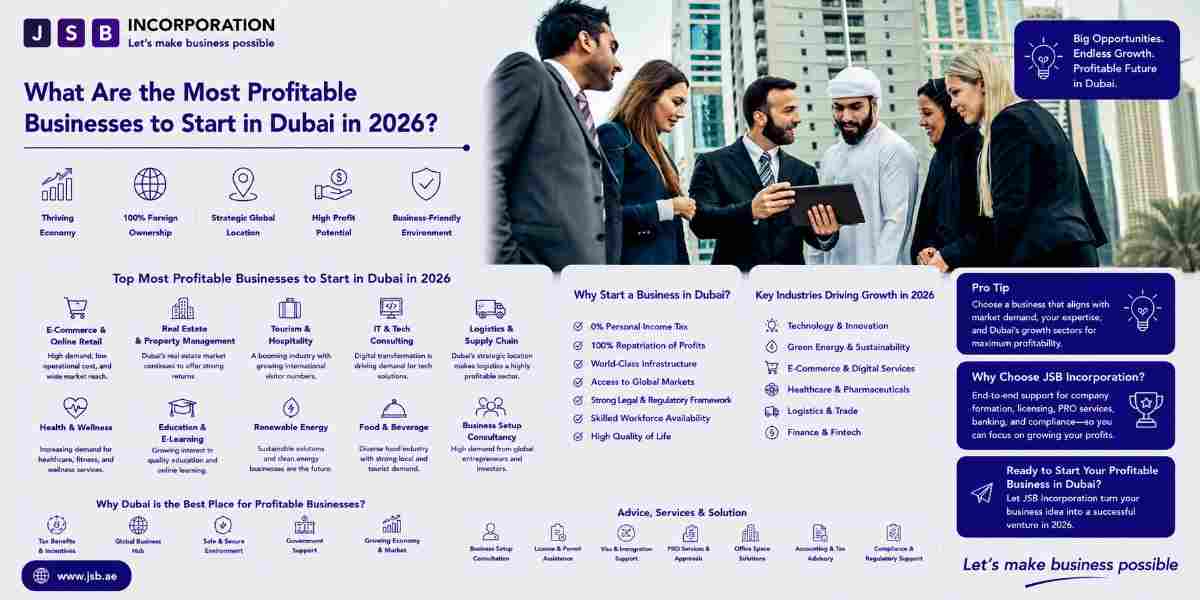
Consulting, e-commerce, digital and tech services, real estate brokerage, and F&B are the sectors most frequently discussed as profitable businesses in Dubai right now. Each one carries a different cost structure and licensing path.
The right sector for you depends on your budget, your target customer, and how much regulatory work you’re prepared to take on.
Service-based sectors tend to carry a stronger margin-to-cost ratio, since they need less physical infrastructure.
Capital-heavy sectors like real estate and F&B can generate higher absolute revenue, but they also carry higher entry costs and more regulatory steps.
The table below compares five commonly discussed profitable business sectors.
Sector | Margin profile | Cost tier | Best-fit jurisdiction | Licensing authority |
Professional consulting | High and low overhead | Low | Free zone | Free zone authority or DET |
E-commerce and digital retail | Moderate to high | Low to moderate | Free zone | Free zone authority or DET |
Digital and tech services | High and low overhead | Low | Free zone | Free zone authority |
Real estate brokerage | Moderate, high revenue ceiling | Moderate to high | Mainland | DET and Dubai Land Department (RERA) |
F&B | Lower margin, capital-intensive | High | Mainland | DET and Dubai Municipality health approval |
Keep reading the article to learn more.
Service-based, low-overhead models such as consulting, digital marketing, and content production usually carry the strongest margin-to-cost ratio in Dubai.
These businesses need minimal physical setup, so more of each dirham earned converts to profit. A flexdesk free zone licence is typically the fastest route to launch one of these profitable business models.
Common low-cost, high-margin profitable business types include the following:
Free zone licence fees for a lean, zero-visa setup generally sit at the lower end of the UAE licensing market compared with mainland or high-visa packages.
Real estate brokerage and general trading can generate a higher revenue ceiling than digital services, but they usually carry a higher entry cost and more regulatory overhead.
Digital services scale faster on lower fixed costs. Which one is more profitable for you depends on whether you’re optimizing for absolute revenue or for margin-to-cost efficiency.
Real estate brokerage in Dubai requires more than a base trade licence. The Dubai Land Department requires anyone practicing a real estate activity, including brokerage, to register and hold the relevant professional practice card through its Trakheesi system before they can legally operate.
General trading licences typically require mainland registration if you plan to import, distribute, or sell physical goods directly to the local market.
This layered approval structure is exactly why sector choice and licence choice have to happen together, not separately.
Also Read:
Gold vs. Real Estate in Dubai: Which Investment Is Better for Indians in 2026?
Real Estate vs. Tech vs. Stocks: Where Should You Invest in the UAE in 2026?
A free zone licence lowers your entry cost and speeds up setup. A mainland licence gives you unrestricted access to the local UAE market and eligibility for government contracts.
Neither structure is universally more profitable. The right choice depends on whether your customers sit mostly outside the UAE, mostly local, or a mix of both.
Following amendments to the UAE Commercial Companies Law, foreign investors can now hold up to 100% ownership in most mainland business activities without a local UAE national partner.
Free zones have offered full foreign ownership as their standard model from the outset. The table below breaks down the practical differences.
Factor | Free zone | Mainland |
|---|---|---|
Foreign ownership | 100% as standard | Up to 100% for most non-restricted activities |
Local market access | Limited without a mainland branch or distributor | Unrestricted access to the UAE market |
Setup speed | Generally faster | Slightly longer due to additional approvals |
Government contract eligibility | Limited | Full eligibility |
Renewal and office requirements | Often lighter, flexidesk options available | Typically requires a registered Ejari tenancy |
If your customers and suppliers sit mostly overseas, a free zone licence usually protects your margin better.
If you’re selling directly to UAE-based retail or corporate clients, mainland access tends to earn back its extra setup cost over time. A licensing-comparison consultation can help you weigh both options against your specific customer base.
“What a fabulous service by Gaurav. He literally solved our problems for opening a company in UAE. Has a professional team to assist. Amazing customer service. Highly recommended for company formation. He also assisted us with banking services. Thank you once again.” Dhaval Shah, Google Reviews.
Budget for four cost categories before you commit capital: the trade licence fee, your visa quota, workspace, and annual renewal.
A lean, low-visa-free zone setup generally costs less than a mainland or capital-heavy setup, though the exact gap depends on your activity and chosen authority.
Yes. Under the Federal Tax Authority’s Small Business Relief framework, eligible resident taxable persons with revenue at or below AED 3,000,000 in a tax period can elect to be treated as having no taxable income.
That means many small profitable businesses can reach a 0% effective corporate tax rate if they qualify and elect correctly.
A few eligibility notes matter here. The relief excludes businesses that are part of a Multinational Enterprise Group above the group revenue threshold.
Qualifying Free Zone Persons using the separate 0% qualifying-income regime generally don’t rely on this relief instead. You must actively elect for small business relief since it isn’t applied automatically.
Relief periods under this framework have been extended more than once since the rule was introduced.
Confirm the currently active expiry date directly with the Federal Tax Authority or with JSB’s tax and VAT compliance team before you plan your tax position around it.
Without electing this relief, the standard UAE corporate tax applies at 9% on taxable income above AED 375,000 and 0% below that threshold. Costs and regulations are subject to change.
Yes. Several sectors above need sector-specific approval on top of the base trade licence. The approval authority depends entirely on your business activity, and skipping this step is one of the most common reasons a promising licence application stalls.
Navigating multiple authorities at once is where most delays happen, so map every required approval before you file your licence application.
Validate your idea by modeling your license and visa cost against a realistic first-year revenue forecast, then checking competitor density in your target free zone or emirate.
Skipping this step is how founders end up with a licence for a business that can’t clear its own overhead in year one.
Consulting, e-commerce, digital and tech services, and real estate brokerage are the sectors most often named as profitable business options in Dubai in 2026.
The right choice depends on your budget, your target customer base, and how much regulatory overhead your sector requires.
2. Is e-commerce still one of the most profitable businesses in Dubai?
Yes, e-commerce remains a strong, profitable business option in Dubai, particularly for asset-light or dropshipping models run through a free zone trade licence.
Margins compress as inventory and fulfillment costs grow, so lean digital-first models still perform best relative to setup cost.
3. What is the most profitable small-scale business to start in the UAE?
Low-overhead, service-based businesses such as consulting, digital marketing, and content production tend to be the most profitable small-scale options in the UAE. They need minimal physical infrastructure, so a larger share of revenue converts directly to profit.
4. Do I need a mainland licence to run a profitable real estate or trading business?
Real estate brokerage and general trading businesses that sell directly to the local UAE market typically need a mainland license plus sector-specific registration, such as the Dubai Land Department’s RERA requirements.
Free zone licences work well if your trading activity stays outside the local UAE market.
5. How much capital is needed to start a profitable business in Dubai?
Capital needs vary widely by sector. A lean, service-based free zone setup generally sits at the lower end of the market, while mainland or capital-heavy sectors like F&B or real estate typically require considerably more once office, visa, and approval costs are included.
6. Can foreigners own 100% of a profitable business in Dubai?
Yes. Free zones have offered 100% foreign ownership as their default model from the outset, and mainland companies now allow up to 100% foreign ownership for most non-restricted activities, following amendments to the UAE Commercial Companies Law.
7. Which free zone offers the lowest-cost setup for a profitable business right now?
Pricing and promotions vary by free zone and change periodically, so there’s no single fixed answer. Request current published pricing for your target activity directly from the free zone authority before you compare options.
8. Does UAE Small Business Relief mean my profitable small business pays zero tax?
If your revenue stays at or below AED 3,000,000 in the relevant tax periods and you actively elect for the relief, you can be treated as having no taxable income under the Federal Tax Authority’s Small Business Relief framework, subject to the currently active eligibility rules.
Reviewed by Gaurav Keswani, Founder, JSB Incorporation.
Gaurav Keswani is the Founder of JSB Incorporation, a Dubai-based business setup and immigration consultancy. He appeared on Talk 100.3 FM answering live listener questions on UAE Golden Visa eligibility, citing GDRFA and ICP guidelines directly on air. JSB Incorporation handles documentation preparation and application coordination; all visa and license decisions rest with the relevant UAE government authorities—GDRFA, ICP, DET, and DLD.
Choosing the most profitable business model for you means matching your sector to the right license, jurisdiction, and compliance path before you spend a single dirham on setup.
Book your free consultation call today with the experts of JSB Incorporation to learn more.

Office 2505, 25th Floor, Regal Tower, Business Bay, Dubai, UAE P.O Box 27614.
+971 4 824 4842
info@jsbincorporation.com
