
 Gaurav Keswani
Quick Answer
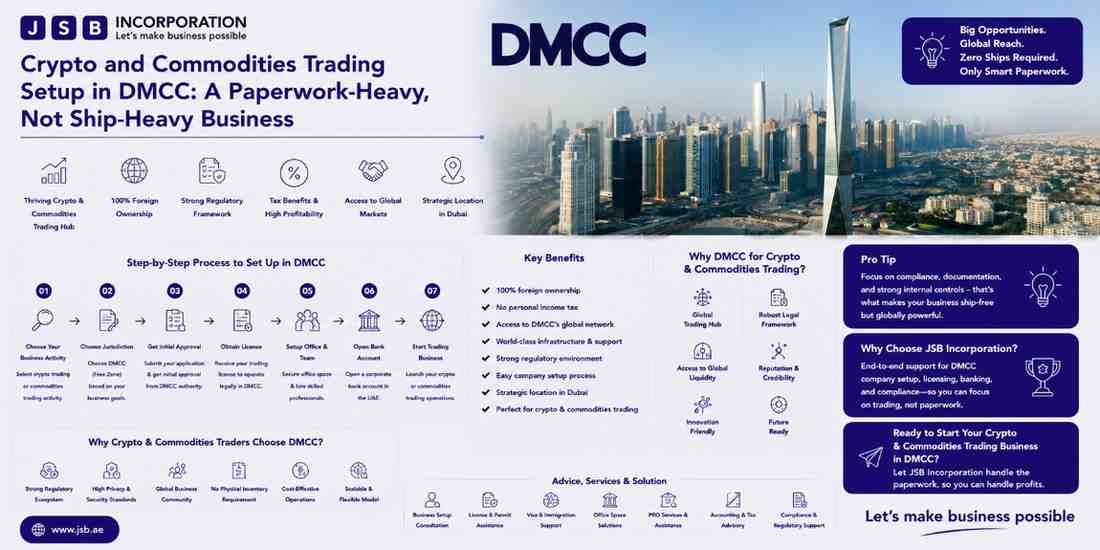
Traditional commodities trade runs on freight bookings, customs clearance, and warehousing contracts. DMCC’s proprietary trading and crypto-commodities activities run on shareholder documentation, KYC files, and activity-code approvals filed through a digital portal instead.
That distinction changes what you prepare before applying. You won’t need a shipping agent or bonded warehouse contract. You will need clean, notarized identity and ownership paperwork, because DMCC’s compliance review checks that first.
Physical trade paperwork typically includes freight and bill-of-lading documents, customs declarations, warehousing leases, and third-party quality certifications tied to the physical goods.
Proprietary and crypto trade paperwork typically includes shareholder and director KYC packs, a completed business plan and activity questionnaire, Ultimate Beneficial Owner disclosure, and a signed Memorandum of Association filed through the DMCC portal.
JSB’s DMCC company formation team maps your specific trading model to the right activity code before you file, so you’re not guessing which paperwork track applies to your business.
Continue reading to learn more.
Yes, in most cases. DMCC’s trade licence covers company formation and non-regulated activities, but Dubai’s Virtual Assets Regulatory Authority separately regulates virtual asset activity touching third-party clients.
A licensed Virtual Asset Service Provider is not permitted to use its regulated licence to trade its own or its group’s portfolio.
A separate company must be set up for proprietary trading, and it needs a VARA No Objection Certificate rather than a full Virtual Asset Service Provider licence. Proprietary trading above certain volumes must also register with VARA as part of the same disclosure process.
Activity type | Is the DMCC licence alone sufficient? | VARA requirement |
Proprietary crypto-commodities trading, own capital, no clients | No | VARA No Objection Certificate |
Exchange, custody, broker-dealer, advisory, or lending services | No | Full Virtual Asset Service Provider licence |
Costs and regulations are subject to change. Confirm current figures with the relevant UAE government authority before making decisions.
To obtain a Proprietary Trading No Objection Certificate, you contact your commercial licensor, in this case DMCC, and complete an Initial Disclosure Questionnaire as part of the VARA review.
JSB’s PRO and regulatory coordination service handles this filing alongside your DMCC application.
VARA regulates eight distinct virtual asset activities: Advisory, Broker-Dealer, Custody, Exchange, Lending and Borrowing, Management and Investment, Transfer and Settlement Services, and VA Issuance.
Only proprietary trading of your own capital, with no client funds, stays under DMCC plus a VARA No Objection Certificate. Every other activity on that list needs a full virtual asset service provider license.
Getting this classification right matters. Misclassifying a client-facing activity as proprietary trading can delay your entire application, since VARA reviews the underlying business model before confirming which pathway applies.
The core document set is the same whether you’re trading crypto or physical commodities: identification for every shareholder and director, company ownership documents, and full business information.
DMCC may request additional documents or third-party approvals depending on the nature of your business activity, and all submissions must be complete before licence issuance.
The shareholder and Memorandum of Association paperwork stays identical to a crypto licence. What changes is the layer of activity-specific approvals sitting on top of that core set.
Physical commodity licenses typically add notarized and attested corporate documents and a lease covering physical storage or vault space.
On the question of extra regulatory sign-off, DMCC’s own guidance lists financial services, crypto and virtual asset activities, healthcare, and oil, gas, and energy as the categories that generally require additional third-party regulatory approval.
Gold, diamond, and precious metals trading is not listed among those categories, so the standard document core plus DMCC’s own internal review typically applies, though DMCC can still request activity-specific documentation case by case.
Working with JSB on a company formation file often looks like this in practice. As client Dhaval Shah put it in a Google Review: “What a fabulous service by Gaurav. He literally solved our problems for opening a company in the UAE. Has a professional team to assist. Amazing customer service. High recommended for company formation. He also assisted us with banking services. Thank you once again.“
Also Read:
Gold Trading License Cost in Dubai: Free Zone vs Mainland Fee Breakdown
Gold vs. Real Estate in Dubai: Which Investment Is Better for Indians in 2026?
DMCC’s published Schedule of Charges lists the standard trading and service licence at AED 20,285 a year.
This sits alongside one-time fees: an application fee of AED 1,035, a new company registration fee of AED 9,020, an Articles of Association fee of AED 2,020, and an annual establishment card fee of AED 1,825.
Cost item | Amount (AED) | Applicability |
Application fee | 1,035 | One-time |
New company registration | 9,020 | One-time |
Articles of Association | 2,020 | One-time |
Standard trading and service licence | 20,285 | Annual |
Establishment card | 1,825 | Annual |
VARA proprietary trading no-objection certificate | Set by VARA’s published fee schedule | Annual |
Costs and regulations are subject to change. Confirm current figures with the relevant UAE government authority before making decisions.
DMCC states that initial setup costs across its various packages typically range from AED 10,345 to AED 84,515, depending on licence duration and whether an office is included.
A fixed minimum paid-up share capital figure isn’t published on DMCC’s official setup page.
The exact amount depends on your activity and company structure, and DMCC confirms it during your application review.
Yes, DMCC business setup requires every company to hold a registered business address within the free zone, fulfilled through a flexi-desk, serviced office, or dedicated workspace in Jumeirah Lakes Towers.
This is a lease-and-documentation step, not an operational requirement. You need a signed lease on file before DMCC issues your e-license.
Firms pursuing a VARA No Objection Certificate typically arrange dedicated office space rather than a shared flexi-desk, since VARA’s review expects a stable, verifiable business address.
Your visa entitlement is also tied to this office choice, since DMCC bases your visa quota on the size of your office space and your licence type.
A proprietary trading structure lets a company trade crypto-commodities or other assets using its own capital rather than client money.
DMCC supports this model for crypto activities, and VARA treats it as a non-regulated activity requiring a No Objection Certificate rather than a full Virtual Asset Service Provider license, provided the company isn’t also licensed to serve external clients.
The distinction matters for your compliance load. A client-facing crypto business, one holding customer funds or offering custody, sits under VARA’s full licensing regime, which runs through an Approval to Incorporate stage followed by a full licence application.
A proprietary trading structure sits under the lighter no-objection certificate pathway instead.
DMCC’s own process typically runs around 10 working days from application to a working e-license, depending on how quickly your documentation comes together.
The trade licence itself is issued electronically within 2 to 3 working days once your setup process is complete.
If your business needs a VARA No Objection Certificate, that review runs through the Initial Disclosure Questionnaire process as a separate track from your DMCC registration.
VARA does not publish a fixed review timeframe for this stage, so build in some flexibility rather than assuming it will match DMCC’s own 10-working-day window.
No. Any virtual asset activity carried out by way of business in Dubai requires VARA licensing, registration, or a No Objection Certificate, and no activity is exempt from oversight once it’s conducted commercially.
2. Is DMCC the only UAE free zone that allows a proprietary trading license?
DMCC is one of several UAE free zones where companies coordinate with VARA for proprietary trading No Objection Certificates, since VARA’s rulebook applies to virtual asset activity conducted in or from Dubai regardless of which commercial licensor issues the underlying trade licence.
3. What is the minimum share capital for a DMCC crypto or commodities company?
DMCC doesn’t publish a single fixed minimum share capital figure on its official setup pages. The required amount depends on your activity and structure, confirmed during your application review.
4. What is a VARA No Objection Certificate, and how is it different from a full VARA license?
A No Objection Certificate confirms a specific non-regulated activity, such as proprietary trading, can run with VARA’s oversight but without a full licence. A full virtual asset service provider license is required for client-facing activities like exchange, custody, or brokerage.
5. Can a DMCC crypto license holder open a UAE corporate bank account easily?
Bank account opening depends on each bank’s own compliance review of your activity, source of funds, and shareholder structure. JSB’s business bank account opening support helps prepare your file, though final approval rests with the bank.
6. Do I need a special regulator approval for a DMCC gold or precious-metals license?
DMCC’s own guidance names financial services, crypto and virtual assets, healthcare, and oil, gas, and energy as the activity categories generally requiring extra third-party regulatory approval.
Gold and precious metals trading isn’t listed among them, though DMCC can still request activity-specific documents.
7. How many visas can I get with a DMCC flexi-desk license?
Your visa count is determined by the size of your office space and your licence type; DMCC confirms your specific quota once your office solution is selected.
8. What’s the difference between a DMCC trading license and a DMCC crypto or DLT license?
A standard DMCC trading licence covers general commercial activities, while a crypto-focused setup adds activity codes and infrastructure specific to virtual asset and blockchain-related business, alongside the VARA coordination that crypto activities require.
9. How long from application to a working DMCC e-license?
Around 10 working days from a complete application to full setup, with the e-license itself issued 2 to 3 working days after your documentation clears DMCC’s review.
Reviewed by Gaurav Keswani, Founder, JSB Incorporation
Gaurav Keswani is the Founder of JSB Incorporation, a Dubai-based business setup and immigration consultancy. He appeared on Talk 100.3 FM answering live listener questions on UAE Golden Visa eligibility, citing GDRFA and ICP guidelines directly on air. JSB Incorporation handles documentation preparation and application coordination; all visa and license decisions rest with the relevant UAE government authorities—GDRFA, ICP, DET, and DLD.
If you’re weighing a DMCC crypto or commodities trading setup, the fastest way forward is a direct conversation, not more research.
JSB will put together a tailored document checklist and cost quote based on your exact structure.
Start with JSB’s DMCC free zone company formation and licensing service, and loop in JSB’s PRO and compliance support service for VARA coordination once your activity code is confirmed.

Office 2505, 25th Floor, Regal Tower, Business Bay, Dubai, UAE P.O Box 27614.
+971 4 824 4842
info@jsbincorporation.com