
 Gaurav Keswani
Quick Answer
Yes. Amazon’s own UAE seller portal requires a valid Commercial Registration if you own the business or a Power of Attorney if you’re a legal representative or account manager before you can open a professional seller account.
This is a platform requirement set directly by Amazon, not a UAE government rule, so you’ll find it on Amazon’s own onboarding pages rather than a government portal.
To verify your account, Amazon typically asks for the following:
Amazon states this requirement plainly on its own seller onboarding pages, and it applies whether your business operates from the mainland or a free zone.
Getting your trade licence sorted first saves you from having to redo your Seller Central verification later.
Amazon UAE does distinguish between individual and professional account tiers at a policy level, but the exact eligibility rules and any volume threshold for the individual tier should be confirmed directly on Amazon’s seller portal before you rely on them.
Community forums discuss this distinction often, but forum posts aren’t a reliable source for exact numeric limits.
At a policy level, the two tiers work differently:
If you’re planning to scale past a handful of listings, moving straight to a registered trade licence saves you from re-verifying your account later.
A free zone or mainland licence also lets you open a proper business bank account, which most FBA sellers eventually need for supplier payments and VAT filing.
Per the UAE Government’s official eCommerce guidance, mainland sellers need a trade licence from the Dubai Department of Economy and Tourism (DET) with an eCommerce activity code.
Dubai also offers a standalone eTrader licence through Invest in Dubai, and free zones issue their own e-commerce licenses for international and intra-free-zone trade. All three routes require a TDRA no-objection certificate before you go live.
Licence type | Issuing authority | Selling scope | Direct mainland Amazon.ae access | Approval needed |
eTrader | Invest in Dubai (DET) | Home-based online selling | Yes | TDRA NOC required |
Mainland commercial licence with eCommerce activity | DET | Full UAE mainland plus online | Yes | TDRA NOC required |
Free zone eCommerce licence | Free zone authority (for example, IFZA) | Within the free zone and internationally | Needs a local distributor or additional arrangement | TDRA NOC plus distributor arrangement for mainland sales |
The UAE Government’s official e-commerce guidance is clear on one point that trips up a lot of new sellers: free zone companies can operate within their free zone and internationally, but selling directly on the UAE mainland requires either a local distributor or additional approvals and arrangements.
If your Amazon.ae account is treated as a mainland-facing marketplace sale, a free-zone-only licence may not be enough on its own. Confirm the exact setup with your free zone authority and DET before you list your first product.
Gaurav Keswani, Founder of JSB Incorporation, has seen this shift firsthand: “Before COVID, opening a business license in Dubai required a minimum of one week of personal time investment. Today, the process has been streamlined to just a few steps, sometimes completed on the same day.“
One JSB client, Dhaval Shah, shared this experience on Google Reviews after going through the process: “What a fabulous service by Gaurav. He literally solved our problems for opening a company in UAE. Has a professional team to assist. Amazing customer service. High recommended for company formation. He also assisted us with banking services. Thank you once again.”
If you’re unsure which structure lets you sell directly on Amazon, JSB’s team can walk you through the free zone, mainland, and eTrader options side by side before you commit to one.
Free zone pricing is the only figure JSB can confirm from its own current rate sheets today.
The official portal currently publishes a fixed fee schedule for the DET mainland commercial licence or the Dubai eTrader license, so those two costs are left out of the table below rather than estimated.
Item | Cost |
|---|---|
IFZA zero-visa, 1-year license | AED 11,900 (inclusive of VAT) |
IFZA 1-visa license (includes 1 free lifetime residence visa under current promotion) | AED 14,900 (inclusive of VAT) |
Establishment card | AED 2,000 |
UAE residence visa (2-year), standard | AED 3,750 (waived under active promotion) |
General Trading activity base fee | AED 10,000 (waived under active promotion) |
Mainland commercial licence | Not publicly listed; confirm directly with DET |
Dubai eTrader licence | Not publicly listed; confirm directly with Invest in Dubai |
Costs and regulations are subject to change. Confirm current figures with the relevant UAE government authority or with JSB before making decisions.
Once you’ve secured a license, Amazon runs its own document verification before activating your Seller Central account.
This checklist mirrors what most FBA sellers in the UAE are asked to submit, based on Amazon’s published onboarding requirements.
Getting these documents attested and consistent across your license, bank account, and Amazon account is where most delays happen.
A mismatch between your licence name and your bank statement is one of the most common reasons Seller Central verification gets rejected.
Per the Federal Tax Authority, VAT registration is mandatory once your taxable supplies and imports exceed AED 375,000 over a rolling 12 months or are expected to exceed that threshold within the next 30 days. Voluntary registration is available once you pass AED 187,500.
Missing the mandatory registration window can trigger penalties from the Federal Tax Authority.
Most sellers register as soon as their monthly sales trend toward the threshold, rather than waiting for the full 12-month figure to confirm it.
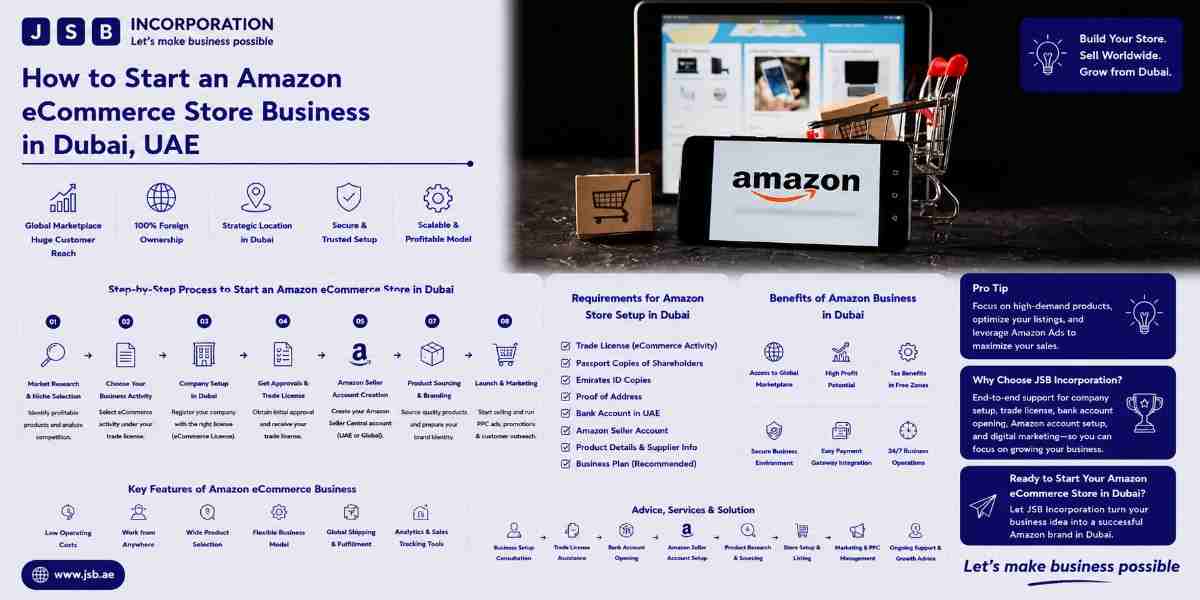
Here’s the sequence from choosing your entity to your first sale, including the TDRA approval step that applies to every UAE e-commerce license.
Most of the delay in this process comes from steps 3 through 7, since they involve three separate authorities that don’t share data with each other.
Sequencing them correctly the first time is what keeps a launch on schedule.
Yes. Amazon requires a valid Commercial Registration if you own the business or a Power of Attorney if you’re a representative before approving a professional seller account.
This applies regardless of whether your business is registered on the mainland or in a free zone, and it’s checked during Seller Central verification.
2. Can I use a free zone licence to sell directly on Amazon.ae, or do I need a distributor?
Free zone companies can trade internationally and within their free zone, but selling directly on the UAE mainland usually needs a local distributor or additional approval per the UAE Government’s official eCommerce guidance.
3. What’s the difference between an individual and professional Amazon seller account in the UAE?
An individual account suits occasional, small-scale selling, while a professional account requires full business verification through a Commercial Registration or Power of Attorney.
4. How much does an e-commerce licence cost in Dubai?
The free zone rate for a zero-visa IFZA business setup licence starts at AED 11,900 inclusive of VAT, with a 1-visa option at AED 14,900.
Mainland and eTrader government fee schedules aren’t publicly listed on u.ae at this time, so confirm those directly with DET or Invest in Dubai before budgeting.
5. Do I need to register for VAT to sell on Amazon UAE?
Yes, once your taxable supplies and imports exceed AED 375,000 over a rolling 12 months, per the Federal Tax Authority.
Voluntary registration is available above AED 187,500 if you want to reclaim input VAT sooner, which can help if you’re importing FBA stock early.
6. What is the TDRA no-objection certificate, and do I need one?
It’s a no-objection certificate from the UAE’s Telecommunications and Digital Government Regulatory Authority, required for anyone practicing an e-commerce activity in the UAE.
It applies to mainland, eTrader, and free zone licences alike, and you’ll need it before your Amazon store can legally trade.
7. Do I need a customs importer code for Amazon FBA stock?
Yes, if you’re importing physical inventory into the UAE for fulfillment, you’ll need a Dubai Customs importer code linked to your trade licence and, once registered, your VAT Tax Registration Number.
This applies even if your licence is issued by a free zone rather than the mainland.
8. Is there a small-business corporate tax exemption relevant to a new Amazon seller?
This depends on your current taxable income and the Federal Tax Authority’s small business relief thresholds, which change periodically and should be checked directly on the Federal Tax Authority’s website.
Speak with JSB before assuming any exemption applies to your specific business structure.
Reviewed by: Gaurav Keswani, Founder, JSB Incorporation
Gaurav Keswani is the Founder of JSB Incorporation, a Dubai-based business setup and immigration consultancy. He appeared on Talk 100.3 FM answering live listener questions on UAE Golden Visa eligibility, citing GDRFA and ICP guidelines directly on air. JSB Incorporation handles documentation preparation and application coordination; all visa and license decisions rest with the relevant UAE government authorities—GDRFA, ICP, DET, and DLD.
Choosing the wrong licence structure can block you from selling directly on Amazon.ae or leave you paying a distributor margin you didn’t need to.
JSB’s team reviews your product category, expected sales volume, and whether you plan to hold FBA inventory in the UAE, then recommends the licence and jurisdiction that fits your growth plan.
Book your free consultation call today with the experts of JSB Incorporation.
Related Reading:
How to Start an Ecommerce Dropshipping Business in Dubai, UAE (2026 Guide)
eCommerce License: Top 10 Facts You Need to Know About Dubai CommerCity

Office 2505, 25th Floor, Regal Tower, Business Bay, Dubai, UAE P.O Box 27614.
+971 4 824 4842
info@jsbincorporation.com