
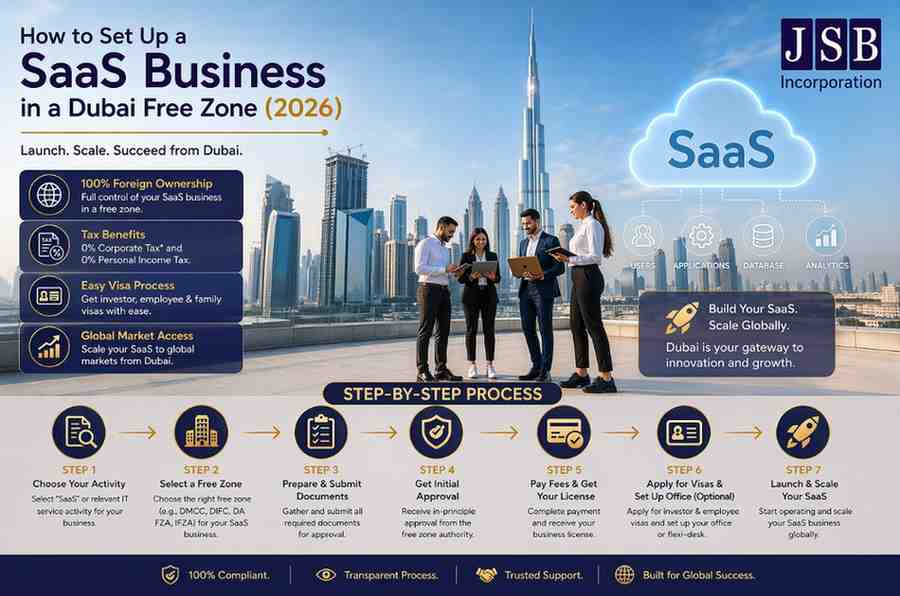
Key Highlights
The UAE has 40+ free zones, all permitting 100% foreign ownership for tech and SaaS businesses with no local sponsor required, regulated independently from the mainland (UAE Ministry of Economy and Tourism).
This guide covers which free zone fits your model and the step-by-step setup process using IFZA as the verified 2026 cost reference and your key tax obligations as a free zone company.
For a SaaS business serving international clients, a free zone is the right structure. The table below covers the key differences so you can move past this question quickly:
Factor | Free Zone | Mainland |
Foreign ownership | 100%, no local sponsor required | License issued by the Department of Economy and Tourism (DET) |
Profit repatriation | Fully permitted, no restrictions | Fully permitted |
Customs duty | 0% | Standard UAE rates apply |
Best for | International SaaS, digital services | UAE government contracts, physical retail |
Free zone benefits are confirmed by the UAE Ministry of Economy and Tourism. Your free zone company can sell to UAE clients.
It can’t conduct physical commercial activity on the UAE mainland without additional approvals from the relevant authority.
For a SaaS product delivered digitally to international subscribers, this restriction doesn’t affect your operations. Verify mainland licensing requirements with the Department of Economy and Tourism (DET).
Choosing the right free zone depends on four things: the activity codes you need, the number of residency visas, your workspace preference, and your Year 1 budget. Use the UAE Free Zones Gateway to compare options by sector and cost.
Here’s how the main Dubai free zones compare for SaaS and tech founders and IFZA official documents:
Free Zone | Location | Best For | Key Advantage |
IFZA | Dubai Silicon Oasis (Dubai Digital Park), Dubai | Solo founders, early-stage SaaS | Lowest entry cost in a dedicated tech environment |
DMCC | Jumeirah Lakes Towers | Tech, AI, crypto, fintech, gaming | One of the most sector-flexible free zones in Dubai |
Dubai Internet City | Tecom, Dubai | Established tech companies | Home to 4,000+ businesses and 31,000+ professionals |
Meydan Free Zone | Meydan, Dubai | Bootstrapped founders | Affordable entry-level packages |
This guide uses IFZA as the 2026 cost benchmark throughout. All fees are sourced directly from the IFZA April 2026 Official Promotion Price List and February 2026 Schedule of Fees.
Also Read: How to Choose the Right Business Industry in UAE: Step-by-Step Guide 2026
IFZA lets you include up to 7 activities on one license. Your first 3 are included free of charge, and each additional activity costs AED 1,000 per activity.
If you need to combine professional and commercial activities on one license, the Cross Business Activity fee is AED 2,000. That fee is waived for all new April 2026 applications and their next three renewals.
SaaS-relevant activities typically include IT software development, digital platform services, cloud services, and IT consulting. Verify the exact IFZA activity codes before you apply. Getting this wrong creates banking rejections and compliance issues later, and fixing it costs AED 2,000 per activity amendment.
The two primary entity types in UAE free zones are a Free Zone Establishment (FZE) for a single shareholder and a Free Zone Company (FZ Co.) for multiple shareholders.
Existing local or foreign companies can also set up a branch within a free zone. For most SaaS founders, FZE works if you’re the sole founder and FZ Co. is right if you have co-founders. Available entity types vary by free zone, so confirm your options directly with your chosen free zone authority.
Your trade name must be unique, must not violate UAE public order, and must align with your business activity. The IFZA Name Reservation fee is AED 500 per shareholder, deducted from your final license price.
To lock in April 2026 pricing, the Lock-In Downpayment is AED 5,000, also deducted from your final package. You must complete setup by June 30, 2026, to qualify. Note: this downpayment is non-refundable and non-transferable.
Your package sets your visa allocation, workspace, and Year 1 cost. Here are the verified 1-year prices for April 2026, inclusive of VAT:
IFZA Package | 1-Year Price (AED, incl. VAT) | Visa Slots | Free FlexiDesk Year 1 |
Zero Visa License | 11,900 | None | 1 FlexiDesk |
1 Visa License | 14,900 | 1 slot + 1 Free Lifetime Visa | 1 FlexiDesk |
2 Visa Licenses | 16,900 | 2 slots + 1 Free Lifetime Visa | 2 FlexiDesks |
3 Visa License | 18,900 | 3 slots + 1 Free Lifetime Visa | 3 FlexiDesks |
Multi-year packages offer real savings: 15% off a 2-year license, 20% off a 3-year license, and 30% off a 5-year license. The License Upgrade Amendment Fee is waived for the lifetime of all new April 2026 licenses.
Pricing disclaimer: All IFZA fees are from the official April 2026 Promotion Price List and February 2026 Schedule of Fees. IFZA reserves the right to amend pricing without prior notice. Always verify current fees before paying.
You don’t need a dedicated physical office for a SaaS business. A FlexiDesk is included free in Year 1 with every new IFZA package, and it fully satisfies your workspace requirement.
You’ll need to book your FlexiDesk in advance during business hours, and it’s subject to availability. Your allocation is 1 desk for Zero Visa and 1-Visa packages, 2 desks for 2-Visa, and 3 desks for 3-Visa packages.
You’ll also need an Establishment Card (E-Card), which is mandatory for every IFZA license holder and is not covered by the promotion. The initial E-Card costs AED 2,000 and renewal costs AED 2,200.
Your IFZA license can sponsor a 2-year UAE Residence Visa. The standard fee is AED 3,750, as listed in the IFZA Schedule of Fees.
The visa is issued through the Dubai Naturalization and Residency Department (DNRD). Under the April 2026 promotion, that fee is waived for the lifetime of your license on any package with 1 or more visa allocations, as long as you keep renewing.
Budget separately for these additional costs:
You’ll need a UAE corporate bank account to receive international SaaS payments and to activate Stripe. Open your account only with a Central Bank of the UAE (CBUAE)-licensed institution.
Stripe requires both a valid UAE trade license and a corporate UAE bank account (AED or USD) before approving your application. Start your bank application in parallel with your license process.
Don’t leave it until after incorporation, because it’s the step that holds most founders up the longest. Standard documents typically include your trade license, Memorandum of Association (MOA), and passport copies.
Confirm the exact list with your chosen bank directly. After your IFZA application is reviewed and approved, your license is typically issued within 14 working days.
Also Read: What Are the Most Profitable Businesses in UAE? (Complete Guide 2026)
Yes, and you need to register from the point of incorporation, not at year-end. The UAE Corporate Tax applies under Federal Decree-Law No. 47 of 2022, effective from the first financial year beginning on or after June 1, 2023.
The standard rates are 0% on taxable income up to AED 375,000 and 9% above that threshold. As a free zone company, you can access a 0% Corporate Tax rate on your qualifying income if you meet all conditions to be treated as a Qualifying Free Zone Person (QFZP).
Any income that doesn’t qualify is still taxed at 9%. This status is not automatic, so verify your qualifying conditions and register.
If you spend on qualifying research and development, yes. The UAE launched the R&D Tax Incentive Programme (Phase 1) on March 18, 2026, under Ministerial Decision No. 24 of 2026, with the credit effective for tax periods beginning on or after January 1, 2026.
You can claim a non-refundable tax credit of up to 50% of eligible R&D expenditure, capped at AED 5 million per tax period, as per the UAE Ministry of Finance.
You’ll need to register for VAT once your annual taxable supplies exceed AED 375,000. Voluntary registration is permitted from AED 187,500, per the Federal Tax Authority (FTA).
You register and file returns through the EmaraTax portal. If your SaaS exclusively serves overseas clients, zero-rating may apply.
Q1: Should I set up my SaaS business in a Dubai free zone or on the mainland?
A free zone is the right choice for SaaS businesses serving international clients. You get 100% foreign ownership, full profit repatriation, and 0% customs duty.
The mainland suits businesses that need direct access to UAE government contracts or a physical retail presence.
Q2: What type of trade license do I need for a SaaS business in Dubai?
Your SaaS business will likely need a license covering IT software development, digital platform services, cloud services, or technology consulting. Exact activity codes vary by free zone. Verify the specific codes at your chosen free zone’s official portal before you apply.
Q3: What’s the minimum cost to set up a SaaS company in Dubai in 2026?
The IFZA Zero Visa License starts from AED 11,900 under the April 2026 promotion, inclusive of VAT. You’ll also need the mandatory Establishment Card at AED 2,000.
If you need a residence visa, the standard fee is AED 3,750, though it’s free for the lifetime of your license on 1-visa or above packages under the current promotion.
Q4: Do I need a physical office for my SaaS business in a Dubai free zone?
No. IFZA includes a free FlexiDesk in Year 1 on all new license packages. You’ll need to book in advance, and it’s subject to availability. A FlexiDesk fully satisfies your workspace requirement for licensing purposes.
Q5: Can I use Stripe with a Dubai free zone company?
Yes. Stripe requires a valid UAE trade license and a corporate UAE bank account (AED or USD) before it approves your application. Open your account with a Central Bank of the UAE (CBUAE)-licensed institution.
Q6: Does my Dubai free zone SaaS company pay corporate tax?
Yes, and registration with the Federal Tax Authority (FTA) is mandatory from incorporation. The standard rates are 0% on taxable income up to AED 375,000 and 9% above.
As a Qualifying Free Zone Person (QFZP), you can access a 0% rate on qualifying income, provided all regulatory conditions are met and you don’t conduct mainland business.
Q7: How long does it take to get a business license in a Dubai free zone?
After your IFZA application is reviewed and approved, your license is typically issued within 14 working days.
You’ve now got the full picture: the right free zone for a SaaS model, a verified 7-step process, exact 2026 IFZA costs straight from official documents, and your core tax obligations clearly laid out.
The step most founders get wrong isn’t the paperwork. It’s picking the wrong activity codes on day one, which causes banking rejections downstream, or applying for a bank account after the license is issued instead of alongside it, which stalls Stripe activation by weeks.
JSB Incorporation helps SaaS founders avoid both mistakes. With hands-on experience across 24+ UAE jurisdictions, including IFZA, DMCC, and JAFZA, JSB manages your license application, activity code verification, E-Card, visa processing, and bank account coordination.
You get transparent pricing with no surprise fees, a setup process measured in weeks rather than months, and a team that stays accountable at every stage from your first document to the day your corporate account is live and your Stripe integration is active.
Book your free consultation call today with the experts of JSB Incorporation to learn more

Office 2505, 25th Floor, Regal Tower, Business Bay, Dubai, UAE P.O Box 27614.
+971 4 824 4842
info@jsbincorporation.com
