
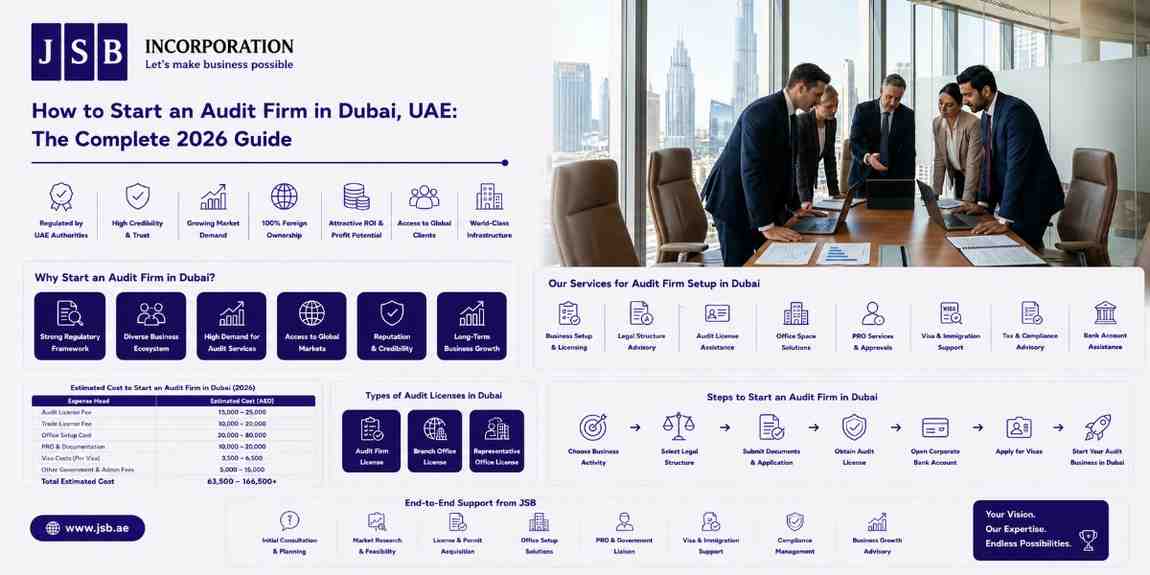
Key Highlights
Starting an audit firm in Dubai follows a strict, non-negotiable sequence: an individual license from the Ministry of Economy (MoE) first, then firm registration through both the Dubai Department of Economic Development (DED) and the MoE together. Both are non-negotiable.
You can’t skip steps, you can’t start in a free zone, and you can’t sign a single audit report without the right individual credentials in place. This is one of the few professional services in the UAE where the government strictly controls who can legally sign an audit report.
Not just any trade license holder qualifies. This guide covers everything: eligibility requirements, experience rules, individual audit license steps, firm registration, mainland vs. free zone rules, 2026 regulatory updates, and the most commonly asked questions.
2026 is an exceptionally strong time to start a licensed audit firm in Dubai because two federal laws effective January 1, 2026, have made licensed auditors legally mandatory for a broader category of UAE businesses than at any previous point.
Federal Decree-Law No. 17 of 2025 amended the UAE Tax Procedures Law to allow the Federal Tax Authority (FTA) to open tax audits beyond the ordinary five-year limitation period in cases linked to refund requests submitted near the deadline, per the UAE Ministry of Finance.
Your future clients need audit-grade record-keeping built into their operations from day one, not assembled after the fact.
Federal Decree-Law No. 16 of 2025 amended the VAT Law to allow the FTA to deny input tax deductions where a supply is part of a tax evasion arrangement, per the UAE Ministry of Finance. Your clients now need auditors who can build proper supplier due diligence into every engagement scope.
The FTA also gained authority to issue binding directions on tax law interpretation, meaning your firm will need to monitor Federal Tax Authority publications and update client guidance whenever new directions are issued.
Beyond these two decrees, here’s the full picture of who legally requires an audit right now:
Corporate tax enforcement, tighter VAT rules, a universal free zone audit mandate, and rising ESG assurance demand together create a durable, long-term client market. That’s not a temporary window.
To start an audit firm in Dubai, every partner who intends to sign audit reports must qualify individually with the UAE Ministry of Economy before any firm registration can begin. Here’s exactly what you need.
Academic Qualification (one of the following is required):
Experience Requirement:
Per Cabinet Resolution No. 48 of 2022, you must have a minimum of five years of practical auditing experience after obtaining your academic qualification.
If you’re a non-UAE national with international audit experience, the following UAE-specific experience is required in addition:
Disclaimer: Experience requirements are set by the UAE Ministry of Economy under Cabinet Resolution No. 48 of 2022 and are subject to amendment. Always verify the current thresholds directly with the Ministry of Economy before applying.
Recognized Professional Certifications with Partial Exam Exemptions:
These six professional bodies qualify you for partial exam exemptions under the EAAA Fellowship Program, per the Ministry of Economy:
If you hold one of these six qualifications, you’re exempt from the IFRS and ISAs modules and only need to pass the UAE Legislation and Tax Regulations module. All other applicants must pass all three subjects with a minimum score of 60% in each.
If you’re an ICAI member (CA, India) or ICAP member (Pakistan), both bodies are recognized under IFAC membership. Verify your current exam exemption status directly with the Ministry of Economy before applying, as exemption terms for non-primary bodies are subject to periodic review.
Personal Eligibility:
Disclaimer: Eligibility requirements, exam exemption privileges, and experience thresholds are set by the UAE Ministry of Economy and are subject to change. Always verify current requirements directly with the Ministry of Economy and the Emirates Association for Accountants and Auditors before beginning your application.
Your individual MoE auditor license is the foundation of everything. No firm registration can happen until every signing partner holds this license independently. The process has three stages.
Stage A: How Do You Join the EAAA?
The Emirates Association for Accountants and Auditors (EAAA) is the mandatory gateway to the UAE Fellowship Program. You must hold a valid EAAA membership before you can sit the fellowship exams, per the Ministry of Economy.
Submit the following to apply for EAAA membership:
Stage B: How Do You Pass the UAE Fellowship Certificate Examination?
The MoE adopted the EAAA Fellowship Program via Ministerial Resolution No. 111/2 of 2022, per the Ministry of Economy. The exam tests three core subjects:
If you hold one of the six recognized qualifications listed above, you’re exempt from subjects 1 and 2 and only need to pass the UAE Legislation and Tax Regulations module. All other applicants must pass all three subjects with a minimum score of 60% in each. Each exam consists of 70 multiple-choice questions with a two-hour duration.
Exam Logistics:
The Fellowship Certificate is valid for one year and is renewable annually. For annual renewal, you’re required to complete a minimum of 30 hours of CPE annually, including at least 12 hours in core fellowship exam subjects, per the Ministry of Economy. Non-compliance puts your individual license renewal at risk, which directly affects your firm’s MoE registration.
Stage C: How Do You Register with the Ministry of Economy as an Individual Auditor?
Once your fellowship exam results are confirmed, apply via the Ministry of Economy portal using your UAE PASS login. Standard processing time is 3 working days from successful submission.
Documents required (verify the full current list with the Ministry of Economy):
Individual auditor registration fees:
Fee Item | Amount |
Application fee | AED 100 |
Registration fee (3-year individual license) | AED 4,500 |
Total | AED 4,600 |
Disclaimer: These fees are sourced from the official Ministry of Economy portal and apply to the MoE registration component only. They don’t include attestation costs, insurance premiums, or EAAA membership and exam fees. Verify current amounts with the Ministry of Economy before submitting any payment.
Once all your signing partners hold their individual MoE licenses, you can form and register the firm. Audit firms in Dubai operate under a dual-regulatory model: a DED trade license plus MoE firm registration, and both are non-negotiable. Here’s the exact sequence.
Stage A: What Business Structure Can an Audit Firm Use?
You must incorporate your audit firm as a mainland entity. Starting directly in a free zone is not permitted as the primary incorporation for an audit firm, per the Ministry of Economy. The two most common structures are the following:
A minimum of two licensed partners is required, each holding a valid individual MoE signing license and a minimum of five years of audit experience, per Cabinet Resolution No. 48 of 2022.
Verify the current UAE national partner equity requirement directly with the Dubai Department of Economic Development and the Ministry of Economy, as ownership rules for professional services firms are subject to periodic updates.
Stage B: How Do You Reserve a Trade Name and Get DED Approval?
Apply for your trade name reservation through the Dubai Department of Economic Development. Register the business activity under Audit and Assurance Services or Accounting and Auditing, per the UAE government’s mainland business setup guidance.
Your chosen name must comply with UAE trade name regulations and can’t include misleading terms or references to government bodies. After name approval, submit your initial application to the Dubai Department of Economic Development for preliminary approval before MoE firm registration can proceed.
Stage C: Why Does Your Audit Firm Need a Physical Office?
A physical office with an Ejari-registered tenancy contract is mandatory for all mainland audit firms, per the Ministry of Economy. A flexi-desk doesn’t meet the regulatory requirement. Once you have your Ejari registration in hand, you can proceed to MoE firm registration.
Stage D: How Do You Register the Firm with the Ministry of Economy?
This is the step that legally authorizes your firm to sign audit reports in the UAE. Submit the firm registration application via the Ministry of Economy portal. Standard processing time is 1 working day from successful submission.
Documents required (verify the full current list with the Ministry of Economy):
Firm registration fees:
Fee Item | Amount |
Application fee | AED 100 |
Firm registration, company structure (3-year license) | AED 10,500 |
Firm registration, sole proprietorship (3-year license) | AED 7,500 |
Branch registration (3-year license) | AED 7,500 |
Late renewal penalty | AED 500 per month, maximum AED 5,000 per year |
Disclaimer: These figures cover MoE registration costs only and don’t include DED trade license fees, office rental, attestation costs, or insurance premiums. Total firm setup costs are approximately AED 50,000 to AED 150,000 depending on your structure, office location, and professional service fees. This is an industry estimate, not an official government figure. Always confirm current fees with the Ministry of Economy before submitting.
Stage E: Can You Add Branches After the Firm Is Established?
Yes. Once your mainland firm is fully registered with the MoE, you can apply to register branches.
Branch registration carries a separate Ministry of Economy fee of AED 7,500 for three years plus the AED 100 application fee. All partner auditors at the branch must hold individual MoE licenses.
Stage F: How Do You Open a Corporate Bank Account?
A UAE corporate bank account is required for all operational and compliance purposes once your license is issued. Prepare your MoE registration certificate, trade license, MOA, partner documents, and a business plan before approaching any bank.
UAE banking due diligence for professional services firms is thorough, so clean documentation from day one saves you significant time.
No. You can’t set up an audit firm directly in a free zone as your primary incorporation. The mainland is the mandatory starting point for all audit firms in the UAE, per the Ministry of Economy. Here’s how mainland and free zone rules compare.
Factor | Mainland | Free Zone |
Incorporation starting point | Mandatory; must start here | Cannot incorporate an audit firm directly here |
Audit report signing authority | Full statutory authority | All signing partners must hold individual MoE registration |
Office requirement | Physical office and Ejari mandatory | Varies by free zone authority |
Client scope | Mainland and free zone clients | Primarily free zone clients |
UAE national partner requirement | Required, verify current % with DED and MoE | Varies by free zone |
Branch setup | Base entity | Only possible after mainland firm is registered |
One rule you need to understand clearly: free zone branches of foreign audit firms, including international Big 4 branches, can’t sign statutory audit reports in the UAE unless every signing partner holds an individual MoE registration, per Ministry of Economy guidelines. This is a firm legal requirement, not a procedural detail.
Starting your firm in 2026 means building these regulatory obligations into your operating model from day one.
Corporate tax audit filing deadlines for mainland entities with a December 31 year-end:
Company Revenue | Filing Deadline from Year-End |
Over AED 100 million | 90 days |
AED 10 million to AED 100 million | 120 days |
Below AED 10 million | 150 days |
Q: Can an Indian CA (ICAI member) open an audit firm in Dubai?
A: Yes, ICAI is recognized as an IFAC member body by the Emirates Association for Accountants and Auditors.
You’ll need to join the EAAA, meet the UAE audit experience requirement under Cabinet Resolution No. 48 of 2022, pass the required fellowship exam modules, and obtain your individual Ministry of Economy registration before any firm can be registered.
Verify ICAI’s current exam exemption status with the Ministry of Economy before applying.
Q: Can I set up an audit firm directly in a free zone like IFZA or DMCC?
A: No. Audit firms must be incorporated on the UAE mainland first, per the Ministry of Economy.
Free zone branches can only be opened after your mainland entity is fully registered with the MoE, and every signing partner at the branch must hold an individual MoE license to sign statutory audit reports.
Q: Is ACCA recognized for UAE audit licensing in 2026?
A: Yes. ACCA is one of the six professional bodies with partial exam exemption privileges under the EAAA Fellowship Program, per the Ministry of Economy. ACCA members only need to pass the UAE Legislation and Tax Regulations module.
Verify current requirements with the Ministry of Economy and the Emirates Association for Accountants and Auditors.
Q: How long does the entire process take?
A: Your individual MoE registration processes in 3 working days once all documents are submitted, per the Ministry of Economy. Firm registration processes in 1 working day.
The total timeline including EAAA membership, exam preparation, fellowship exam sessions, and DED incorporation typically takes 3 to 6 months. Exam sessions run in March, May, July, September, and November.
Q: Do all UAE companies legally need an annual audit?
A: All mainland LLC companies must have audited financials annually, per the UAE government. All QFZPs must submit audited accounts under Ministerial Decision No. 84 of 2025, effective for tax periods from January 1, 2025, regardless of revenue, per the UAE Ministry of Finance.
Mainland businesses above AED 50 million in annual revenue must also maintain audited statements for corporate tax. Verify current thresholds with the Ministry of Finance.
Q: What is the UAE Fellowship Certificate and is it mandatory?
A: It’s mandatory for all auditors practicing in the UAE, introduced via Ministerial Resolution No. 111/2 of 2022 and administered by the Emirates Association for Accountants and Auditors, per the Ministry of Economy.
It covers three exam subjects: Accounting Standards (IFRS), Auditing Standards (ISAs), and UAE Legislation and Tax Regulations. The certificate is valid for one year and must be renewed annually by completing the required CPE hours.
Verify all current details with the Ministry of Economy and the Emirates Association for Accountants and Auditors.
Q: Can a foreign audit firm’s branch in Dubai sign audit reports?
A: No. Foreign audit firm branches can’t sign statutory audit reports in the UAE unless every signing partner holds an individual Ministry of Economy registration, per Ministry of Economy guidelines.
Verify the current foreign firm branch registration requirements with the Ministry of Economy.
Q: Can a Dubai audit firm offer ESG and sustainability assurance services?
A: ESG assurance is a growing service line as UAE and multinational businesses face increasing international sustainability reporting obligations.
Verify the permitted activity scope under your Ministry of Economy audit license and check the rules applicable in the Dubai International Financial Centre and the Abu Dhabi Global Market if you plan to serve clients in those jurisdictions, as their regulatory frameworks differ from the mainland license scope.
Starting an audit firm in Dubai involves two separate regulatory tracks running at the same time: your individual Ministry of Economy qualification and your firm’s Dubai Department of Economic Development plus Ministry of Economy registration. Getting the structure wrong at either stage creates delays that can push your launch back by months.
JSB Incorporation has helped professionals set up their businesses across 24+ UAE jurisdictions, including professional services firms requiring Ministry of Economy registration.
You get a higher success rate, transparent pricing with no hidden fees, setup completed in weeks rather than months, and full end-to-end support from trade license application to corporate bank account opening.
JSB’s team handles the coordination between the Dubai Department of Economic Development and the Ministry of Economy so you can focus on building your client base from day one.
Book your free consultation call today with the experts of JSB Incorporation to learn more.

Office 2505, 25th Floor, Regal Tower, Business Bay, Dubai, UAE P.O Box 27614.
+971 4 824 4842
info@jsbincorporation.com
