
 Gaurav Keswani
Key Highlights
The UAE registered 250,000 new companies in 2025 alone, bringing its total active business base to 1.4 million, according to the UAE Ministry of Economy. Free zone licences grew 28% in the same period, with Dubai accounting for 54% of all free zone commercial licences in the country.
International investors are choosing Dubai over traditional hubs and cost and tax structure are central to that shift.
For investors comparing Singapore vs. Dubai company formation in 2026, the decision comes down to one question: which jurisdiction costs less to own over three years while delivering a tax position and residency outcome that actually fits your business?
This article gives you the verified numbers to decide.
TL;DR: Dubai free zone company formation delivers 0% tax on qualifying income and a path to 10-year UAE residency, advantages that make it the stronger choice for most international investors when the full cost picture is considered. Verify current fees directly with the Federal Tax Authority (FTA) and the Accounting and Corporate Regulatory Authority (ACRA) of Singapore.
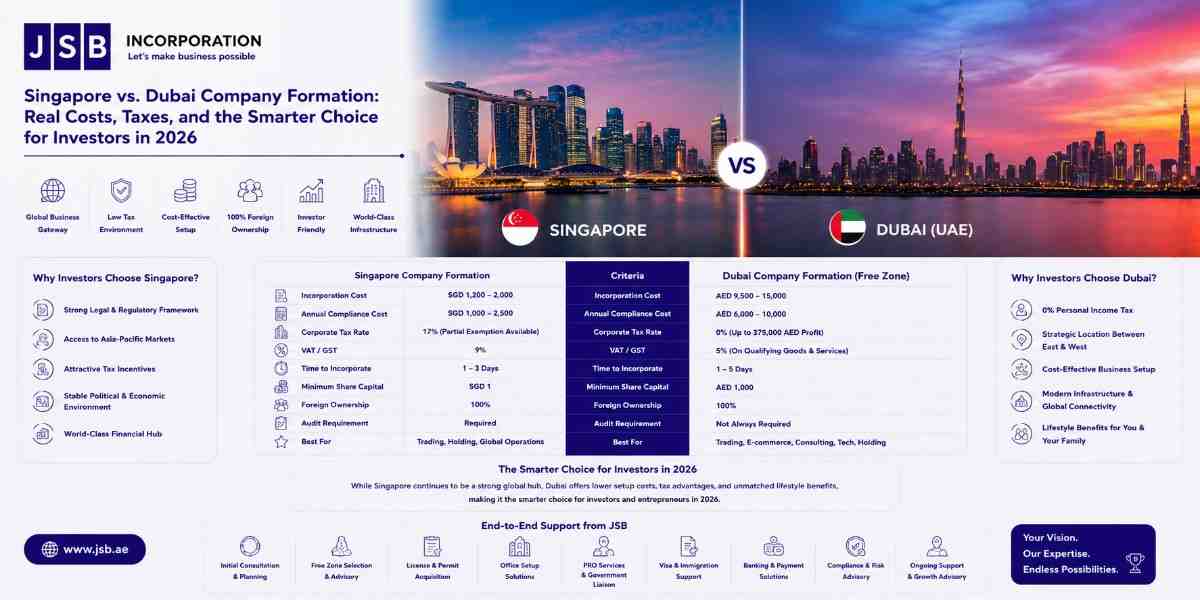
Criteria | Dubai Free Zone | Singapore |
Government registration fee | AED 10,000–AED 25,000+ (varies by free zone) | SGD 315 (ACRA fee) |
Corporate tax rate | 0% on qualifying income (QFZP); 9% standard above AED 375,000 | 17% headline; partial startup exemptions apply |
Foreign ownership | 100% permitted | 100% permitted |
Local director or sponsor required | Not required for free zone entities | Yes—at least 1 Singapore-resident director required |
Residency pathway via company | Investor visa (2-year); UAE Golden Visa (10-year) eligible | No direct long-term residency linked to incorporation |
Setup timeline | 3–7 working days (typical free zone) | 1–3 working days (ACRA digital process) |
TL;DR: A Dubai free zone gives you 100% foreign ownership, 0% corporate tax on qualifying income, and an investor residency visa without a local sponsor or annual nominee director fee adding to your running costs.
A Dubai free zone company that qualifies as a QFZP under Federal Decree-Law No. 47 of 2022 pays 0% corporate tax on qualifying income, as confirmed by the Federal Tax Authority (FTA).
The standard 9% UAE corporate tax rate applies to taxable income above AED 375,000 for non-qualifying income. Qualifying status requires adequate economic substance in the free zone and compliance with the de minimis rule on non-qualifying income.
Free zone companies in the UAE permit 100% foreign ownership with no local sponsor and no mandatory resident director. Under UAE free zone regulations confirmed by the Ministry of Economy (MOEC), foreign founders hold full equity from day one.
The QFZP framework is the critical tax consideration. To maintain 0% status, your company must conduct qualifying activities, maintain real substance in the free zone, and keep non-qualifying income within the FTA’s de minimis threshold.
JSB Incorporation’s in-house team manages ongoing substance documentation and FTA compliance, so the 0% rate stays intact, not just at setup but through every financial year.
Free zone options with established track records for international investors include IFZA (International Free Zone Authority), DMCC (Dubai Multi Commodities Centre), RAKEZ (Ras Al Khaimah Economic Zone), and SHAMS (Sharjah Media City).
A Dubai free zone trade licence starts under AED 25,000 for service businesses, per Invest in Dubai (investindubai.gov.ae). Additional line items include the establishment card, visa fees per person, and flexi-desk or virtual office selection, all variable by free zone authority and configuration.
There is no nominee director fee. There is no mandatory resident director engagement. Those cost categories simply do not exist in the free zone structure.
Forming a free zone company entitles you to apply for an investor residence visa, typically valid for 2 years.
Qualifying investors can also apply for the UAE Golden Visa through the Federal Authority for Identity, Citizenship, Customs, and Port Security (ICP), a 10-year renewable residency with no employer sponsor requirement. Family sponsorship for spouse and children is available under both categories.
JSB Incorporation carries a 97.5% business setup approval rate—confirming that eligibility, documentation, and authority submission are handled with the precision that complex formation cases require.
TL;DR: Singapore offers fast digital incorporation and strong institutional credibility but its headline registration fee excludes the mandatory resident director cost and 17% corporate tax rate that apply from the first operating year.
Singapore’s Accounting and Corporate Regulatory Authority (ACRA) processes company registration digitally in 1–3 working days, with a government fee of SGD 315. The headline corporate tax rate is 17% on chargeable income.
A Startup Tax Exemption (SUTE) scheme offers partial relief for qualifying new companies in their first three years. It does not eliminate the tax liability; it reduces it on a tiered basis.
Singapore requires every company to have at least one director who is ordinarily resident in Singapore. For a foreign founder without Singapore residency, this means engaging a nominee director service annually.
100% foreign shareholding is permitted; no local equity partner is required. The EntrePass scheme offers a residency pathway for qualifying entrepreneurs, but it is a separate, eligibility-gated application—not an automatic right linked to company incorporation.
TL;DR: Singapore’s SGD 315 registration fee becomes materially more expensive than a Dubai free zone licence once nominee director fees and the 17% corporate tax rate are applied over a standard 3-year operating horizon.
For an international investor forming a Singapore company, the nominee director is a mandatory recurring cost.
At SGD 5,000–SGD 15,000 per year, three years of nominee director engagement adds SGD 15,000–SGD 45,000 to your operating overhead before accounting for corporate tax.
A Dubai free zone company has no equivalent cost category. There is no nominee director, no mandatory resident director, and no annual engagement fee of this type.
Singapore’s Companies Act requires at least one Singapore-resident director per company. Foreign founders who do not hold Singapore residency must appoint a nominee.
This is not optional, and it recurs every year the company operates. A Dubai free zone company has no equivalent regulatory requirement. Foreign founders direct their own companies from day one.
Consider a business generating SGD 300,000 in annual profit after the SUTE exemption period. At Singapore’s 17% headline rate, the annual corporate tax liability is approximately SGD 51,000.
A Dubai free zone QFZP entity with equivalent qualifying income pays 0% under the FTA framework confirmed in Federal Decree-Law No. 47 of 2022. That differential compounds across every year of operation.
Maintaining QFZP status requires documented substance in the free zone and compliance with the FTA’s de minimis rule for non-qualifying income. JSB Incorporation’s in-house team structure monitors this compliance so your 0% rate is defensible at audit, not just claimed on a registration form.
TL;DR: Dubai is the stronger choice for investors prioritizing tax efficiency, long-term residency, and lower total operating costs. Singapore suits founders who specifically need an Asia-Pacific institutional headquarters or access to Singapore’s VC and banking ecosystem.
Dubai free zone formation is the right structure if you:
Singapore is the stronger choice if you:
JSB Incorporation advises on UAE company formation only. For investors who have evaluated both jurisdictions and confirmed Dubai as their preferred base, JSB’s team handles the full process from free zone selection to trade licence, visa, and FTA compliance. Investors who qualify may also explore the UAE Golden Visa pathway alongside their company setup.
Reviewed by: Gaurav Keswani, Founder, JSB Incorporation
Gaurav Keswani is the Founder of JSB Incorporation, a Dubai-based business setup and immigration consultancy. He appeared on Talk 100.3 FM answering live listener questions on UAE Golden Visa eligibility, citing GDRFA and ICP guidelines directly on air. JSB Incorporation handles documentation preparation and application coordination for all visa and license decisions that rest with the relevant UAE government authorities — GDRFA, ICP, DET and DLD.
Dubai free zone companies that qualify as a Qualifying Free Zone Person (QFZP) under Federal Decree-Law No. 47 of 2022 pay 0% corporate tax on qualifying income, as confirmed by the Federal Tax Authority (FTA).
The standard 9% UAE corporate tax rate applies to taxable income above AED 375,000 for non-qualifying income or non-QFZP entities. Qualifying status requires adequate substance in the free zone and compliance with the de minimis rule.
2. How much does it cost to set up a free zone company in Dubai in 2026?
Dubai free zone trade licence fees start under AED 25,000 for service businesses, depending on the free zone authority, number of visa allocations, and office type selected.
Additional costs include visa fees, establishment cards, and flexi-desk or virtual offices. Verify current fees directly with the relevant free zone authority or through JSB Incorporation’s free eligibility consultation before committing to a specific zone.
3. Does Singapore require a local director for foreign-owned companies?
Yes. Singapore’s Companies Act requires every company to have at least one director who is ordinarily resident in Singapore. For foreign founders without Singapore residency, this means engaging a nominee director service, typically costing SGD 5,000–SGD 15,000 per year.
This is a mandatory recurring cost that does not apply to UAE free zone company formation, where foreign founders can direct their own companies without a locally resident representative.
4. Can I get UAE residency by forming a free zone company in Dubai?
Yes. Forming a free zone company in Dubai entitles you to apply for an investor residence visa, typically valid for 2 years and processed through the Federal Authority for Identity, Citizenship, Customs, and Port Security (ICP).
Qualifying investors may also apply for the UAE Golden Visa, a 10-year renewable residency based on their investment threshold. Family sponsorship for spouse and children is available under both categories.
5. What is the UAE corporate tax rate for free zone companies?
The Federal Tax Authority (FTA) applies 0% corporate tax to qualifying income earned by a Qualifying Free Zone Person. The standard 9% UAE corporate tax rate applies to non-qualifying income.
Free zone entities that do not hold QFZP status are taxed under the standard regime, where the 9% rate applies to taxable income above AED 375,000, per the Federal Tax Authority (FTA). UAE tax regulations are subject to change. Verify current requirements directly with the Federal Tax Authority or consult a qualified tax advisor for your specific situation.
Singapore’s SGD 315 registration fee is a useful headline; it is not a useful basis for a jurisdiction decision. When nominee director costs, corporate tax rates, and residency outcomes are put into the same calculation, Dubai free zone company formation delivers a stronger economic case for most international investors.
The right free zone, the correct licence activity, and QFZP substance compliance are the decisions that determine whether you capture the 0% tax advantage or lose it.
Check your business setup eligibility in 5 minutes—book a free consultation with JSB Incorporation today.

Office 2505, 25th Floor, Regal Tower, Business Bay, Dubai, UAE P.O Box 27614.
+971 4 824 4842
info@jsbincorporation.com