
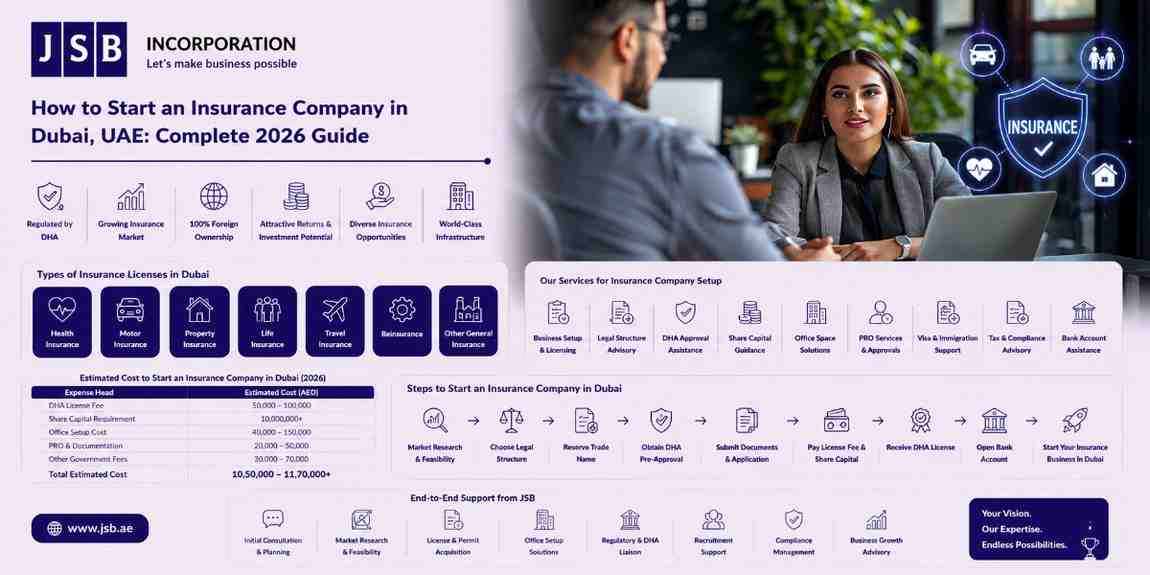
Key Highlights
Starting an insurance company in Dubai requires a license from the Central Bank of the UAE (CBUAE) under Federal Decree-Law No. 6 of 2025.
There’s no shortcut, no standard free zone workaround for mainland insurance sales, and no lighter version of this process.
But it’s a process you can follow step by step if you know exactly what’s required. This guide gives you that, backed by official UAE government sources only.
Let’s be honest about what makes this harder than most UAE business formations.
The UAE insurance sector isn’t like setting up a consultancy or a trading company. It’s one of the most tightly regulated financial activities in the country, and that’s intentional.
The CBUAE overhauled the entire framework when it enacted Federal Decree-Law No. 6 of 2025, issued September 8, 2025 and effective September 16, 2025.
This law replaced both Federal Decree-Law No. 14 of 2018 on financial institutions and activities and Federal Decree-Law No. 148 of 2023 on insurance activities, bringing both under one consolidated regulatory framework.
The three things that catch most applicants off guard are the capital threshold (AED 100 million minimum), the ownership restriction for mainland incorporated entities (at least 75% UAE or GCC national ownership under Cabinet Resolution No. 42 of 2009), and the fact that standard free zone licenses don’t cover mainland insurance operations at all. All three are addressed in detail below.
The Central Bank of the UAE (CBUAE) is the sole regulator for all insurance companies operating in the UAE, under Federal Decree-Law No. 6 of 2025, effective September 16, 2025.
No insurance company, whether it’s a mainland entity, a free zone company, or a foreign branch, can conduct insurance operations in the UAE without CBUAE authorization.
The CBUAE absorbed the former Insurance Authority in 2020 under Decretal Federal Law No. 25 of 2020, and the 2025 law completed that integration by repealing the standalone insurance law entirely.
In late 2025, the CBUAE Board approved updated insurance regulations covering Insurance Licensing and Insurance Brokerage, bringing the framework in line with current market needs and consumer protection standards.
Each category below requires its own separate CBUAE license. You can’t use a general trade license or a standard free zone license for any of these activities.
These are separate regulated activities. Each needs its own CBUAE license and carries distinct capital requirements:
The minimum paid-up capital to start an insurance company in Dubai is AED 100 million, as confirmed by the Central Bank of the UAE. Reinsurance companies require AED 250 million. Here’s the full breakdown across all entity types:
Entity Type | Minimum Capital | Additional Requirement |
Insurance Company (national, GCC, or foreign) | AED 100 million | Fixed deposit: AED 6 million (property/liability) or AED 4 million (life/persons) |
Reinsurance Company | AED 250 million | Separate deposit conditions apply |
Insurance Agent | AED 500,000 | Must be 100% UAE national-owned |
Health Insurance TPA | AED 5 million | Plus AED 1 million bank guarantee |
Surveyor and Loss Adjuster | AED 1 million | 51% UAE national ownership required |
Insurance Consultant | 51% UAE national ownership | Plus AED 3 million professional indemnity policy |
Actuary (UAE-incorporated) | AED 100,000 | Standard CBUAE registration |
Actuary (financial free zone or foreign) | AED 250,000 | Standard CBUAE registration |
Beyond paid-up capital, your company also needs to place a fixed deposit with a UAE-licensed bank in favor of the CBUAE Chairman. That’s AED 6 million for property and liability insurance classes and AED 4 million for life, person, and fund accumulation operations.
The CBUAE also charges three separate fees across the licensing process: AED 10,000 for examination of the licensing application, AED 20,000 for the licensing itself, and AED 15,000 for registration of the insurance company.
Disclaimer: All capital figures, deposit amounts, and fee amounts in this article are sourced from official CBUAE and UAE government portals as of June 2026. These figures are subject to change by the CBUAE or UAE Cabinet at any time. Always verify the latest requirements directly with the Central Bank of the UAE before making any financial decisions.
Your legal structure determines how you enter the market and who can own your entity. Getting this wrong before you apply delays the entire process.
For UAE mainland-incorporated insurance companies, the required legal form is a Public Joint Stock Company (PJSC). Under Cabinet Resolution No. 42 of 2009, at least 75% of your company’s capital must be owned by UAE or GCC national individuals or corporate bodies.
This ownership rule applies to national and foreign insurance companies licensed to operate on the UAE mainland, including Takaful entities. Importantly, Cabinet Resolution No. 42 of 2009 explicitly exempts companies operating in UAE free zones from this 75% ownership rule under Article 3 of the resolution.
If you’re a foreign company looking to enter the UAE mainland insurance market, you have two options:
One more structural point worth knowing: Federal Decree-Law No. 20 of 2025, effective October 2025, allows free zone companies to establish onshore branches.
That flexibility doesn’t exempt you from CBUAE insurance licensing. Any entity conducting insurance activity on the UAE mainland, regardless of its registered structure, still needs full CBUAE authorization.
The CBUAE insurance licensing process works in two phases. Phase 1 leads to in-principle approval. Phase 2 gives you the final license certificate. Here’s exactly what each step involves.
Step 1. Decide on your insurance activity and company type.
Choose between insurance, reinsurance, Takaful, or a specific insurance-related profession. Each carries a distinct license type and capital requirement, as confirmed by the Central Bank of the UAE. This decision shapes everything downstream, so get it right before you do anything else.
Step 2. Choose your legal structure.
For UAE mainland-incorporated entities, you’ll form a PJSC. Foreign companies choose between a branch office or appointing a UAE-licensed insurance agent, as outlined in the legal structure section above.
Step 3. Contact the CBUAE Licensing Division before you prepare anything.
New applicants can contact the CBUAE Licensing Division at licensing@cbuae.gov.ae before submitting a formal application. Do this first. It saves time and gives you direct confirmation of what documents you’ll need for your specific application type.
Step 4. Reserve your trade name and get initial authority approval.
For Dubai mainland companies, apply through the Department of Economy and Tourism (DET) to reserve your trade name and get your initial commercial registration approval.
Step 5. Pay the AED 10,000 examination fee and submit your application through the CBUAE online portal.
An examination fee of AED 10,000 is payable at the application stage.
Applications are submitted electronically through the CBUAE system, which requires a username and password. New users need to contact the CBUAE to request login credentials before accessing the portal.
Documents required for national and GCC companies (verify the full current list with the Central Bank of the UAE):
Additional documents required for foreign company branch applications (verify the full current list with the Central Bank of the UAE):
For Takaful companies, all of the above apply, plus the following:
Step 6. CBUAE reviews your application and interviews your technical team.
CBUAE staff review all your documents and verify requirements. Your company’s technical staff will be interviewed at CBUAE headquarters as part of this phase. Make sure your proposed Director-General and key technical staff are prepared for this interview.
Step 7. Receive in-principle approval and complete phase 2 within one year.
In-principle approval doesn’t mean you can start operating. You have exactly one year from the date of your approval letter to complete all phase 2 requirements specified by the CBUAE. Don’t let this deadline slip.
Step 8. Place your fixed deposit with a UAE-licensed bank.
Deposit the required amount with a UAE-licensed bank in favor of the CBUAE Chairman: AED 6 million for property and liability insurance classes or AED 4 million for life, persons, and fund accumulation operations.
Step 9. Pay the remaining fees and collect your certificate.
The licensing fee is AED 20,000 and the registration fee is AED 15,000, both payable at this stage. The CBUAE issues the license and publishes its decision in the Official Gazette.
The CBUAE states that the estimated time from submission of a complete application until completion of the service is 60 days. This covers phase 1 only. After in-principle approval, you have up to one year to fulfill all phase 2 requirements before receiving your final license certificate.
A standard UAE free zone license does not authorize insurance operations on the UAE mainland. This is one of the most common misconceptions and it’s worth addressing directly.
Insurance is a regulated financial activity under the CBUAE. A general trade license from IFZA, DMCC, JAFZA, RAKEZ, or any similar non-financial free zone doesn’t cover mainland insurance operations.
Any entity in a non-financial free zone wanting to conduct insurance activity on the UAE mainland must obtain CBUAE authorization directly.
The DIFC and ADGM are a different case. These financial free zones operate under their own independent legal frameworks, regulated by the Dubai Financial Services Authority (DFSA) and the Financial Services Regulatory Authority (FSRA), respectively.
Both can authorize insurance within their own jurisdictions. However, even DIFC and ADGM-licensed insurance entities can’t distribute insurance products to UAE mainland customers without separate CBUAE authorization.
If your target market is UAE mainland customers, you need a CBUAE license. There’s no route around that.
Getting your CBUAE license is the start of your compliance obligations, not the end. Here’s what you need to stay on top of once you’re operating.
Solvency margins. The CBUAE requires all licensed insurance companies to maintain solvency margins, governed by the Insurance Core Principles set by the International Association of Insurance Supervisors.
Under Federal Decree-Law No. 6 of 2025, companies that don’t meet solvency standards face regulatory intervention, which can include restructuring, additional capital requirements, or appointment of a trustee.
Emiratisation targets. You’ll need to comply with annual UAE national hiring targets. Your formal Emiratisation undertaking is required at the application stage, before you receive any approval.
Director-General qualifications. Your Director-General must hold a minimum university degree and at least 10 years of insurance experience, five of which in an executive leadership position.
Takaful ongoing requirements. Your Takaful company must maintain a functioning Shariah Supervisory Committee and appoint an internal Shariah Controller throughout operations. Family Takaful and General Takaful must stay as separate licensed entities.
CBUAE Rulebook compliance. All licensees must continuously comply with the CBUAE Rulebook, the centralized repository of all active regulations, standards, and guidelines, maintained by the Central Bank of the UAE.
Q1. Who regulates insurance companies in Dubai?
CBUAE under Federal Decree-Law No. 6 of 2025, effective September 16, 2025. The CBUAE absorbed the former Insurance Authority in 2020 under Decretal Federal Law No. 25 of 2020 and now holds all licensing, supervisory, and enforcement authority for the entire UAE insurance sector.
Q2. What is the minimum capital to start an insurance company in Dubai?
The minimum paid-up capital is AED 100 million for insurance companies and AED 250 million for reinsurance companies, as confirmed by the Central Bank of the UAE. Insurance agents require AED 500,000 and must be 100% UAE national-owned.
Q3. Can a foreigner own 100% of an insurance company in Dubai?
For UAE mainland-incorporated insurance companies, no. Under Cabinet Resolution No. 42 of 2009, at least 75% of the capital must be owned by UAE or GCC nationals.
This ownership rule doesn’t apply to companies operating in UAE free zones, which are explicitly exempt under Article 3 of the same resolution.
A foreign company can also operate on the mainland via a branch office, subject to CBUAE authorization and applicable capital requirements.
Q4. Can I set up an insurance company in IFZA, DMCC, or another standard free zone?
A standard free zone license doesn’t authorize mainland insurance operations. Any entity in a non-financial free zone wanting to conduct insurance activity on the UAE mainland must obtain CBUAE authorization.
DIFC and ADGM entities have their own regulators but can’t serve UAE mainland customers without separate CBUAE authorization.
Q5. What’s the difference between an insurance company and an insurance broker in the UAE?
An insurance company underwrites risk and issues policies directly to policyholders. An insurance broker independently intermediates between clients and insurers, earns a commission, and doesn’t underwrite any risk. Both require separate CBUAE licenses.
Q6. How long does it take to get an insurance license in Dubai?
The CBUAE states the estimated time from submission of a complete application to service completion is 60 days. This covers phase 1 only. After in-principle approval, you have up to one year to complete phase 2 requirements and receive your final license certificate.
Q7. What is Takaful insurance and does it need a separate license?
Takaful is Islamic cooperative insurance where participants contribute to a shared pool rather than paying conventional premiums.
It requires the same CBUAE insurance license as conventional insurance, plus a mandatory Shariah Supervisory Committee and an internal Shariah Controller. Family Takaful and General Takaful can’t be combined under one license.
Starting an insurance company in Dubai means meeting one of the most demanding regulatory standards in the UAE financial sector.
You’re looking at AED 100 million in minimum capital, three separate CBUAE fees totaling AED 45,000 across the licensing process, a structured two-phase application, ownership requirements under Cabinet Resolution No. 42 of 2009, and ongoing compliance obligations under Federal Decree-Law No. 6 of 2025.
Each document in your application has to be complete and accurate. Each step has to happen in the right sequence. One gap pushes your 60-day phase 1 timeline back to zero.
At JSB Incorporation, we work with entrepreneurs and investors across 24+ UAE jurisdictions, including regulated financial sectors where the details, sequencing, and the right regulatory contacts matter as much as the documents themselves.
We offer transparent pricing, end-to-end support, and a process built to move efficiently. You don’t have to figure out each step on your own.
Book your free consultation call today with the experts of JSB Incorporation to learn more.
Also Read:
18 Common Business Setup Mistakes in Dubai and How to Avoid Them
UAE Business Setup and Golden Visa in 2026: A Comprehensive Analysis
How Long Does Business Setup Take in UAE in 2026? (Per Jurisdiction) Breakdown)
The Ultimate Comparison: Business Setup in IFZA Free Zone vs. Mainland Dubai

Office 2505, 25th Floor, Regal Tower, Business Bay, Dubai, UAE P.O Box 27614.
+971 4 824 4842
info@jsbincorporation.com
