
 Gaurav Keswani
Key Highlights
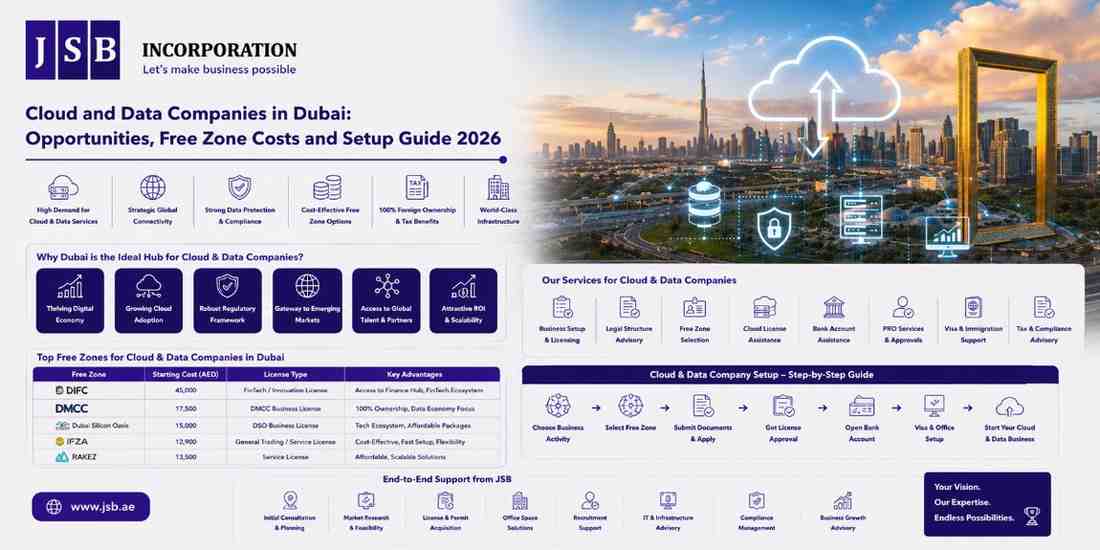
In Dubai, you can set up a cloud or data company with 100% foreign ownership, 0% personal income tax, and a technology license starting from AED 11,900 per year at IFZA’s Dubai Digital Park.
The UAE cloud computing market was valued at USD 12.84 billion in 2025 and is forecast to reach USD 45.41 billion by 2030 at a CAGR of 28.75%.
If you want to start something in the cloud and data in Dubai, this article will help you in many ways. Keep reading to learn more.
Dubai gives your cloud or data company 0% corporate tax on qualifying free zone income, 100% foreign ownership, and access to a cloud market growing at 28.75% per year through 2030. Here’s what backs that up:
If you’re running a cloud service, SaaS platform, or data business targeting international clients, a UAE free zone gives you 0% corporate tax on qualifying income and 100% foreign ownership with same-day license issuance possible at IFZA.
Mainland is the right call only if your primary revenue will come from UAE government contracts or large local enterprises that need direct supplier relationships.
Here’s how the two compare:
Factor | Free Zone | Mainland |
Foreign Ownership | 100% | 100% (post-2025 CCL amendments) |
Corporate Tax | 0% on qualifying income | 9% above AED 375,000 |
UAE Market Access | Requires distributor or dual license | Direct, no restrictions |
Government Contracts | Restricted | Eligible |
Setup Speed | As fast as same day (IFZA) | 3 to 7 working days via DET |
Best For | International SaaS, cloud services, data analytics | UAE enterprise and government cloud contracts |
UAE Federal Decree-Law No. 20 of 2025, effective 15 October 2025, now lets your free zone company set up a mainland branch without creating a separate full legal entity. That means you can serve UAE government clients through a mainland branch while keeping your free zone license and its tax advantage active simultaneously.
The same law introduced Article 15 bis, which lets your company transfer its registration between free zones, between emirates, or from a free zone to the mainland, with your company’s legal identity fully preserved throughout.
Confirm the current status with the UAE Ministry of Economy before acting on this, as implementing conditions apply.
If you’re planning to bring in investors, Article 76 of the amended UAE Commercial Companies Law now lets LLCs and private joint stock companies issue two classes of shares with different voting and profit rights. That gives you proper tools to structure investor equity without losing operational control.
An IFZA technology license starts at AED 11,900 per year for the Zero Visa package or AED 14,900 per year for the 1-Visa package, which includes one free lifetime residence visa.
IFZA operates from Dubai Digital Park, Dubai Silicon Oasis, a technology-dedicated free zone hub in Dubai regulated by the Dubai Silicon Oasis Authority. Cloud computing, SaaS, software development, and IT services are all confirmed within IFZA’s permitted activity list of over 800 activities.
Package | Annual Fee (incl. VAT) | Visa Allocation | What’s Included |
Zero Visa | AED 11,900 | 0 | Free FlexiDesk for Year 1 |
1-Visa | AED 14,900 | 1 | 1 free lifetime residence visa |
2-Visa | AED 16,900 | 2 | 1 free lifetime residence visa, 2 FlexiDesks |
3-Visa | AED 18,900 | 3 | 1 free lifetime residence visa, 3 FlexiDesks |
4-Visa and above | AED 20,900 | 4+ | 1 free lifetime residence visa |
That free residence visa waives the standard AED 3,750 issuance charge per person, and the waiver stays in place for the full life of your business license on continual renewal.
Three business activities come bundled into every package at no extra charge. You can add up to four more activities at AED 1,000 each, for a maximum of seven activities total under one license.
Yes. IFZA’s multi-year discount structure lowers your effective per-year spend if you’re committing to Dubai long term:
Confirm current promo availability directly with IFZA before you commit. IFZA reserves the right to revise pricing without prior notice.
This is where first-year budgets most often fall short. Your license fee covers the license itself. These are the additional government fees you need to budget for separately:
Fee Item | Amount |
Establishment Card, initial application | AED 2,000 |
Establishment Card renewal | AED 2,200 |
UAE Residence Visa, 2-year validity, per additional visa | AED 3,750 |
Visa Status Change (if you’re already inside the UAE at time of application) | AED 1,600 |
Any amendment: activity change, shareholder change, or name change | AED 2,000 per item |
Two or more amendments submitted at the same time | 50% discount on additional requests |
Late license renewal penalty | AED 1,000 per month after the grace period |
NOC for Golden Visa application | AED 1,250 |
Emirates ID and medical exam fees are charged separately. Confirm current rates with IFZA directly before finalizing your budget.
Your realistic first-year total, covering your license, Establishment Card, one additional residence visa, and Emirates ID and medical fees, typically falls between AED 18,000 and AED 25,000 depending on how many visas you need.
Pricing disclaimer: Verify all current costs directly with IFZA before submitting your application.
Your cloud or data company in Dubai must comply with the UAE Personal Data Protection Law, sector-specific data residency rules, and VAT and corporate tax obligations.
There’s no single UAE cloud law. Your compliance spans multiple federal regulations, and each one applies differently depending on what type of data your platform processes.
The UAE Personal Data Protection Law, Federal Decree-Law No. 45 of 2021, became effective from 1 January 2026 with a one-year transition period. Full compliance is required by 1 January 2027.
Executive Regulations are still pending, but the UAE Data Office is operational and issuing guidance. The law applies to any business collecting, processing, or storing personal data of UAE residents, regardless of where your servers are located. Administrative fines for serious violations can reach AED 5 million.
Your key obligations under the PDPL:
General business data has no blanket localization requirement in the UAE. But two specific categories carry hard legal boundaries:
Federal Decree-Law No. 16 of 2025, effective 1 January 2026, updated the UAE’s VAT rules and these apply directly to your cloud business:
For your free zone cloud company, qualifying income is taxed at 0%, provided you meet the Qualifying Free Zone Person criteria as defined by the Federal Tax Authority.
Non-qualifying income within the same free zone entity is taxed at 9%. On the mainland, the rate is 9% on all taxable income above AED 375,000. Confirm your qualifying activity scope with the Federal Tax Authority before your first corporate tax filing.
Yes. As a cloud or data company founder in Dubai, you can qualify for the UAE Golden Visa, a 10-year renewable residency, through three main routes, as confirmed by the Federal Authority for Identity, Citizenship, Customs, and Port Security.
Additional details worth knowing before you apply:
Setting up a cloud or data company at IFZA Dubai takes as little as a few working days for your trade license, with your UAE residence visa following over the next 2 to 4 weeks. Here’s the process in order:
Q1: How much does it cost to set up a cloud company in Dubai in 2026?
An IFZA technology license starts at AED 11,900 per year for the Zero Visa package, or AED 14,900 per year with one free lifetime residence visa included.
Adding your Establishment Card (AED 2,000), one additional residence visa (AED 3,750), and Emirates ID and medical fees brings your typical first-year total to AED 18,000 to AED 25,000, depending on how many visas you need.
These figures come from IFZA’s official Schedule of Fees, Revision 0201, February 2026. Verify your exact total directly with IFZA before applying.
Q2: Which free zone is best for a cloud or SaaS company in Dubai?
IFZA at Dubai Digital Park, Dubai Silicon Oasis, offers technology licenses starting from AED 11,900 per year, with cloud computing, SaaS, and software development confirmed within its permitted activity list of over 800 activities. DMCC suits commodity-linked technology businesses.
DIFC suits fintech and financial data platforms that need a regulated financial environment. Your best choice depends on your client profile and whether you need a specific regulatory environment. Confirm your activities appear on IFZA’s current permitted list before submitting your application.
Q3: Do cloud companies in Dubai need to store data locally inside the UAE?
General business data has no blanket localization requirement. Personal data under the UAE Personal Data Protection Law, Federal Decree-Law No. 45 of 2021, requires PDPL-compliant safeguards, including UAE Data Office approval or Standard Contractual Clauses for any cross-border transfer.
Health data under Federal Law No. 2 of 2019 must remain in the UAE without exception. E-invoicing data must flow through an Accredited Service Provider on the UAE’s Peppol network, which is mandatory from 1 January 2027 for large businesses and 1 July 2027 for all other in-scope businesses.
Q4: Can a foreigner own 100% of a cloud company in Dubai?
Yes. 100% foreign ownership is available across all UAE free zones. On the mainland, 100% foreign ownership is also permitted for most technology activities following amendments to the UAE Commercial Companies Law under Federal Decree-Law No. 20 of 2025, effective 15 October 2025.
Q5: Can a cloud company founder get a UAE Golden Visa?
Yes, through three routes: a company investment of AED 2 million, annual UAE corporate tax payments of AED 250,000 or more, or a startup investment of AED 500,000 with confirmation from an approved incubator or authority that the project is innovative and technological.
Applications are submitted through the Federal Authority for Identity, Citizenship, Customs, and Port Security.
Q6: Is there corporate tax on cloud company profits in Dubai?
Free zone cloud companies pay 0% corporate tax on qualifying income, subject to meeting Qualifying Free Zone Person criteria as defined by the Federal Tax Authority.
Non-qualifying income within the same free zone entity is taxed at 9%. Mainland companies pay 9% on all taxable income above AED 375,000.
VAT at 5% applies to cloud and SaaS services sold within the UAE under Federal Decree-Law No. 16 of 2025, effective January 2026. Confirm your qualifying activity scope with the Federal Tax Authority before your first tax filing.
Setting up a cloud or data company in Dubai in 2026 gives you 100% ownership, 0% personal income tax, access to a market growing from USD 12.84 billion to USD 45.41 billion by 2030, and a clear, documented path to a 10-year UAE Golden Visa.
Your first-year all-in cost at IFZA starts from AED 18,000 to AED 25,000, your trade license can be issued in days, and the compliance framework, while multi-layered, is specific enough to plan around with the right guidance. The structure is there. What it takes now is moving from considering to doing.
At JSB Incorporation, the team works with tech founders, SaaS entrepreneurs, and cloud service providers across 24 UAE jurisdictions, including IFZA, DMCC, and JAFZA.
From your trade license application and PRO services to bank account opening, VAT registration, and your UAE Golden Visa application, everything is handled with clear timelines and transparent pricing at every step. JSB Incorporation is based at Regal Tower, Business Bay, Dubai.
Book your free consultation call today with the experts of JSB Incorporation to learn more.

Office 2505, 25th Floor, Regal Tower, Business Bay, Dubai, UAE P.O Box 27614.
+971 4 824 4842
info@jsbincorporation.com