
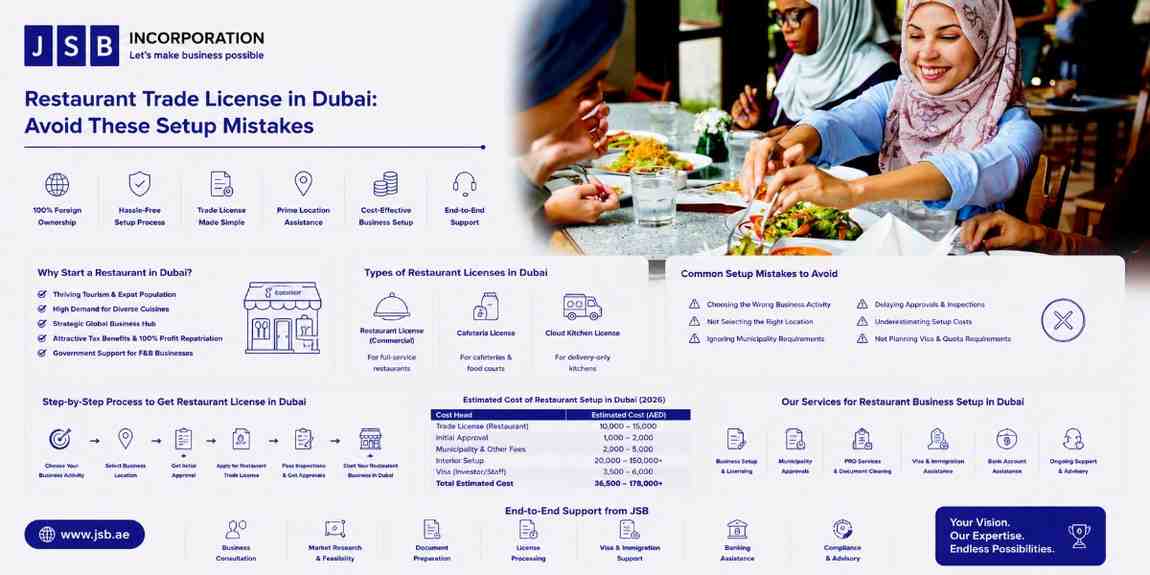
KEY HIGHLIGHTS
Choosing the wrong jurisdiction for your restaurant can force you into a mid-process licence conversion, adding weeks of delay and unplanned fees.
This article walks you through which restaurant activities require mainland registration versus free zone eligibility, so you can choose the right path before you file.
A restaurant trade license in Dubai typically combines a mainland commercial licence with a separate food establishment permit, and free zone eligibility depends entirely on your specific F&B activity type.
Getting your restaurant open legally requires more than one approval, and skipping a step here is where most delays start.
Dubai Economy and Tourism (DET) issues the commercial trade licence that authorizes your restaurant to operate as a legal business entity.
A restaurant licence falls under DET’s commercial activity category, covering food preparation, dine-in service, and retail food sales depending on your declared activity, and it confirms your legal structure and approved activity before any food-specific permit can be processed.
A restaurant trade licence in Dubai requires two separate approvals: a DET commercial licence confirming your legal business structure and a Dubai Municipality food establishment permit confirming your kitchen meets hygiene and food safety standards. Both must be secured before you can legally open.
Missing either approval is the single most common reason restaurant openings get delayed past their planned launch date.
Once your commercial licence is issued, Dubai Municipality requires a separate food establishment permit before your restaurant can prepare or serve food, covering kitchen hygiene standards and food handler certifications specific to F&B operations.
Verify this requirement directly with Dubai Municipality at the time of application, since permit conditions can change.
DET confirms your right to operate as a business, while Dubai Municipality confirms your kitchen and food handling meet public health standards. Skipping either approval means your restaurant cannot legally open, even if one licence is fully issued.
Not every jurisdiction supports every restaurant activity, and this is where founders lose the most money.
Free zone authorities generally structure their licences for trading or limited retail rather than public-facing food service, which restricts full-service, dine-in restaurant activities.
Cloud kitchens and catering operations without a public dine-in component may qualify for free zone licensing, while full restaurant formats typically require mainland registration through business setup in Dubai to access unrestricted commercial activity.
Mainland licensing gives your restaurant full access to walk-in customers across Dubai without geographic restriction, while free zone setups limit your customer base to permitted activities within that zone.
If your model depends on foot traffic or a physical dine-in location, mainland vs free zone Dubai registration is almost always the correct path.
Understanding the full cost picture before you commit prevents the budget surprises that derail many first-time restaurant founders. Rajnishnair, a Google Reviews Local Guide, described working through the setup process this way:
“We were helped by the gentleman named Gaurav who was kind enough to drive down to the place where we lived and explained to us the process in detail. Gaurav is confident about his work and has extensive knowledge about the DED process. We consulted a few other service providers but Gaurav knew something that the other providers in the market did not. Thank you for hand holding us in the initial set up including bank account opening. Will definitely come back in future!”
This kind of upfront clarity on process and documentation is what prevents costly missteps before they happen.
Getting the jurisdiction decision right the first time depends on reviewing your specific activity before any paperwork is filed.
Before recommending mainland or free zone registration, JSB reviews your restaurant concept, including whether you plan dine-in service, delivery-only operations, or a hybrid model, since each carries different jurisdiction requirements.
This review happens before any application is filed, which is what prevents a mid-process conversion.
Once activity and jurisdiction are confirmed, the process moves to preparing documentation for both DET and Dubai Municipality submissions, since both approvals are required before opening.
You can review current licensing procedures through trade licence Dubai resources, which cover documentation stages in more depth. JSB coordinates submission, while final approval decisions rest with DET and Dubai Municipality.
Cloud kitchens or catering operations without public dine-in service may qualify for free zone licensing, while full-service dine-in restaurants generally require mainland registration to operate without activity restrictions.
2. How long does a restaurant trade licence take to issue?
End-to-end restaurant licensing timelines in Dubai typically run 45 to 90 working days, covering both the DET commercial licence and the Dubai Municipality food establishment approval. Confirm current processing times directly with DET before finalizing your opening date.
3. Do I need a separate food permit from Dubai Municipality?
Yes. A DET commercial trade licence alone does not authorize food preparation or service. Dubai Municipality issues a separate food establishment permit covering kitchen hygiene and food handler requirements before opening.
4. What is the cost difference between mainland and free zone restaurant licensing?
Mainland restaurant licensing generally costs more upfront due to broader activity permissions and physical location requirements, while free zone setups cost less but restrict which F&B formats you can operate.
Choosing based on cost alone, without confirming activity eligibility, is the most common reason founders face expensive licence conversions later.
5. Does a restaurant trade licence in Dubai allow delivery-only operations?
Delivery-only and cloud kitchen models may have more jurisdiction flexibility than full dine-in restaurants, though eligibility still depends on each free zone’s approved activity list.

Office 2505, 25th Floor, Regal Tower, Business Bay, Dubai, UAE P.O Box 27614.
+971 4 824 4842
info@jsbincorporation.com
