
 Gaurav Keswani
Key Highlights
Liquidating a UAE free zone company requires passing a shareholder resolution, cancelling all visas, settling dues, completing a public notice period, and receiving a formal deregistration certificate from your free zone authority.
This article covers the entire liquidation process for free zone companies. Keep reading to learn more.
Liquidation is a formal, government-recognized process that ends your company’s legal existence, while letting a license lapse simply stops renewal payments without closing anything on record.
Under liquidation, you deregister your company, cancel every visa attached to it, settle all dues, and receive an official closure certificate from your free zone authority. If you let a license lapse instead, the authority still considers your company active on its books, so late penalties keep accruing every month.
Whether you set up in DMCC, Jafza, IFZA, or another jurisdiction, UAE free zone regulations require you to pass a resolution, notify the authority formally, cancel visas, and complete deregistration before your company’s legal existence actually ends.
Skipping this step doesn’t close the company; it just accumulates debt against a company that still technically exists on government records.
No, since UAE Federal Decree-Law No. 20 of 2025 introduced Article 15 bis, which allows companies to re-domicile between free zones or between a free zone and the mainland without losing legal personality.
This amendment to the Commercial Companies Law took effect the day after its publication in the Official Gazette on October 14, 2025. Different free zones also use different terms for the closure process itself: DMCC and Jafza both call it termination, while the underlying legal effect matches what most people mean by liquidation.
If your real problem is jurisdiction fit rather than wanting to exit the UAE altogether, re-domiciliation could preserve your company’s history, contracts, and banking relationships instead of forcing a full wind-down.
Implementing regulations for Article 15 bis are still pending, so the exact mechanics will depend on further Cabinet guidance and each free zone’s own acceptance rules. This guide otherwise focuses on voluntary, shareholder-initiated closure, not a closure ordered by a regulator or court.
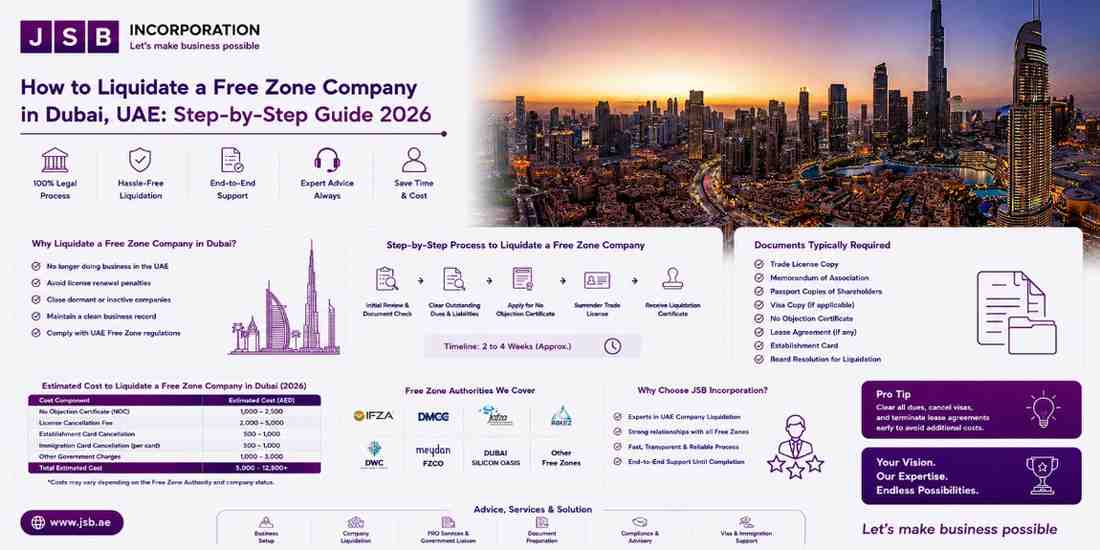
Before filing, settle all outstanding dues, confirm the status of every visa, and gather your original company documents, since incomplete submissions get rejected and reset your processing timeline. Specifically, prepare the following:
Multiple UAE business owners report on Reddit that their original setup agent must complete the cancellation themselves or issue a No Objection Certificate before the owner can switch to a different provider.
This pattern shows up across independent discussions on Meydan, RAKEZ, and Dubai Silicon Oasis free zone closures, so it is worth confirming your own agreement terms early rather than assuming you can self-file.
The core sequence below reflects the process published directly by DMCC and Jafza, two of the UAE’s largest free zones.
Step | What happens | Zone-specific detail |
1. Board or shareholder resolution | Shareholders formally approve closing the business | Required by both DMCC and Jafza before any filing |
2. Appoint a licensed liquidator | Needed for FZE/FZCO structures with share capital | Must be a reputable UAE audit or law firm |
3. Submit termination application | File through the free zone’s official process | DMCC uses the DMCC Member Portal; Jafza requires an in-person De-Registration form signed at the Jafza head office, followed by an exit interview at Jafza 15, rather than an online portal |
4. Cancel all visas | Employee, shareholder, and dependent visas cancelled | IFZA fees: Establishment Card Cancellation AED 500, Entry Permit Cancellation AED 500, Visa Cancellation within UAE AED 750, outside UAE AED 1,500, Work Permit Cancellation AED 500 |
5. Settle dues and get clearances | DEWA, telecom, and customs clearances, where applicable | Jafza requires DEWA, Etisalat, and RTA clearance for warehouse or plot leases |
6. Close the bank account | Obtain a formal closure letter from the bank | Standard documentation required across free zones |
7. Deregister for VAT and Corporate Tax | File through EmaraTax | Juridical persons must submit a deregistration application within three months of the date the entity ceases to exist |
8. Public notice period | Termination is published for creditor objections | DMCC publishes twice for 14 days each; Jafza publishes in local newspapers |
9. Submit the liquidator’s final report | Confirms nil assets and liabilities | Required for FZE/FZCO and branch structures |
10. Pay the cancellation fee and receive your certificate | Final license termination and deregistration letters issued | IFZA license cancellation fee: AED 2,000 |
DMCC states the full process, inclusive of both 14-day publication windows, typically takes 45 to 60 days once all requirements are submitted.
Delaying cancellation triggers AED 1,000 per month in penalties at IFZA for both late Business License Cancellation and late Establishment Card Cancellation once the grace period passes.
Jafza applies a comparable structure: an expired license triggers an AED 1,000 per month fine on top of the AED 6,500 termination fee for FZCO/FZE companies, or AED 1,500 for branch and overseas companies.
Jafza’s AED 1,500 fee also applies separately when a client holds multiple licenses and wants to cancel just one of them, which is a different scenario from terminating the entire company.
Corporate Tax deregistration carries a separate penalty track. UAE tax advisory sources report an AED 1,000 penalty for missing the three-month deadline after ceasing operations, followed by a further AED 1,000 for each additional month the deregistration remains outstanding, up to a cap of AED 10,000.
Confirm the current penalty structure with the Federal Tax Authority or a licensed tax agent before relying on it for planning. These penalties stack independently of whatever your free zone charges, which is why an unfiled liquidation can end up costing more over time than a properly filed one.
You’ll need a shareholder resolution, original company documents, and third-party clearance letters, based strictly on DMCC and Jafza’s published requirements:
IFZA’s published fee schedule shows a Business License Cancellation fee of AED 2,000, with separate visa and entry permit cancellation fees ranging from AED 500 to AED 1,500.
Fee item | Amount |
Business License Cancellation | AED 2,000 |
Establishment Card (E-Card) Cancellation | AED 500 |
Entry Permit Cancellation | AED 500 |
Visa Cancellation, within UAE | AED 750 |
Visa Cancellation, outside UAE | AED 1,500 |
Work Permit Cancellation | AED 500 |
Late cancellation penalty, per month after grace period | AED 1,000 |
Liquidator and audit fees sit outside this list entirely, and they vary by free zone and by how complex your company’s financials are.
Disclaimer: All fees and figures above reflect published information at the time of writing. UAE government fees, free zone charges, and tax rules change periodically. Always confirm current costs directly with your specific free zone authority and the Federal Tax Authority before budgeting or filing.
Pass a shareholder resolution, appoint a liquidator if required, cancel all visas, submit a termination application through your free zone’s process, settle dues, complete the public notice period, and receive a final deregistration certificate.
2. Do I need a liquidator to close my free zone company?
Typically yes, for FZE and FZCO structures with share capital. DMCC requires the liquidator to be a reputable UAE audit or law firm.
3. What are the actual cancellation fees for closing an IFZA company?
IFZA charges AED 2,000 for business license cancellation, plus separate fees for establishment card, entry permit, and visa cancellations ranging from AED 500 to AED 1,500.
4. What happens if I don’t cancel my license and let it lapse instead?
Penalties accrue monthly, AED 1,000 per month at IFZA and Jafza, on top of whatever cancellation and outstanding fees you already owe, and a separate Corporate Tax penalty applies if that deregistration is also missed.
5. Can I reclaim outstanding VAT credit before liquidating my company?
Yes. Rules effective January 1, 2026, give you five years from the end of the relevant tax period to claim VAT credit balances, with a one-year transitional window for balances near expiry.
6. Is re-domiciliation to another free zone or the mainland an alternative to liquidation?
Potentially. Article 15 bis of the amended Commercial Companies Law allows re-domiciliation without losing legal personality, though implementing regulations are still pending.
7. Can I close my free zone company without going through my original setup agent?
It depends on your portal access and the terms of your setup agreement. Some business owners describe needing an NOC or direct portal access from their original agent before proceeding independently.
8. How long does free zone company liquidation take?
DMCC estimates 45 to 60 days inclusive of two 14-day publication periods. Corporate Tax deregistration through EmaraTax must be filed within three months of the entity ceasing to exist, adding processing time on top of the free zone timeline.
Reviewed by Gaurav Keswani, Founder of JSB Incorporation. Gaurav has advised UAE entrepreneurs on business setup and residency matters and has been featured on Talk 100.3 FM discussing the UAE Golden Visa and business regulations.
JSB Incorporation handles free zone liquidation and termination across DMCC, Jafza, IFZA, and 24-plus UAE jurisdictions, managing visa cancellations, FTA deregistration, and liquidator coordination with upfront pricing.
If you’re deciding between liquidation and re-domiciliation, stuck with an unresponsive original agent, or just need someone to manage the paperwork, JSB’s team can walk you through the exact steps for your specific free zone.
Book your free consultation call today with the experts of JSB Incorporation to learn more.
Also Read:
Can You Start a New Business After Liquidation in Dubai? (2026 Legal Guide)
Complete Guide to Company Liquidation in UAE (2026)
Company Liquidation in Dubai, UAE: The Complete 2026 Guide (Mainland, Free Zone, DIFC, and ADGM)

Office 2505, 25th Floor, Regal Tower, Business Bay, Dubai, UAE P.O Box 27614.
+971 4 824 4842
info@jsbincorporation.com