
Key highlights
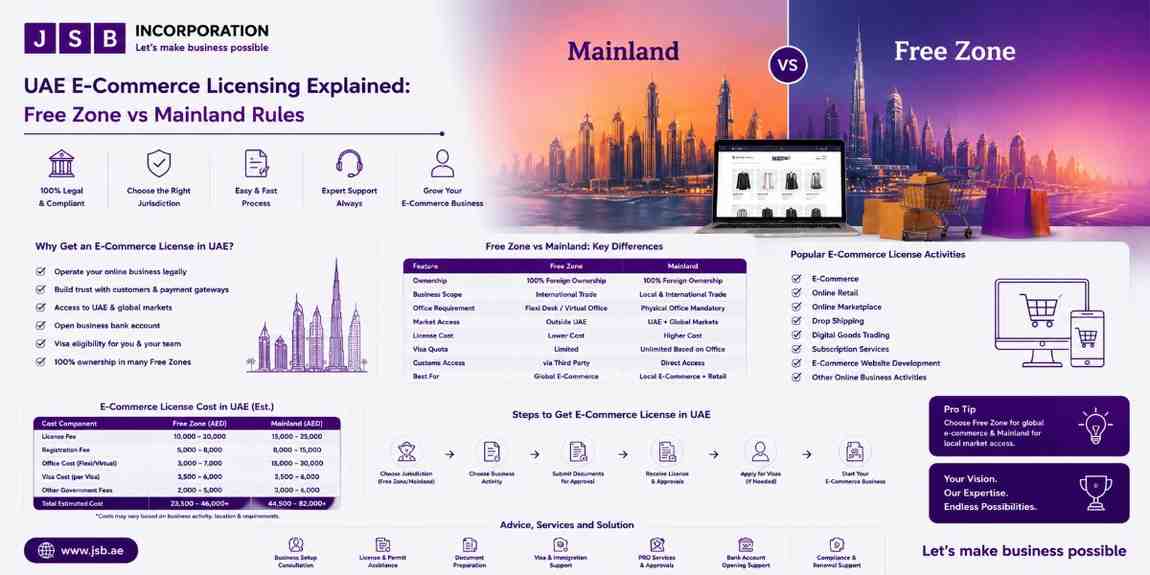
This guide walks you through exactly how mainland and free zone e-commerce licensing work today, what changed under the UAE’s newest regulations, and how to choose the right structure for your specific business model.
Keep reading the article to learn more.
Yes. Since Dubai Executive Council Resolution No. 11 of 2025 took effect in October 2025, free zone companies can operate on the Dubai mainland through two distinct mechanisms: a Branch License or a Free Zone Operating Permit.
Before this change, free zone companies could sell internationally and within their own zone, but reaching mainland customers required a local distributor or a separate mainland entity, adding cost and complexity to what should have been a simple sale.
This shift was reinforced federally through Federal Decree-Law No. 20 of 2025, which amended the UAE Commercial Companies Law and took effect on October 15, 2025.
The amendment revised Articles 3 and 5 to clarify that free zone companies, including those in financial free zones like ADGM and DIFC, may establish branches and representative offices onshore where their free zone legislation permits it, codifying what is now called a dual license regime.
For online sellers specifically, this means your free zone company’s legal identity does not need to change just to expand your customer base beyond the zone’s borders.
Any sale conducted through a website, mobile app, or social media platform counts as e-commerce under UAE law, and all of it requires licensing plus approval from the Telecommunications and Digital Government Regulatory Authority, regardless of jurisdiction.
The UAE regulates this activity through Federal Decree-Law No. 14 of 2023 on Modern Technology-Based Trade, which was designed to bring digital commerce under the same regulatory umbrella as traditional retail.
This means a WhatsApp storefront carries the same licensing obligation as a full e-commerce platform with a shopping cart and payment gateway. Whether you are running a one-person Instagram shop or a multi-warehouse fulfillment operation, the baseline conditions are identical. To legally operate, you need:
Skipping any one of these is not just a technicality. Regulators treat unlicensed digital selling the same way they treat unlicensed physical retail, and enforcement has become more consistent as e-commerce has grown as a share of UAE retail activity.
A mainland e-commerce license is issued by your emirate’s Department of Economic Development, such as Dubai’s Department of Economy and Tourism, and works best if you need a physical storefront, UAE-wide retail reach, or government contracts.
Some emirates issue a standalone individual e-commerce license, while others attach e-commerce as an activity on a regular commercial license, so the exact application path depends on where you are setting up.
Dubai also offers the E-Trader license through Invest in Dubai, built specifically for home-based sellers who trade through social media without a physical office.
This is often the entry point for solo entrepreneurs testing a product idea before scaling into a larger commercial license. Confirm the exact current fee on the DET portal before budgeting, since published third-party estimates can shift as the government updates its fee schedules.
Free zone e-commerce licenses let you operate with 100 percent foreign ownership, 100 percent profit repatriation, and customs exemptions across more than 40 zones nationwide, making them the faster and often cheaper entry point for sellers focused on international markets.
The UAE government recognizes several dedicated e-commerce free zones: Masdar City Free Zone, Dubai CommerCity, EZDubai, Sharjah Media City, Ras Al Khaimah Economic Zone, and Ajman Free Zone.
Here is an illustrative cost example from IFZA in Dubai for a 1-year Commercial Trading License, treated as one operator’s pricing rather than a market average, since costs vary meaningfully across free zones.
Visa allocation | 1-year license price, inclusive of VAT |
Zero visa | AED 11,900 |
1 visa | AED 14,900 |
2 visas | AED 16,900 |
3 visas | AED 18,900 |
4+ visas | AED 20,900 |
Ancillary costs to budget for include a General Trading activity add-on at AED 10,000, each additional business activity beyond the first three at AED 1,000, and an establishment card at AED 2,000 for the initial application.
These add-ons matter because many first-time applicants budget only for the base license and get caught off guard by activity-related fees later in the process.
Free zone companies get mainland access through two distinct routes under Resolution No. 11 of 2025, and it is important not to confuse the two.
The Mainland Branch License lets a free zone company open a branch office on the Dubai mainland, valid for 12 months at AED 10,000, with the branch sharing the same legal identity as its free zone parent company.
The Free Zone Operating Permit is a separate, activity-specific permit required to actually conduct business once the branch exists, valid for 6 months at AED 5,000, renewable at the same fee.
Both mechanisms are issued by the Department of Economy and Tourism through its Business Registration and Licensing Corporation.
Companies using either mechanism must maintain separate financial records for mainland activity, distinct from their free zone operations, and must pay 9 percent corporate tax on mainland-related revenue under Federal Decree-Law No. 47 of 2022 on the Taxation of Corporations and Businesses.
Feature | Mainland Branch License | Free Zone Operating Permit |
Purpose | Establish a mainland branch office | Conduct specific business activities |
Validity | 12 months | 6 months, renewable |
Fee | AED 10,000 | AED 5,000 |
Issuing authority | DET via DBLC | DET via DBLC |
Corporate tax on mainland revenue | 9 percent | 9 percent |
This framework is currently limited to the Emirate of Dubai and excludes financial entities regulated by the DIFC.
Free zone companies already operating outside their zone before this framework existed must regularize their status within one year of the resolution’s effective date, with a possible one-year extension.
Yes, mainland activity conducted through either the Branch License or the Operating Permit is subject to a 9 percent corporate tax on related revenue.
This same activity can also put your broader 0 percent Qualifying Free Zone Person status at risk unless your overall mainland-sourced income stays within qualifying or de minimis thresholds. This is one of the most overlooked risks in the entire 2025 reform, since the market access sounds like an unambiguous win at first glance.
Before applying for either mechanism, model exactly how much mainland revenue you expect to generate, factor in the 9 percent tax rate on that revenue, and check whether it pushes your qualifying income past the de minimis thresholds.
A structure that expands your customer base can also quietly disqualify your free zone tax benefits if you do not plan the numbers in advance, so this step deserves real financial modeling rather than a rough guess.
Two federal decrees, effective January 1, 2026, introduced a five-year limitation period for reclaiming VAT credit balances and gave the Federal Tax Authority explicit power to deny input tax deductions tied to evasion arrangements.
Federal Decree-Law No. 17 of 2025 amended the Tax Procedures Law, and Federal Decree-Law No. 16 of 2025 amended the VAT Law, and both apply to every VAT-registered seller regardless of whether they touch mainland customers.
If your credit balance’s five-year window expired before January 1, 2026, or expires within a year of that date, you get a one-year transitional window to submit your refund request, so this is worth checking against your own accounting records soon.
The amendments also removed the requirement to issue self-invoices under reverse charge, though supporting documentation must still meet Executive Regulation standards, meaning your paperwork obligations have not actually gone away.
If you are a hybrid seller moving goods between a free zone base and mainland customers, your mainland supplies are generally standard-rated for VAT unless specifically exempt, so your invoicing system needs to reflect that distinction from day one.
You apply for a UAE e-commerce license in five steps: classify your activity, secure primary approval from DED, DET, or your free zone authority, obtain mandatory TDRA approval, apply for mainland access if needed, and register for VAT.
Each step depends on the one before it, so trying to shortcut TDRA approval or VAT registration tends to create delays later rather than saving time upfront.
Choose a free zone if your sales are international-only, mainland if you need UAE-wide retail reach or government contracts, and a hybrid branch-and-permit structure if you genuinely need both markets.
The most common mistake is assuming social-media-only sales are license-exempt, when Federal Decree-Law No. 14 of 2023 covers all digital sales channels regardless of platform. Other frequent errors worth watching for include:
Each of these mistakes tends to surface months after setup, usually during a renewal cycle or a tax filing, which is exactly when they are most expensive to fix.
Yes, all digital sales channels fall under UAE e-commerce licensing requirements per Federal Decree-Law No. 14 of 2023.
2. Can a free zone company sell directly to mainland customers now?
Yes, through a Mainland Branch License at AED 10,000 for 12 months, combined with a Free Zone Operating Permit at AED 5,000 for six months, under Resolution No. 11 of 2025. Mainland revenue is subject to 9 percent corporate tax and may affect your Qualifying Free Zone Person status.
3. What is the E-Trader license and who qualifies?
It is Dubai’s low-cost individual license for home-based sellers operating through social media without a physical office. Confirm the current fee on the DET portal before budgeting.
4. Is TDRA approval required for free zone e-commerce licenses too?
Yes, TDRA approval applies to every e-commerce license regardless of jurisdiction.
5. Which free zones officially offer e-commerce licensing?
Masdar City Free Zone, Dubai CommerCity, EZDubai, Sharjah Media City, Ras Al Khaimah Economic Zone, and Ajman Free Zone are the government-recognized options.
Disclaimer: Pricing, fees, and regulatory details in this article, including free zone license costs, government fee schedules, and mainland permit fees, are subject to change without notice. Always verify current figures directly with the relevant UAE government authority, free zone authority, or the Federal Tax Authority before making licensing or tax decisions.
Reviewed by:
Gaurav Keswani, Founder of JSB Incorporation, a business setup consultancy based at Regal Tower, Business Bay, Dubai, UAE, P.O. Box 27614. Gaurav has advised entrepreneurs on UAE company formation, free zone structuring, and Golden Visa applications and has discussed UAE business setup and residency rules publicly on Talk 100.3 FM.
If you are weighing a free zone against the mainland for your online store, or you are unsure whether the new 2025 mainland access rules apply to your setup, it helps to talk through your specific numbers with someone who handles this daily.
JSB Incorporation offers transparent, upfront pricing with no hidden fees, end-to-end support from license application through bank account opening, and a track record of setting up businesses in weeks rather than months across more than 24 UAE jurisdictions.
Whether you need a straightforward free zone license, a mainland structure, or help navigating the new branch and permit pathway, JSB’s team can walk you through the right fit for your business model.
Book your free consultation call today with the experts of JSB Incorporation to learn more.v

Office 2505, 25th Floor, Regal Tower, Business Bay, Dubai, UAE P.O Box 27614.
+971 4 824 4842
info@jsbincorporation.com
