
 Gaurav Keswani
Key Highlights
What’s the Real Difference Between a Free Zone and a Mainland Company?
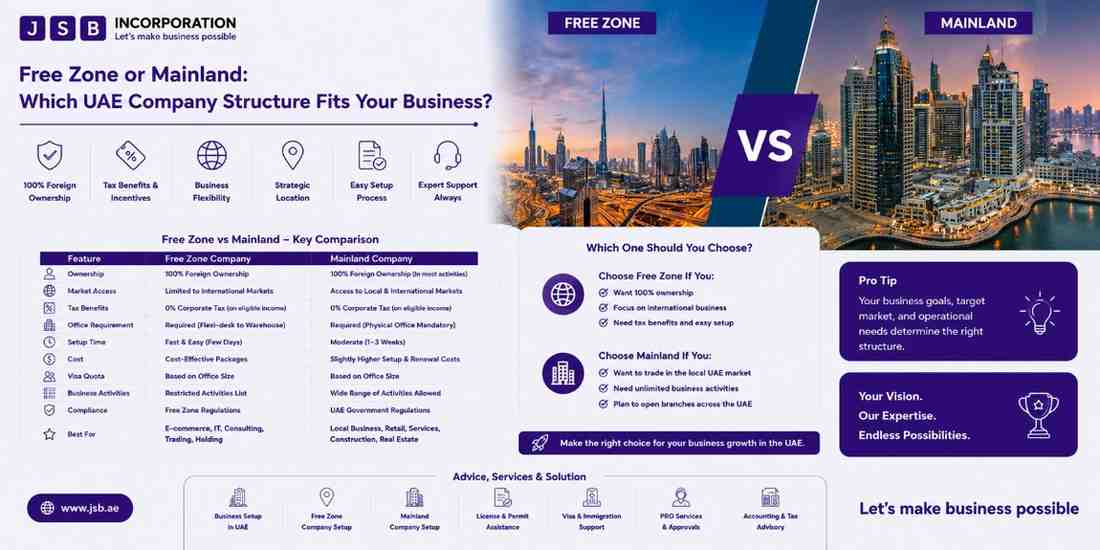
A free zone company operates inside a designated economic zone and holds a licence issued by that zone’s authority, while a mainland company holds a trade licence issued by DET and can trade anywhere in the UAE.
Ownership is no longer the dividing line it once was. DET now permits foreign investors to hold 100% ownership of mainland commercial and industrial companies without a local UAE national partner, following amendments to the Commercial Companies Law.
The real difference is market access, not ownership percentage. Mainland companies can sell directly to any UAE-based customer without restriction, while free zone companies need a specific licensing route to do the same.
Free zones like DMCC, IFZA, and JAFZA were built to serve international trade, holding companies, and specific sectors such as commodities or logistics, and each authority sets its own activity list, office requirements, and renewal terms independently of the others.
Mainland licensing suits businesses whose primary customers, government clients, or physical retail presence sit outside the free zone perimeter. A consultancy serving only overseas clients rarely needs a mainland license, while a retail brand opening a storefront in Dubai Mall almost always does.
UAE corporate tax applies at 0% on taxable income up to AED 375,000 and 9% on taxable income above that threshold, and this rate structure applies to both mainland and free zone companies by default.
A free zone company can access a 0% rate on qualifying income only if it meets Qualifying Free Zone Person (QFZP) conditions, which the Federal Tax Authority (FTA) reviews on a case-by-case basis.
QFZP status depends on three conditions the FTA assesses together:
A free zone company that fails to meet these conditions mid-year loses the 0% benefit for that tax period. Non-qualifying income, or income earned after a QFZP breach, gets taxed at the standard 9% rate above the AED 375,000 threshold.
This distinction matters most for free zone companies that start selling non-qualifying services or begin trading with mainland entities without restructuring first. Costs and regulations are subject to change.
Yes, under a defined legal framework. Dubai’s Executive Council Resolution No. 11 of 2025, in force since 3 March 2025, formally regulates how free zone establishments can conduct activities in mainland Dubai. The resolution creates three distinct pathways rather than leaving it to case-by-case negotiation with each free zone authority.
A free zone company can obtain a mainland branch licence to open a physical branch outside its free zone, apply for a dual licence that lets it keep its free zone base while trading onshore under a parallel license, or take out a temporary permit valid for activities of limited duration, capped at six months.
The resolution sets statutory annual fees for these routes directly in its published text. Costs and regulations are subject to change.
This shifts the practical question for most founders away from whether they can sell into the mainland and toward which of the three pathways fits their activity and timeline.
A short-term project favors the temporary permit, while a business expecting sustained mainland revenue is usually better served by the branch or dual licence route.
Yes, mainland company setup has a structural advantage for government tenders and walk-in retail clients because most UAE government procurement portals require mainland registration before a vendor can submit a bid.
If your business model depends on local clients paying in person, a mainland trade licence removes the client-facing friction of explaining structure limitations mid-negotiation, which can cost you the deal entirely in competitive sectors.
Common tender-eligible activities under mainland licensing include:
Visa quotas are tied to your office size and package tier, not to whether you’re mainland or a free zone.
A flexi-desk package in the best free zone typically allows fewer visas than a dedicated office, and the same principle applies on the mainland, where visa allocation ties to your Ejari-registered office space and the physical square footage on your tenancy contract.
The exact quota formula and any administrative fees per additional visa should be confirmed directly with ICP, since these figures update periodically and vary by emirate and package.
Businesses that expect to scale headcount quickly should factor office size into their structure decision early, rather than treating the office as a formality to satisfy after the licence is issued. Costs and regulations are subject to change.
|
Factor |
Free Zone |
Mainland |
|
Market access |
Needs a branch license, dual license, or temporary permit for mainland sales |
Unrestricted UAE-wide trading |
|
Government tenders |
Generally not eligible directly |
Eligible, subject to activity approval |
|
Corporate tax |
0% possible on qualifying income if QFZP conditions are met |
9% on taxable income above AED 375,000 |
|
Ownership |
100% foreign ownership standard |
100% foreign ownership for most activities |
|
Licensing authority |
Individual free zone authority such as DMCC, IFZA, or JAFZA |
DET |
|
Best suited for |
Export, holding companies, single-client consultancies |
Local retail, government contracts, multi-client service businesses |
Structure decisions shouldn’t come down to which licence looks cheaper on a comparison chart. Score your business against these factors before committing to either path:
Once you’ve scored each point honestly, the right structure usually becomes clear rather than a guess. Founders who skip this exercise tend to pick based on which package looked cheapest during initial research, then pay more later to fix a structure that never matched their actual client base.
“We have recently incorporated our company through JSB Incorporation. Gaurav Keswani has been a tremendous help throughout the entire process. His support enabled us to complete everything seamlessly, even accommodating last-minute changes. It was a wonderful experience working with JSB Incorporation. We look forward to a long-term engagement.” Veena Talegaonkar, Google Reviews
Q: Can I convert a free zone company to mainland later?
A: Yes, conversion is possible, but it isn’t a simple licence swap. It typically requires fresh mainland registration, new approvals from DET, and in some cases a new trade name reservation. JSB handles the documentation and authority coordination for conversions on a case-by-case basis.
Q: Do I need a local sponsor for a mainland company in 2026?
A: Most mainland activities allow 100% foreign ownership without a local sponsor, following the UAE’s Commercial Companies Law reforms.
Certain restricted activities, such as security, telecommunications, and banking, still require government approval or a different ownership structure.
Q: Which free zones are cheapest to set up in?
A: Setup costs vary significantly by free zone, activity type, and package tier, and figures change frequently.
Q: Is a free zone company cheaper to maintain long-term than mainland?
A: It depends on your activity and office requirements rather than the licence type alone.
Free zone renewals can be lower for businesses on flexi-desk packages, but mainland companies avoid the cost of adding a distributor or dual licence later. A full cost comparison should be based on your specific activity and growth plan.
Q: What happens if I lose my QFZP status mid-year?
A: Your company reverts to the standard 9% corporate tax rate on taxable income above AED 375,000 for the relevant period, per FTA rules.
You’ll also need to review your accounting and substance arrangements to understand the exact tax exposure. JSB’s compliance team can help assess what triggered the loss of status and how to correct it going forward.
Q: Can a mainland company also hold a free zone license?
A: Yes, and this now also works in the other direction. A free zone company can obtain a mainland branch license, a dual license, or a temporary permit under Dubai’s Executive Council Resolution No. 11 of 2025 to operate in the mainland while keeping its free zone base.
Q: Does free zone status affect my ability to open a UAE corporate bank account?
A: Banks apply their own due diligence regardless of licence type, though some banks have historically shown preference for mainland companies with a physical office.
Free zone companies with clear activity documentation and audited accounts generally face no additional barrier. JSB’s corporate bank account opening service prepares the documentation banks expect for either structure.
Q: Does choosing a free zone limit which bank I can open an account with?
A: No single free zone forces you into one specific bank, but some banks are more familiar with certain free zone authorities than others. This affects processing speed more than eligibility itself. JSB’s team routes your application to banks with existing familiarity with your chosen jurisdiction.
Q: How long does mainland company registration typically take compared to free zone?
A: Both routes can be completed within days once documentation is ready, though mainland registration sometimes involves additional activity-specific approvals from other government departments.
Free zone registration is often faster for standard activities since it’s a single-authority process.
Q: Can I hold multiple free zone licences across different jurisdictions at once?
A: Yes, there’s no rule preventing an individual or a group of companies from holding licences in more than one free zone simultaneously.
This is common among businesses testing different sectors or serving different regional markets. Each licence carries its own renewal cycle and compliance obligations, so JSB recommends consolidating structures only when the operational overlap justifies it.
Reviewed by: Gaurav Keswani is the Founder of JSB Incorporation, a Dubai-based business setup and immigration consultancy. He appeared on Talk 100.3 FM answering live listener questions on UAE Golden Visa eligibility, citing GDRFA and ICP guidelines directly on air. JSB Incorporation handles documentation preparation and application coordination; all visa and license decisions rest with the relevant UAE government authorities, GDRFA, ICP, DET, and DLD.
Choosing between a free zone and mainland isn’t a one-size-fits-all decision. Getting it wrong can mean paying for a conversion later or missing out on government contracts you were eligible for from day one.
JSB’s team reviews your activity, client base, and growth plan against current jurisdiction rules before recommending a structure, rather than defaulting to whichever licence sounds cheapest upfront.
Also Read:
Best Free Zone for EV Business Setup in Dubai: JAFZA vs Dubai South vs IFZA Compared
Avoid Costly Delays: The Right Way to Handle Salon Business Setup in Dubai
Crypto Business Setup in Dubai: Get the Right Free Zone and Licence Before You Invest
Business Setup in Jebel Ali Free Zone (JAFZA): 2026 Complete Guide

Office 2505, 25th Floor, Regal Tower, Business Bay, Dubai, UAE P.O Box 27614.
+971 4 824 4842
info@jsbincorporation.com